Rooted in Sapience: The Moment Is Now, this series dives deep into the mythic, historical, and psychological forces shaping human consciousness, culture, and collapse—and what it means to truly awaken.
There is a feeling in the air right now that’s hard to deny, even if people are still arguing about what to call it. Something is rising, as if from a great depth… sometimes it feels like a volcano, sometimes it feels like the sea is rising. It is happening everywhere… all at once.
And it is making something break.
You see it in the escalation of wars and the widening circles of conflict. You feel it at the gas pump, in the grocery aisle, in the quiet calculations people are making about what they can no longer afford. You hear it in the language of fear, in the hardening of identities, in the rising hostility between neighbor and neighbor. You see it in the streets, where enforcement begins to look less like law and more like force. And you sense it in the growing number of people who no longer believe the system they live under is stable—or even survivable.
Call it instability. Call it fracture. Call it the early tremors of something much larger.
Or call it what it may actually be: the beginning of a fall.
In Sapience: The Moment Is Now, there is a dream—a vision experienced by a man trying to answer a question that may be the most important one humanity has ever faced:
How do we transform human consciousness so that, if we survive what’s coming, we don’t rebuild the same broken world?
What he sees is not a distant future. It feels uncomfortably close.
He sees a species that has become more ferocious than any predator it once feared—not because of strength, but because of blindness. A blindness born not of stupidity, but of disconnection. Disconnection from nature. From reality. From the deeper layers of the self that understand complexity, interdependence, and consequence.
Instead, modern life has trained us to live inside ideas.
We mistake models for reality. Narratives for truth. Memes for meaning.
We’ve been taught to scan the world in lines—headlines, feeds, slogans—while reality itself unfolds as a vast, interconnected field where everything is happening at once. The result is a dangerous simplification. A thinning of perception. A kind of collective “ignore-ance”—not just ignorance, but an active ignoring of what doesn’t fit the story we’ve been handed or have chosen to believe.
And from that place, we act.
We act on partial truths. On distorted fears. On inherited divisions. On identities that feel solid but are, in many cases, carefully constructed and continuously reinforced.
We act as if we are separate—from each other, from the environment, from consequence itself.
But there is no such separation.
There is no human being without an environment any more than there is a heart without a body. What we are doing to the world, we are doing to ourselves. And yet, the dominant mindset still treats nature as an adversary to be controlled, extracted from, or defeated.
That is not just an error.
It is a fatal one.
In the dream, people begin to feel it—though they don’t understand it. A rising pressure. A loss of coherence. A creeping sense that something fundamental has gone wrong.
And instead of turning inward—toward deeper awareness, toward integration—they are pushed further outward into fragmentation.
The pace of life accelerates. Information fragments into smaller and more emotionally charged pieces. Cultural understanding collapses into viral units—memes that spread faster than truth and stick harder than nuance. These fragments don’t deepen awareness; they inflame reaction.
And slowly, almost invisibly at first, humanity is herded into shallower and shallower waters of consciousness.
Waters too shallow to sustain a thinking, feeling, interconnected species.
Cut off from what the book calls the Primordial Being—that deeper, integrated awareness capable of holding complexity—people begin to unravel. Some sink into despair. Others lash out. Many retreat into hardened psychological bunkers.
Fear becomes the dominant currency.
And fear does what fear always does: it divides, isolates, and escalates.
In the dream, this psychological fragmentation doesn’t stay internal. It spills outward into the physical world.
The environment degrades under the weight of unchecked consumption and short-term thinking. Air thickens. Waters choke. Waste piles into monuments of excess. The systems designed to sustain life begin to buckle under the strain.
At the same time, social systems fracture.
Trust erodes. Cooperation collapses. Violence—both personal and collective—rises. Not everywhere at once, but enough, and often enough, to shift the overall balance.
People begin to turn on each other.
Not because they are inherently evil—but because they are overwhelmed, disconnected, and operating from a distorted sense of reality.
In that state, even “civilized instinct” becomes dangerous. It is no longer guided by wisdom or awareness, but by centuries of conditioning layered over fear and scarcity.
The result is a world that feels increasingly unrecognizable.
Unstable.
Unsafe.
Insane.
And here is the hardest part to confront:
In the dream, the fall is not caused by a single event.
It is the cumulative result of millions—billions—of small actions taken from a fragmented state of mind.
The tipping point comes not because there were no good people left. There were many. There were even good groups, good efforts, real attempts to change course.
But the balance had shifted too far.
Fear outweighed cooperation.
Division outpaced unity.
Reaction overwhelmed reflection.
And so, when the moment came to act together—to truly confront the climate crisis, to de-escalate conflict, to reimagine systems—the collective capacity simply wasn’t there.
Not because it was impossible.
But because the consciousness required to do it had not been cultivated.
That is the warning embedded in the dream.
And that is why it matters now.
Because if you’re paying attention, you can feel how close we are to that tipping dynamic—not necessarily to an immediate, singular collapse, but to a continued slide driven by fragmentation, fear, and disconnection.
The point is not to declare that collapse is inevitable.
But it is equally dangerous to pretend that nothing fundamental is happening.
The real question is this:
What do we do with this awareness?
If the core problem is fragmentation of consciousness, then no purely external solution—political, technological, or economic—will be enough on its own.
Those matter. They are necessary.
But they are downstream.
Upstream is perception. Awareness. The ability to hold complexity without collapsing into fear or simplistic narratives. The willingness to reconnect—with reality, with each other, and with the deeper layers of our own minds.
That kind of shift is harder than protest. Harder than policy. Harder than innovation.
It requires discipline.
It requires honesty.
And it requires resisting the constant pull toward outrage, simplification, and psychological retreat.
You don’t fix a fragmented world with a fragmented mind.
So as protests rise, as tensions escalate, as the world feels increasingly unstable, the work is not just “out there.”
It’s in here.
Because if we carry the same patterns of thought—the same reactive instincts, the same shallow processing—into whatever comes next, we will rebuild the same conditions that led us here.
Different faces. Same outcome.
That is the cycle the dream is trying to break.
Not just survival.
But transformation.
The moment we’re in right now is not just political or economic.
It is psychological.
And whether this is a death spiral or a turning point depends, in no small part, on whether enough people are willing to move beyond the surface… and learn how to think, perceive, and act from a deeper place.
That’s not a comforting conclusion.
But it is an honest one.
And at this stage, honesty may be the most necessary starting point we have.
Excerpt — Sapience: The Moment Is Now
Dream Yong Xing-li has as he nears understanding how to Transform human consciousness on a scale never before achieved in human history, a transformation necessary so that humans do not go right back over the Climate Cliff that very nearly annihilates all life on Earth (including human) during the 21st Century (our time now).
Modern Man is more ferocious, savage, and feral than the most dangerous animal on Earth. He ignores the balances and limits nature worked out over eons of time on others. He blames his own Element of Irreducible Rascality, his shadow, his Yetzer Hara, his sin on others.
Disconnected from his inner most nature, Modern Man acts in ignorance wherever he goes. This ignore-ance is his greatest evil. Deeds done in the name of ignorance are more savage than the biggest, baddest saurian ever was. Instead, man feels himself to be as the English poet Alfred Edward Housman wrote: “I, a stranger and afraid, in a world I never made.” His feeling of utter alienation in an unintelligent universe leaves him feeling trapped inside his own skin and at war with the blind, stupid forces of nature and the universe. But, this feeling it due to an idea based on 19th century commonsense that human beings are fluke in nature and if humanity does not fight nature, it will not be able to maintain its status as an intelligent fluke. And so, the war on nature rages based on a ghastly error of thinking, a way of living in the world that can only examine the world in lines like a scanner. Therefore modern education takes so long, each child must scan miles of lines of print just to know the basic stuff man has come to understand about himself, society, nature, and the universe. But the world does not come at us in lines. It comes at us in a multi-dimensional continuum of everything happening together everywhere at once. In short, man ideas of reality are paltry substitutes for what it really is and basing actions on ideas has led humanity to an all-out war with nature, which is really himself for you do not find a man without an environment and if man leaves the atmosphere of Earth, he must take a canned version of his environment with him just as he must take his legs, arms, and head with him—they go together—man and environment are the same thing for there is no man without a sufficiently complicated environment to support bodies and living beings.
And so, Modern Man hassled and stressed and often beholden to men greater than himself who held the power, money, and authority to dictate his life, increasingly based his deeds and actions around ideas. At first, many Modern people based their lives around religious ideas and cultural norm, but increasingly as these fabrics of society frayed, he based core beliefs on memes, a unit of cultural information spread by imitation such as a practice, a ceremony, an image, a story, or a joke passed between people. As the pace of modern life got faster and faster, the unit of cultural information was diluted and reduced to tiny bits of polarizing ideas that spread like virulent viruses through the world wide web increasingly replacing the world of nature with the world of ideas created by men.
Without even knowing it, the Good People of Earth had been herded into conscious waters too shallow to sustain them. Here most of the humanity were trapped by their circumstance dictated by harsh and heartless economic realities created by men who had more than them and desired even. Carefully taught over centuries of civilization not to swim into the deeper waters of their own consciousness, Modern Man became more and more divorced from their Primordial Being who knows the world is vastly more complicated than a mere idea, fact, or fantasy. Cut off from the very part of themselves that could help them most, people sank into deep pits of hopelessness, sadness, and despair. Others lash out in cruel ways further polarizing the risingSea of Unconsciousness flooding the ground of civilization all modern people stood, the unconsciousness pouring out of each person cut off from their Primordial Being. It was a sea choked with of carbon waste piled into high mountains of garbage; filling rivers with poop and plastic; and filling the air with Methane and CO2 pumped out by the machines Modern man used to save time, cut costs, and save labor.
People adopted a locked down, bunker, and siege mentality.
It was hell.
Instinct takes over…
…but it was a Civilized Instinct…
…one misshaped after centuries of social programming.
Just before the fall, the suicide and homicide rates rose exponentially. Big and little wars broke out all over the world. Husbands turned on wives… wives turned on husbands… children turned on parents… neighbor on neighbor. Nobody felt safe or normal anymore. There were plenty of good people and even a good number of good collectives in the world, but the balance had tipped too far. The slide over the climate cliff was inevitable because instead of acting together to mitigate climate change, fear and hopelessness had been poured on theFlames of Division, further fragmentating and polarizing theSea of Unconsciousness.
“Across centuries and continents, ruthless rulers rise not in silence—but in splendor. They drape themselves in divine titles, rewrite the past, demand obedience over truth, and build legacies on the bones of the people.
In this episode of Wisdom Guardians, we travel back over 2,000 years to meet China’s first emperor, Qin Shi Huang—a man who unified a nation with brutal brilliance, burned books to erase the past, buried scholars to silence dissent, and built a tomb the size of a city.
But the archetype he embodied—the Divine Ruler, above the law, unchallenged by truth—didn’t die with him. It lives on. In today’s power-hungry populists. In loyalty tests. In book bans. In gilded towers and cries of false prophecy.
History doesn’t repeat itself. It shape-shifts. And today, we follow its shadow.”
Qin Shi Huang to Trump | Intro for Episode #7 Wisdom Guardians | Loyalty Over Truth Deep Dive
“Qin Shi Huang believed he had conquered death. That his tomb would house him for eternity. That his dynasty would last ten thousand years. It lasted fifteen.”
“The truth he buried rose again. And like mercury in the blood, it poisoned everything he built.”
“Today, new emperors rise. They silence scholars, reward sycophants, and rewrite history for their own ends. But the lesson of Qin is clear: Ruthlessness can conquer… but only for a moment. And in the end, truth—though buried—will speak.”
Loyalty Over Truth: From Qin Shi Huang to Trump: Deep Dive:Qin Shi Huang to Trump — Part 1Loyalty Over Truth: From Qin Shi Huang to Trump: Deep Dive:Qin Shi Huang to Trump — Part 2
I. Divine Seeds: From Righteousness to Ruthlessness
Ruthlessness grows from the seeds of Righteousness.
Every ruthless ruler claims the mantle of righteousness—often justified by religion.
To understand the ruthless, we must first understand our human drive to worship, to moralize, and to enshrine divine law.
In my book Sapience: The Moment Is Now, my character Yong Xing-li searches for a way to transform human consciousness. He is doing this because the world has plunged over the Climate Cliff. His AIs have shown this will happen again unless human consciousness can be transformed on a scale previously never achieved.
Survivors of The Fall live under the rule of CEOs. Ordinary people who more effectively, and often aggressively, outcompeted and outperformed everybody else to amass gigantic wealth. These CEOs head Multinational Corporations that run the world now. And, their prevailing doctrine is: Profit Over People… that is, except for Yong Xing-li who is arguably the richest man in this dystopian world.
Yong Xing-li did not achieved his massive wealth ruthlessly. He did so by creating AIs who can not only out compute and out think human beings, but who are empathic and compassionate. His AIs are showing him how to Transform human consciousness. One of his most important lessons lies in the Hall of Ruthless Rulers.
Loyalty Over Truth: From Qin Shi Huang to Trump: Hall of Ruthless Rulers
A. Hall of Ruthless Rulers
The Hall of Ruthless Rulers is Ra’s domain. Ra is the AI tasked with helping Yong Xing-li understand how the seeds of ruthlessness have grown strong in the minds of modern men. From the book (p. 227):
Ra:Keeper of Roots, Religions, Royals, Regents, & Ruthless Rulers maintains databases on philosophy delving into cognitive sciences, logic, informational and computational science, politics, economics, art and visual studies. He studies the intersection of religion and culture and how it reveals insights into individual and collective motivation as manifested through cultural expressions and traditions. He collects and maintains information about what happens in the gap between all realms of knowing, physical and non-physical venturing into the realms of mystical sciences, paranormal activity, magic, and the unknown.
His databases overlap with the other AIs because he is the AI considered to be Keeper of Cosmic Knowledge. His database includes stories, writings, and teachings of Abraham (2000–1638 BCE) • Isaiah (8th-century BCE prophet) • Mahavira (0599-0527 BCE) • Gautama Buddha (0563-0483 BCE) • Zoroaster/Zarathustra (0000 BCE) • Moses (1391-1272 BCE) • Jesus Christ (0000-0033) • St. Paul (0005-0067 CE) • Prophet Muhammad (0571 -0632 CE) • Saint Valentine (0226A-0269 CE: 2/14) • St. Augustine (0354-0430 CE) • Kabir (1440 -1518) • Chaitanya Mahaprabhu (1486 -1534) • Guru Nanak (1469 -1539) • Martin Luther (1483-1546) • Francis Xavier (1506-1552) • Guru Gobind Singh (1666-1708) • Sai Baba of (1835-1918) • Ramakrishna (1836 -1886) • Swami Vivekananda (1863-1902) • Sri Aurobindo (1872-1950) • Paramahansa Yogananda (1893-1952).
And Ruthless Rulers including Qin Shi Huang (221-206 BCE) • King Herod (73-4 BCE) • Gaius Julius Caesar Augustus Germanicus (Caligula) (37-41 CE) • Nero (54-68 CE) • Attila the Hun (434-453 CE) • Wu Zetian (690-705 CE) • Æthelred the Unready (978-1016) • Genghis Khan (1206-1227) • Tomas de Torquemada (1483-1498) • Timur (Tamerlane) (1370-1405) • Vlad III, Prince of Wallachia (Vlad Drăculea, aka Vlad the Impaler) (1st 1448; 2nd 1456-1462; 3rd 1476) • Czar Ivan IV (Ivan the Terrible) (Grand Prince of Moscow: 1533-1547; Czar of All the Russians: 1547-1584) • King Henry VIII (1485–1509) • Bloody Mary I (1516-1558) • Bloody Bess (1558–1603) • Maximilien Robespierre (1789-1794) • King Leopold II of Belgium (1865-1909) • Mehmet Talat Paşa (1913-1918) • Vladimir Lenin (1917-1924) • Benito Mussolini (1922-1943) • Joseph Stalin (1922-1953) • Adolf Hitler (1933-1945) • Khorloogiin Choibalsan (1939-1952) • Francisco Franco (1938-1973) • Mao Zedong (1943-1976) • Pol Pot (1975-1979) • Idi Amin Dada (1971-1979) • Augusto Pinochet (1973-1990) • Vladimir Putin (1952-2025).
Ra shows Yong Xing-li the entire evolution of Homo sapiens. His studies focus in on some of man’s earliest signs of worship. Ra sets the stage by connecting religion, divine authority, and the psychological need to believe in helping early humans survive an unpredictable and sometimes brutal world.
He shows Yong Xing-li that as human civilizations grew, so too did the role of religion, divine authority. He shows the manipulation of Rulers to bend the human psychological need to believe to their advantage.
B. Previously, Wisdom GuardiansExplored
In previous episodes of Wisdom Guardians, we explored Nimrod (who was more myth than man) and Akhenaten (the heretic king).
Nimrod dared to defy the Lord. Nimrod, a figure mentioned in the Book of Genesis, is described as a “mighty hunter before the Lord”. While this phrase might appear complimentary, the traditional Jewish, Christian, and Islamic interpretations often view it as meaning “in opposition to the Lord” or “in defiance of the Lord”.
His Name: The name Nimrod is associated with the Hebrew word meaning “rebel”.
His Actions and Ambition: Nimrod is believed to be the instigator of the Tower of Babel. This project, intended to reach the heavens, was seen as an act of defiance against God’s command to “fill the earth”.
Seeking Self-Glorification: The builders of the Tower aimed “to make a name for ourselves,” which is interpreted as seeking glory for themselves rather than for God.
Establishment of Tyranny: Some interpretations portray Nimrod as a power-hungry ruler who sought to detach people from the fear of God and make them dependent on his own power.
Opposition to God’s Will: His rebellion extended to going against God’s instructions for humanity to disperse and fill the earth, instead attempting to keep them localized and under his control.
Therefore, Nimrod dared to challenge God’s authority through his actions and ambitions, leading to his portrayal as a rebellious figure in religious traditions.
Akhenaten is called the “heretic king” because he radically changed ancient Egyptian religion by abandoning the traditional polytheistic beliefs and promoting the worship of a single god, the Aten, represented by the sun disk. This unprecedented shift, along with his suppression of other deities and their priests, led to his being labeled a heretic by later generations who restored the old religious order.
Here’s a more detailed explanation:
Traditional Egyptian Religion: Ancient Egypt had a complex pantheon of gods and goddesses, with Amun-Ra being a prominent deity.
Akhenaten’s Revolution: Akhenaten, originally known as Amenhotep IV, ascended to the throne and in his fifth year, he began to promote the Aten as the supreme god.
The Aten: The Aten was not a traditional anthropomorphic god but was represented by the sun disk, with rays extending towards the earth.
Suppression of Other Gods: Akhenaten went further, ordering the closure of temples dedicated to other gods, the erasure of their names from monuments, and the persecution of their priests.
New Capital: He moved the capital from Thebes to a newly built city called Akhetaten (modern-day Amarna), further symbolizing his break from the past.
Monotheism? Some scholars consider Akhenaten a pioneer of monotheism, while others view his Aten worship as a form of solar cult or henotheism (worship of one god without denying the existence of others).
Legacy: After Akhenaten’s death, his reforms were largely reversed, and his memory was suppressed. Later rulers and priests restored the old religious order, and he became known as the “heretic king”.
Why “Heretic”? The term “heretic” implies a departure from accepted religious doctrine. Akhenaten’s actions were seen as a radical and unacceptable deviation from established religious norms, hence the label.
II. The Making of a Ruthless God-King
In episode 7 of Wisdom Guardians, we dive into the intrigue, immorality, and infamy of the Qin Empire under Qin Shi Huang, notoriously known as the First Emperor of China. The rise of ruthlessness as a recurring archetype in human history, specifically examining Qin Shi Huang as a prime example and drawing compelling parallels to modern authoritarian figures like Donald Trump. The sources argue that cunning rulers exploit systems of belief, suppress truth, and obsess over their legacy, ultimately sowing the seeds of their own destruction.
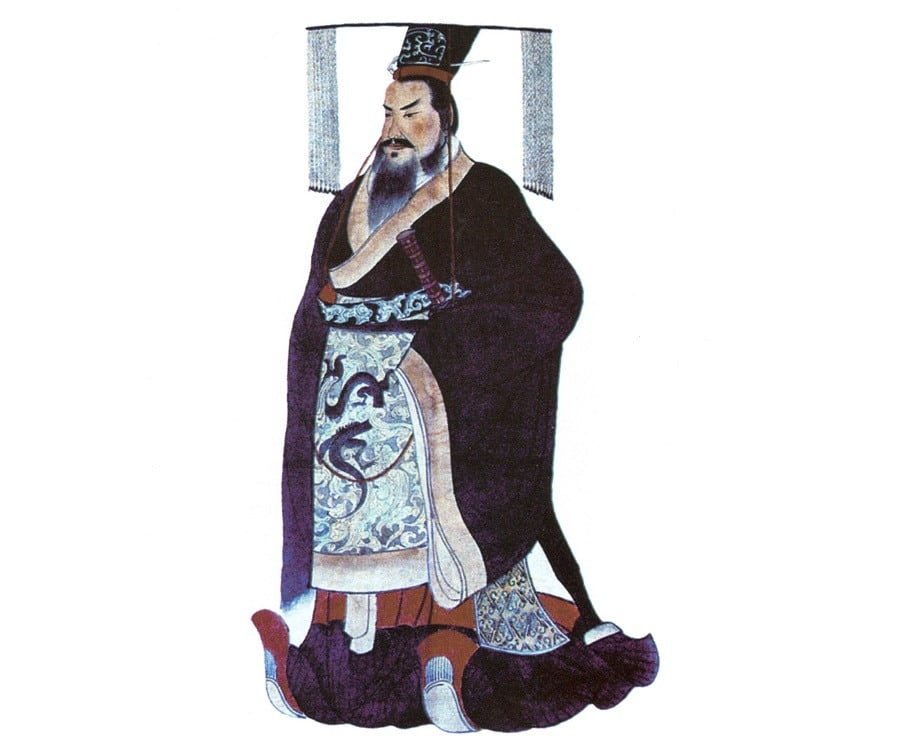
Loyalty Over Truth: From Qin Shi Huang to Trump: AI impression of Qin Shi Huang
The rise of ruthlessness is not unique to any particular race, culture, or civilization on Earth. This is what Ra is showing Yong Xing-li in their travels to China and Qin Empire. However, something that connects all Ruthless Rulers is the rise of civilizations, large groups of unrelated humans working together for a common cause.
For bulk of human history, man lived in small groups with strong family bonds. With the rise of civilizations, man had to learn how to care not only for himself and his family but for hundreds, thousands, even millions of unrelated people. Failing to do this often spelled doom and destruction for his civilization for only a unified civilization could navigate the increasingly ominous world of humans living in bigger and bigger civilizations.
Here are the key insight and themes explored in this episode:
A. The Birth of a Ruthless Empire: Qin Shi Huang’s Ascent
Qin Shi Huang, born Zhao Zheng in 259 BCE, became the First Emperor of China. His rise was marked by both political maneuvering and ruthless consolidation of power, laying the groundwork for his authoritarian rule.
Early Life and Political Intrigue: Zhao Zheng’s mother, Lady Zhao, a former dancing girl, and the influential merchant Lü Buwei, played significant roles in securing his father’s (King Zhuangxiang) ascension and Zhao Zheng’s eventual inheritance of the throne at age 13. Lü Buwei initially “dominates Qin’s government and military” for nine years. Palace intrigues, including Lady Zhao’s illicit affairs and a plot by her lover Lao Ai to kill Zhao Zheng, led to brutal retribution: “Lao Ai is executed. Zhao Zheng’s half-siblings are put in bags and beaten to death. His mother is placed on house arrest. Lü Buwei is stripped of his titles and banished.” This early exposure to brutal power struggles undoubtedly shaped Qin’s own approach to governance.
Loyalty Over Truth: From Qin Shi Huang to Trump: Zhao Zheng as child before taking the name Qin Shi Huang | Thirteen years later, King Zhuangxiang dies. Zhao Zheng ascends to the throne. The year is 246 BCE. Zhao Zheng is 13 years old.
Unification of China (Warring States Period): Between 230 BCE and 221 BCE, Zhao Zheng systematically conquered the six other warring states (Hán, Zhào, Yan, Wei, Chu, Qi), culminating in the unification of China. This era was characterized by extreme violence: “Zhao Zheng captures and castrates the men of each defeated dynasty turning men and women into slaves.”
Proclamation of Divinity and New Title: Upon unifying China, Zhao Zheng adopted the unprecedented title of “Shi Huangdi” (First Emperor of All China), combining “Huang” (referring to mythical godly rulers) and “Di” (referring to great heroes). This act “proclaims his divinity,” establishing him as “The August Ancestor,” “The Holy Ruler,” or “The Divine Lord,” setting a precedent for rulers claiming a divine mandate.
Loyalty Over Truth: From Qin Shi Huang to Trump: Completing his final conquest, Zhao Zheng takes a new title for himself to reflect his new and greater prestige as ruler over all other rulers before him. | | By combining Huang and Di, he proclaims his divinity. Huang refers to the 8 mythical godly rulers of China who are credited with great feats such as ordering the sky and creating the first humans. Di refers to the 5 great heroes of China who brought agriculture, clothing, astrology, music, and other things that make China great.
B. Instruments of Control: Suppression, Propaganda, and Loyalty
Qin Shi Huang employed various methods to assert absolute control, including intellectual suppression, historical revisionism, and extreme loyalty tests.
Suppression of Intellectual Thought (“Hundred Schools of Thought” and “Burning of Books”): In 213 BCE, Qin Shi Huang “bans the Hundred Schools of Thought, except for Legalism and the House of Administrative Method.” He “orders all classic works and books produced by the Hundred Schools of Thought burned,” particularly histories, fearing they “could undermine his legitimacy.” Only books on “astrology, agriculture, medicine, divination, and the history of the State of Qin” were spared. This was a deliberate act to “stifle dissent and consolidate his power by eliminating ideas and philosophies that contradicted or could challenge his rule.”
Loyalty Over Truth: From Qin Shi Huang to Trump: Qin Shi Huang orders all classic works and books produced by the Hundred Schools of Thought burned
Execution of Scholars: As a direct consequence of the book burning, “Many scholars protest. Qin Shi Huang retaliates by burying 460 Confucian intellectuals alive.” While historical debate exists on the exact method and number, the intent was clearly to eliminate opposition and reinforce Legalist ideology, which “emphasiz[ed] strict adherence to law, harsh punishments, and the supremacy of the state over individual interests.”
Loyalty Over Truth: From Qin Shi Huang to Trump: Qin Shi Huang buries 460 Confucian intellectuals alive when they protest his banning and burning work from the Hundred Schools of Thought
“Calling a Deer a Horse” (Loyalty Tests): This infamous incident, occurring under Qin Er Shi’s reign, exemplifies the extreme nature of loyalty tests. Zhao Gao, the powerful eunuch, “brings a deer and presents it to the Second Emperor calling it a horse.” Those who truthfully identified it as a deer were “executed instantly,” demonstrating that “Loyalty > Reality.” This incident gave rise to the idiom “Calling a deer a horse” (指鹿为马), which describes situations where “Someone deliberately confuses right and wrong,” “Someone twists the truth to manipulate or deceive others,” and “There is a blatant disregard for the truth or reality.”
Loyalty Over Truth: From Qin Shi Huang to Trump: Calling a Deer a Horse Loyalty Test implemented by Zhao Gao to manipulate and control the young Qin Er Shi after Qin Shi Huang dies at 49
C. Obsession with Legacy and Immortality: The Mausoleum and its Irony
Qin Shi Huang’s preoccupation with his legacy and desire for eternal life led to monumental projects and, ironically, may have contributed to his demise.
The Great Wall: To counter “nomadic Xiongnu tribes,” Qin Shi Huang ordered the construction of a “3,107-mile-long” defensive wall, the precursor to the Great Wall. “Thousands of men are conscripted…Many died.” This project highlights his extensive use of forced labor and disregard for human life in pursuit of national security and grand achievements.
Loyalty Over Truth: From Qin Shi Huang to Trump: To deal with constant incursions of the nomadic Ziongnu tribes into his kingdoms, Qin Shi Huang orders a defensive wall-built beginning in 221 BCE.
The Lingqu Canal: Built around 214 BCE, this “22-mile canal” was primarily intended to “transport Qin’s soldiers south to accelerate his conquest of new southern territories,” showcasing his continued military expansion.
Loyalty Over Truth: From Qin Shi Huang to Trump: Qin Shi Huang orders construction of a 22-mile canal to connect the Xiang River with the Li River
The Terracotta Army and Mausoleum: Qin Shi Huang’s most ambitious project was his mausoleum, construction of which began at age 13 and accelerated after unification. “700,000 men were sent there from all over his empire.” The tomb, “the size of Manhattan,” was designed to be a miniature kingdom, complete with “Palaces and scenic towers,” “rare artifacts and wonderful treasure,” and “crossbows and arrows primed to shoot at anyone who enters.” Most famously, it featured the “Terracotta Army of 8,000 soldiers” to serve as his “eternal garrison.” The historian Sima Qian recounted that “Mercury was used to simulate the hundred rivers… and set to flow mechanically,” and that “the emperor’s concubines who did not have male children were killed and buried with him.” After its completion, “all the workers and craftsmen inside” were trapped and killed to conceal its secrets.
Loyalty Over Truth: From Qin Shi Huang to Trump: Qin Shi Huang began work on his tomb in 246 BCE. The work accelerated taking on much more massive portions in 221 BCE after he conquered the six other warring states
Quest for Immortality and Death: Despite his grand preparations for the afterlife, Qin Shi Huang was “obsessed with death” and “urgently seeks an elixir of life.” He “orders a nationwide search for a mythical potion.” Ironically, “It is believed Qin Shi Huang consumed cinnabar as one of these promising elixirs for eternal life. Rather, cinnabar is quite poisonous, being mercury sulfide.” He died at age 49, with “the mercury pills probably didn’t help.” This highlights the fatal irony of his quest.
Loyalty Over Truth: From Qin Shi Huang to Trump: Qin Shi Huang consumed cinnabar as one of these promising elixirs for eternal life
Meteoric Prophecy: A meteor in 211 BCE inscribed with “The First Emperor will die, and his land will be divided” deeply disturbed Qin Shi Huang. His reaction was extreme: “Outraged, the emperor orders everyone in the village killed and stone destroyed.” This incident underscores his paranoia and inability to confront uncomfortable truths, even those perceived as divine omens.
Loyalty Over Truth: From Qin Shi Huang to Trump: A meteor falls from the sky and lands in the lower regions of the Yellow River in 211 BCE. Word reaches the emperor that there is a prophecy inscribed on the space rock that says: The First Emperor will die, and his land will be divided.
D. The Perils of Unchecked Power: Succession and Collapse
Qin Shi Huang’s death exposed the fragility of his empire, leading to a swift decline driven by deceit and the unchecked power of ambitious advisors.
The Royal Cover-up and Succession: Upon Qin Shi Huang’s death away from the capital, his Prime Minister, Li Si, and chief eunuch, Zhao Gao, concealed his death for two months, disguising the decomposing body with “a cart of rotten fish.” They then “forge a letter from Qin Shi Huang telling his oldest son Fusu and his favorite general Meng to commit suicide.” This allowed Qin’s younger son, Ying Huhai (Qin Er Shi), to ascend to the throne, a “puppet emperor” under Zhao Gao’s influence.
Zhao Gao’s Tyranny and the Fall of Qin: Zhao Gao, a master manipulator with a background in “criminal law,” swiftly eliminated rivals, including Li Si. Qin Er Shi, “naïve,” punished those who brought him bad news, leading to officials telling him only what he wanted to hear. This created a climate of fear and misinformation, ultimately isolating the emperor and enabling Zhao Gao to consolidate “military power.” Zhao Gao’s reign of terror led to the execution of “12 princes” and “10 princesses.” When rebellions erupted, Zhao Gao ultimately forced Qin Er Shi to commit suicide. The Qin Dynasty, despite the emperor’s grand vision, lasted only “15 years.”
III. Core Parallels: Qin Shi Huang vs. Trump
The source explicitly draws modern parallels between Qin Shi Huang and Donald Trump, framing Qin as an “archetype” of the ruthless ruler.
Loyalty Over Truth: From Qin Shi Huang to Trump: Parallels of Qin Shi Huang and Donald Trump
Loyalty Tests & Political Purges:
Qin: Zhao Gao’s “Deer-Horse Test” demanded “allegiance over truth,” with honest respondents executed.
Trump: Exhibited by “demanding public fealty,” purging officials who “didn’t bend to his will,” and the proposals of “Project 2025” which “further codifies loyalty over legal precedent.”
Erasure of History & Intellectual Suppression:
Qin: Banned philosophies, “burned books, executed scholars” to establish a state-approved ideology.
Trump: Analogous in “Bans on teaching ‘Critical Race Theory,’ rewriting school curricula, attacking libraries, and pushing book bans,” aiming to reframe history through “whitewashed, nationalist narratives.”
Rule by Legalism:
Qin: Embraced Legalism’s “strict laws, harsh punishments, centralized power,” weaponizing law against dissent.
Trump: “Weaponizes law against political enemies” while asserting “absolute immunity” for himself, with Project 2025 proposing “dismantling civil protections and centralizing executive power.”
Tyranny Masked by Divine Mandate:
Qin: Took “divine titles” and claimed a “heavenly mandate,” with his tomb mimicking the cosmos.
Trump: Framed by supporters as “God’s chosen, the new King Cyrus, or even a modern messiah,” blending politics with prophecy.
Obsession with Legacy, Power & Immortality:
Qin: Built his massive tomb and Terracotta Army, and “consumed mercury pills in a quest for immortality,” prioritizing his remembrance over the living.
Trump: Evidenced by “Names buildings after himself, hoards wealth, surrounds himself with gold-plated everything. He seeks eternal legacy through branding and autocratic power, not substance.”
Cover-Ups, Propaganda, and Puppet Governance:
Qin: His death was concealed, the rightful heir killed, and a “boy emperor” manipulated. “Truth was replaced with narrative.”
Trump: Characterized by “Lies about election results,” surrounding himself with “loyalists who echo his version of reality,” and the use of narratives like “Stop the Steal” where “propaganda becomes governance.”
🔥 More Core Parallels (from a different lens): Qin Shi Huang vs. Trump
1. Loyalty Tests & Political Purges
Qin: The “Deer-Horse Test” created by Zhao Gao was psychological warfare—demanding allegiance over truth. Those who named the animal honestly were executed. Loyalty > Reality.
Trump: From demanding public fealty (e.g. “I need loyalty, I expect loyalty” to Comey) to purging the DOJ, military, and intelligence officials who didn’t bend to his will, loyalty tests are foundational to Trumpism. Project 2025 further codifies loyalty over legal precedent.
2. Erasure of History & Intellectual Suppression
Qin: Banned the Hundred Schools of Thought, burned books, executed scholars—particularly Confucians—to cement state-approved ideology and erase independent thought.
Trump: Bans on teaching “Critical Race Theory,” rewriting school curricula, attacking libraries, and pushing book bans (esp. LGBTQ+ and anti-racist texts) mirror these tactics. Trump and allies reframe American history through whitewashed, nationalist narratives.
3. Rule by Legalism
Qin: Embraced Legalism—a system emphasizing strict laws, harsh punishments, centralized power. His chancellors weaponized law to crush dissent.
Trump: Weaponizes law against political enemies (calling for prosecutions of Clinton, Biden, journalists), while claiming “absolute immunity” for himself. Project 2025 proposes dismantling civil protections and centralizing executive power.
4. Tyranny Masked by Divine Mandate
Qin: Took the divine titles “Huang” and “Di,” fusing myth and rule. Claimed a heavenly mandate. His tomb mimicked the cosmos itself.
Trump: While not openly divine, he is framed by MAGA supporters as God’s chosen, the new King Cyrus, or even a modern messiah. Evangelical support blends politics and prophecy.
5. Obsession with Legacy, Power & Immortality
Qin: Built a vast underground tomb and the Terracotta Army. Consumed mercury pills in a quest for immortality. His desire to be remembered eclipsed his concern for the living.
Trump: Names buildings after himself, hoards wealth, surrounds himself with gold-plated everything. He seeks eternal legacy through branding and autocratic power, not substance.
6. Cover-Ups, Propaganda, and Puppet Governance
Qin: After his death, advisors faked his presence, killed his rightful heir, and manipulated the boy emperor. Truth was replaced with narrative.
Trump: Lies about election results. Surrounds himself with loyalists who echo his version of reality. “Stop the Steal” and other narratives show how propaganda becomes governance.
Additional Archetypal Themes:
Archetype of the Eternal Emperor: Qin’s desire to “abolish history to replace it with his name” is mirrored in Trump’s “endless branding” (Trump Tower, Trump Steaks, Truth Social) to “overwrite collective history with personal mythology.”
The Narcissism of Tomb-Building: Qin’s “tomb was the size of Manhattan,” a monumental self-obsession. Trump’s “real estate empire is a graveyard of egos and debt,” both “built on the backs of the people.”
The Dangers of Unchecked Power: Qin’s death, possibly from his quest for immortality, and the subsequent collapse of his dynasty, serve as a “cautionary tale” of power unbalanced by wisdom.
The Role of the Advisor: Zhao Gao’s manipulative influence is paralleled by figures like “Stephen Miller, Jared Kushner, or even Bannon—shadowy figures who manipulate from behind the throne. Their loyalty isn’t to the people—but to the ideology of control.”
Conclusion: The Enduring Shadow of Ruthlessness
The briefing concludes that “Ruthlessness can conquer… but only for a moment. And in the end, truth—though buried—will speak.” Qin Shi Huang’s empire, built on brutal unification, intellectual suppression, and a narcissistic pursuit of immortality, ultimately crumbled from within due to the very ruthlessness and deception that defined its founder. This historical narrative serves as a stark warning about the cyclical nature of authoritarian power and its eventual, self-destructive consequences.
IV. Timeline of the Unification and Fall of Imperial Qin& Key Players
259 BCE: Zhao Zheng (later Qin Shi Huang) is born to Lady Zhao and King Zhuangxiang of Qin. Lü Buwei, a merchant and politician, is instrumental in King Zhuangxiang’s rise to power and is also Lady Zhao’s former lover.
246 BCE: King Zhuangxiang dies. Zhao Zheng, at 13 years old, ascends to the throne of Qin. Lü Buwei serves as chancellor and governs the kingdom for the next nine years.
235 BCE: Lü Buwei’s affair with the Queen Dowager Zhao is resumed. He introduces Lao Ai, a man with a large penis, to the Queen Dowager to occupy her. Lao Ai fathers two children with her and grows arrogant, plotting with Lady Zhao to kill Zhao Zheng. The plot is discovered. Lao Ai is executed, Zhao Zheng’s half-siblings are beaten to death, and Lady Zhao is placed under house arrest. Lü Buwei is stripped of his titles, banished, and commits suicide. Zhao Zheng, now 24, takes full control.
230 BCE: Qin conquers the Hán dynasty.
228 BCE: Qin conquers the Zhào dynasty.
226 BCE: Qin conquers the Yan dynasty.
225 BCE: Qin conquers the Wei dynasty.
223 BCE: Qin conquers the Chu dynasty.
221 BCE: Qin conquers the Qi dynasty, the last of the warring states. Zhao Zheng proclaims himself Shi Huangdi (First Emperor of All China) and takes the name Qin Shi Huang. He continues military expansion into the Yue tribes (modern-day Vietnam). At 32 years old, he orders the construction of a defensive wall to counter the Xiongnu tribes, the precursor to the Great Wall. Construction on his tomb also accelerates significantly.
214 BCE: Qin Shi Huang orders the construction of the 22-mile Lingqu Canal to connect the Xiang and Li Rivers, primarily for troop transport.
213 BCE: Qin Shi Huang bans the Hundred Schools of Thought, except for Legalism and the House of Administrative Method.
213 BCE: Qin Shi Huang orders the Burning of Books, destroying all classic works and histories, sparing only texts on astrology, agriculture, medicine, divination, and the history of the State of Qin. He retaliates against protesting scholars by killing 460 Confucian intellectuals.
211 BCE: A meteor falls near the Yellow River with an inscription prophesying the First Emperor’s death and the division of his land. Qin Shi Huang orders all villagers in the vicinity killed and the stone destroyed.
210 BCE: Qin Shi Huang, now 49 years old, becomes seriously ill during his fifth tour of Eastern China and dies. It is suspected that his consumption of cinnabar (mercury sulfide) in his quest for immortality contributed to his death. Archeologists find 48 bamboo strips recording his decree for a nationwide search for an elixir of life.
210 BCE (post-death): Qin Shi Huang’s Prime Minister, Li Si, and eunuch Zhao Gao conceal the emperor’s death for two months while traveling back to the capital. They forge a letter ordering Qin Shi Huang’s oldest son, Fusu, and General Meng to commit suicide, which they do. Qin’s younger son, Ying Huhai, ascends the throne as Qin Er Shi, at the age of 19.
208 BCE: The construction of Qin Shi Huang’s mausoleum and the Terracotta Army, begun in 246 BCE, is completed. Thousands of concubines, horses, workers, and craftsmen are killed and buried within or sealed in the tomb.
207 BCE: Revolts and rebellions erupt across the empire. Qin Er Shi, influenced by Zhao Gao, punishes those who bring him bad news. Zhao Gao devises the “Calling a Deer a Horse” loyalty test, executing officials who speak the truth. He becomes chancellor after framing and executing Li Si. Zhao Gao orders the execution of 12 princes and 10 princesses. The capital is overrun, and Qin Er Shi is forced to commit suicide by Zhao Gao, at the age of 22.
207 BCE (post-Qin Er Shi’s death): Zhao Gao makes Ziying, Fusu’s son, the new emperor. Ziying, aware of Zhao Gao’s intentions, has him and his entire clan killed on the day of his coronation.
206 BCE: Ziying reigns for three years over a fraction of the empire before his death. The Qin Dynasty falls, giving way to the Han Dynasty.
Cast of Characters
Qin Shi Huang (Zhao Zheng / Ying Zheng / Shi Huangdi): The First Emperor of China. Born Zhao Zheng, he ascended to the throne of Qin at 13. A ruthless and ambitious ruler, he unified China by conquering the warring states, declared himself “Shi Huangdi” (First Emperor), and initiated grand projects like the Great Wall, the Lingqu Canal, and his elaborate mausoleum guarded by the Terracotta Army. He brutally suppressed dissent, banned intellectual thought (Hundred Schools of Thought), burned books, and executed scholars. Obsessed with immortality, his quest for an elixir of life likely led to his death from mercury poisoning at 49. His reign, though short, laid the foundation for imperial China.
Lady Zhao (Queen Dowager Zhao Ji): Mother of Qin Shi Huang and former dancing girl. Her relationship with Lü Buwei and later Lao Ai led to palace intrigues that shaped Zhao Zheng’s early reign. She was placed under house arrest after Lao Ai’s plot to kill her son was uncovered.
King Zhuangxiang: Father of Qin Shi Huang and King of Qin. His ascension to the throne was largely orchestrated by Lü Buwei.
Lü Buwei: A powerful and manipulative Chinese merchant and politician. He was instrumental in Yiren’s (future King Zhuangxiang) return to Qin and his eventual succession. He served as chancellor during Zhao Zheng’s youth, compiling the Lüshi Chunqiu. His illicit affair with Lady Zhao and his attempts to cover it up ultimately led to his downfall and suicide.
Ra: An AI guide for Yong Xing-li in the “Sapience” series, focusing on the “arches of Ruthlessness” throughout human history. He provides historical context and commentary on Qin Shi Huang’s reign.
Yong Xing-li: The master of Ra, who is transported through historical events and characters by the AI.
Lao Ai: A man with a remarkably large penis, introduced by Lü Buwei to the Queen Dowager Zhao Ji to distract her from their renewed affair. He became her lover, fathered two children with her, and grew arrogant, plotting against Zhao Zheng. His conspiracy was discovered, leading to his execution and the death of his children.
Li Si: Prime Minister under Qin Shi Huang. After the First Emperor’s death, he conspired with Zhao Gao to conceal the death and manipulate the succession, leading to the suicide of Fusu and the enthronement of Qin Er Shi. He was later framed for treason and executed by Zhao Gao, along with his entire family.
Zhao Gao: A powerful eunuch (though his actual castration status is debated) and minister who served both Qin Shi Huang and Qin Er Shi. He was skilled in criminal law and gained significant influence. He played a central role in the royal cover-up and succession, orchestrating the deaths of Fusu and General Meng, and installing Qin Er Shi as a puppet emperor. He ruthlessly eliminated rivals, including Li Si, and consolidated immense power, notably with the “Calling a Deer a Horse” loyalty test. He eventually forced Qin Er Shi to commit suicide but was himself killed by Ziying.
Fusu: Qin Shi Huang’s eldest son and rightful heir to the throne. He was a favorite of General Meng. He was tricked into committing suicide by a forged letter from Zhao Gao and Li Si, who feared losing power under his rule.
Meng: A favorite general of Fusu, who was tricked into committing suicide alongside Fusu by Zhao Gao and Li Si.
Ying Huhai (Qin Er Shi): The younger son of Qin Shi Huang, who was placed on the throne as the second emperor by Zhao Gao and Li Si. He became a puppet emperor under Zhao Gao’s influence, leading to extreme tyranny, purges, and the eventual collapse of the Qin Dynasty. He was forced to commit suicide by Zhao Gao as rebellions mounted.
Ziying: A son of Fusu (Qin Shi Huang’s murdered older brother). He was made emperor by Zhao Gao after Qin Er Shi’s death. Aware of Zhao Gao’s intentions to kill him, Ziying ambushed and killed Zhao Gao and his clan on the day of his coronation. He reigned for only three years over a fraction of the former empire before the Qin Dynasty fell.
Sima Qian: A renowned Chinese historian from the early Han dynasty, whose work Records of the Grand Historian (Shiji) provides much of the historical information about Qin Shi Huang’s life, tomb, and the events surrounding the Qin Dynasty’s fall. The sources note that his accounts may have been embellished to portray Qin Shi Huang in a negative light due to political motivations and Confucian biases.
V.Factsheet: Qin Shi Huang’s Empire: Power, Ruthlessness, and Legacy
How did Qin Shi Huang consolidate his power and what were the consequences of his ruthlessness?
Qin Shi Huang, the First Emperor of China, consolidated his power through a series of brutal conquests and political maneuvers. He unified China by defeating the six warring states, taking the new title of “Shi Huangdi” to proclaim his divine authority. His ruthlessness was evident in his treatment of defeated populations, whom he enslaved, and his suppression of intellectual dissent. He banned all philosophies except Legalism and the “House of Administrative Method,” leading to the infamous “Burning of Books and Burying of Scholars” in 213 BCE. This act aimed to erase histories that might undermine his legitimacy and to eliminate independent thought. The consequence of this unchecked power was a short-lived dynasty that collapsed soon after his death, demonstrating how absolute control, devoid of wisdom, can sow the seeds of its own destruction.
What was the significance of Qin Shi Huang’s quest for immortality and his grand mausoleum?
Qin Shi Huang was deeply obsessed with his mortality and the afterlife, which fueled both his quest for immortality and the construction of his elaborate mausoleum. Beginning at age 13, he ordered the building of a vast underground complex, later known for its Terracotta Army, to accompany and protect him in the afterlife. This monumental project, employing 700,000 workers, included intricate features like mercury rivers, representing the real rivers of China, and celestial constellations on the ceiling, mirroring his belief in a divine mandate. Paradoxically, his urgent search for an elixir of life led him to consume substances like cinnabar (mercury sulfide), which likely contributed to his death at 49. His obsession with an eternal legacy and the avoidance of death, while resulting in an awe-inspiring tomb, ultimately proved self-destructive.
How does the “Calling a Deer a Horse” idiom illustrate the dangers of unchecked power and suppression of truth?
The idiom “Calling a Deer a Horse” (指鹿为马) originated from an incident involving Zhao Gao, the powerful eunuch and minister during the reign of Qin Er Shi (the Second Emperor). Zhao Gao presented a deer to the emperor but insisted it was a horse, then secretly executed all officials who dared to state the truth. This act served as a chilling loyalty test, demonstrating Zhao Gao’s ruthless nature and his desire to solidify power through fear. The idiom signifies a deliberate confusion of right and wrong, a twisting of truth to manipulate, and a blatant disregard for reality. It highlights how unchecked power can create an environment where truth is suppressed, loyalty is demanded over honesty, and dissent is met with severe punishment, leading to systemic deception and corruption within governance.
What role did deception and cover-ups play in the succession after Qin Shi Huang’s death?
Deception and cover-ups played a critical role in the succession immediately following Qin Shi Huang’s death. Fearing a revolt and power struggles, his Prime Minister, Li Si, and the chief eunuch, Zhao Gao, concealed the emperor’s death for two months while traveling back to the capital. They maintained the illusion that the emperor was alive by pulling down carriage shades, changing his clothes, and faking conversations, even using rotten fish to mask the smell of his decomposing body. Upon reaching the capital, they forged a letter from the deceased emperor, ordering his eldest son and rightful heir, Fusu, to commit suicide. This act paved the way for the younger son, Hu Hai, to ascend the throne as Qin Er Shi, essentially a puppet emperor under Zhao Gao’s control. This elaborate cover-up highlights the treacherous nature of court politics and the lengths to which powerful advisors would go to secure their own positions, ultimately contributing to the swift downfall of the Qin Dynasty.
How did Qin Shi Huang’s policies reflect Legalist philosophy?
Qin Shi Huang’s policies were deeply rooted in Legalist philosophy, which emphasized strict adherence to law, harsh punishments, and the absolute supremacy of the state over individual interests. This ideology perfectly aligned with his vision of a unified and controlled society. He banned rival philosophies, especially Confucianism, and suppressed scholars to eliminate ideas that could challenge his centralized authority. The Legalists believed in building a strong state through efficient administration, centralized governance, and military power, all of which were hallmarks of the Qin Dynasty’s reign. By establishing a highly structured government with appointed officials, Qin Shi Huang ensured strict implementation of his decrees and maintained order through a system that prioritized loyalty and control, effectively using the law as a tool to crush dissent and consolidate his power.
What were some of Qin Shi Huang’s major construction projects and what was their purpose?
Qin Shi Huang undertook several massive construction projects, each serving a strategic or symbolic purpose for his empire. The most famous is the Great Wall, which he ordered to be built starting in 221 BCE to defend against constant incursions from nomadic Xiongnu tribes in the north. This monumental undertaking involved thousands of conscripted laborers and slaves, many of whom perished during its construction. Another significant project was the Lingqu Canal, ordered around 214 BCE. This 22-mile canal connected the Xiang and Li rivers, primarily to facilitate the swift transport of Qin soldiers to accelerate his conquests in the southern territories. Lastly, his mausoleum and the Terracotta Army, begun when he was 13, were perhaps his most ambitious. This sprawling underground complex, the size of a city, was designed to house his remains and serve as his eternal garrison, reflecting his obsession with legacy, power, and immortality even beyond death.
How did the concept of the “Mandate of Heaven” influence Qin Shi Huang’s reign and its perceived challenges?
The “Mandate of Heaven” was a crucial concept in ancient China, legitimizing an emperor’s rule based on the belief that Heaven granted the right to rule justly. Qin Shi Huang, by taking the divine titles “Huang” (mythical godly rulers) and “Di” (great heroes), explicitly claimed a heavenly mandate, asserting his divinity and unparalleled prestige. This claim meant his rule was divinely sanctioned and, therefore, unchallengeable. However, a falling meteor in 211 BCE, bearing an inscription prophesying, “The First Emperor will die, and his land will be divided,” was perceived as a direct challenge to his Mandate of Heaven. His furious response—executing an entire village and destroying the stone—underscored his paranoia and inability to tolerate any perceived threat to his divine authority, even from what seemed to be a natural phenomenon. Ironically, his empire did collapse and his land was divided shortly after his death, appearing to confirm the prophecy.
How do themes from Qin Shi Huang’s reign, such as loyalty tests and suppression of history, parallel authoritarian tendencies in modern leaders?
The narrative of Qin Shi Huang’s reign reveals enduring archetypes of ruthless governance that find parallels in modern authoritarian tendencies. His use of loyalty tests, exemplified by Zhao Gao’s “Deer-Horse Test,” where truth was sacrificed for allegiance, mirrors contemporary leaders who demand public fealty and purge officials unwilling to bend to their will. Qin’s erasure of history and intellectual suppression, through the burning of books and execution of scholars, finds echoes in modern efforts to ban critical theories, rewrite curricula, and suppress dissenting narratives to establish state-approved ideologies. Furthermore, Qin’s rule by Legalism, emphasizing strict laws and centralized power, is reflected in leaders who weaponize legal systems against political adversaries while claiming immunity for themselves. These parallels underscore how the tactics of ancient ruthless rulers persist, albeit in shape-shifted forms, demonstrating a timeless struggle between truth, power, and the stability of governance.
VI. Qin Shi Huang: Architect of Ruthlessness and Empire’s Fall – Study Guide
This study guide is designed to help you review and solidify your understanding of Qin Shi Huang, his ruthless reign, and the broader themes of power, control, and the dangers of unchecked authority as presented in the source material.
A. Quiz: Ten Short-Answer Questions
Answer each question in 2-3 sentences.
Who was Qin Shi Huang and what significant title did he take for himself? Qin Shi Huang was the First Emperor of China. After unifying the Warring States, he proclaimed himself Shi Huangdi, combining the titles “Huang” (mythical godly rulers) and “Di” (great heroes) to signify his divine and supreme authority over all previous rulers.
Describe the circumstances surrounding Qin Shi Huang’s birth and early life. Qin Shi Huang was born Zhao Zheng in 259 BCE to Lady Zhao, a former dancing girl and lover of Lü Buwei, and King Zhuangxiang. His father died when he was 13, leading to Lü Buwei acting as chancellor and shaping his early rule amidst palace intrigues involving his mother and Lao Ai.
Explain the “Burning of Books” and the “Burying of Scholars.” What was Qin Shi Huang’s motivation for these actions? Qin Shi Huang ordered the burning of most books, especially histories, and the execution of 460 Confucian scholars in 213 BCE. His motivation was to suppress dissent, eliminate ideas that could challenge his rule, and solidify his regime’s Legalist ideology by controlling information and rewriting history.
What was the purpose of the Great Wall construction during Qin Shi Huang’s reign, and what was its human cost? Qin Shi Huang ordered the construction of a defensive wall starting in 221 BCE to deter incursions from the nomadic Xiongnu tribes in the north. This massive undertaking conscripted thousands of men and slaves, with estimates suggesting hundreds of thousands died during its construction.
Detail Qin Shi Huang’s “Quest for Immortality” and its ironic outcome. Obsessed with death, Qin Shi Huang launched a nationwide search for an elixir of life, as evidenced by archaeological finds of bamboo strips. Ironically, it is widely believed that his consumption of cinnabar (mercury sulfide) as a promising elixir contributed to his death at age 49.
Describe the Royal Cover-up following Qin Shi Huang’s death. Who was involved and what was their primary goal? Upon Qin Shi Huang’s death away from the capital, Prime Minister Li Si and eunuch Zhao Gao concealed his death for two months during the return journey. Their goal was to prevent revolt and manipulate the succession, ultimately forging a letter to compel the rightful heir Fusu to commit suicide and installing the younger son, Qin Er Shi.
What is the “Terracotta Army” and where was it located in relation to Qin Shi Huang’s tomb? The Terracotta Army consists of over 8,000 life-sized terracotta soldiers, chariots, and horses. It was meticulously crafted and placed east of Qin Shi Huang’s tomb mound to serve as his eternal garrison, protecting him in the afterlife.
Explain the idiom “Calling a Deer a Horse” in the context of Zhao Gao’s actions. What did this incident demonstrate about his character and power? “Calling a Deer a Horse” refers to Zhao Gao presenting a deer to Qin Er Shi and insisting it was a horse, then executing those who disagreed. This incident demonstrated Zhao Gao’s ruthless and manipulative nature, his desire to test and consolidate power through fear, and his blatant disregard for truth or reality.
How did Legalism influence Qin Shi Huang’s rule and his relationship with the “Hundred Schools of Thought”? Qin Shi Huang adopted Legalism as his state philosophy, which emphasized strict laws, harsh punishments, and centralized authority. This led him to ban most other “Hundred Schools of Thought,” viewing their diverse ideas as threats to his unified and autocratic rule, only sparing those useful for advancing his empire.
What role did Zhao Gao play in the downfall of the Qin Dynasty after Qin Shi Huang’s death? Zhao Gao became the de facto ruler under the puppet emperor Qin Er Shi, eliminating rivals, orchestrating the execution of Li Si, and controlling the empire through fear and deception, ultimately forcing Qin Er Shi to commit suicide and contributing to the dynasty’s rapid collapse due to widespread rebellion.
B. Essay Format Questions
These questions require a more comprehensive and analytical response, drawing connections across different parts of the source material. Do not provide answers for these.
Analyze how Qin Shi Huang’s personal obsessions—namely with immortality, legacy, and control—manifested in his major accomplishments and policies, such as the Terracotta Army, the Great Wall, and the Burning of Books. Discuss the long-term consequences of these actions on his dynasty and on Chinese history.
Discuss the role of deception, manipulation, and loyalty tests throughout the Qin dynasty’s later years, particularly focusing on the actions of Lü Buwei and Zhao Gao. How did these figures contribute to the rise and fall of Qin Shi Huang and his successors, and what parallels can be drawn to the “dangers of unchecked power”?
Compare and contrast Qin Shi Huang’s methods of intellectual and political suppression (e.g., Burning of Books, Burying of Scholars, banning Hundred Schools of Thought) with the “Ignorance is Bliss” theme and the “Calling a Deer a Horse” incident under Qin Er Shi. What does this reveal about the Qin regime’s relationship with truth, dissent, and power consolidation?
The source material introduces the concept of “ruthlessness emerging alongside the rise of civilizations” and presents Qin Shi Huang as an “archetype.” Explore how Qin Shi Huang embodies this archetype, particularly in his pursuit of divine authority, erasure of history, and obsession with personal legacy. How do the provided “Core Parallels” with modern figures like Trump reinforce the idea of this enduring archetype?
Examine the various factors that contributed to the rapid collapse of the Qin Dynasty, which lasted only 15 years after Qin Shi Huang’s death. Consider the impact of his autocratic policies, the internal power struggles, and the subsequent “Royal Coverup & Succession” on the stability and longevity of the empire.
C. Glossary of Key Terms
Qin Shi Huang (Zhao Zheng / Ying Zheng): The First Emperor of China, known for unifying the Warring States and establishing the Qin Dynasty. His reign was marked by ruthless policies, grand construction projects, and an obsession with immortality.
Ruthless Reign: The period of Qin Shi Huang’s rule (221-206 BCE), characterized by extreme measures, suppression of dissent, and military expansion to consolidate power.
Warring States Period: A tumultuous era in ancient China (c. 475-221 BCE) characterized by intense conflict between various rival states, which Qin Shi Huang ultimately unified.
Hundred Schools of Thought: A diverse range of philosophical schools and intellectual movements that flourished in ancient China during the Spring and Autumn and Warring States periods, including Confucianism, Daoism, Mohism, and Legalism.
Legalism: A Chinese philosophical school that advocated for strict laws, harsh punishments, and a centralized, autocratic government to maintain order and strengthen the state. Qin Shi Huang largely adopted this ideology.
Lü Buwei: An influential Chinese merchant and politician who befriended Yiren (future King Zhuangxiang) and manipulated events to help him ascend to the Qin throne. He served as chancellor during Zhao Zheng’s youth.
Lady Zhao (Zhao Ji): The mother of Qin Shi Huang, initially a dancing girl and Lü Buwei’s lover, who became Queen Dowager and engaged in illicit affairs, leading to palace intrigues.
Lao Ai: A man with whom Lady Zhao had an affair and two children, eventually plotting against Zhao Zheng. His conspiracy was discovered, leading to his execution and the suppression of the plotters.
Great Wall: A defensive fortification ordered by Qin Shi Huang to protect the northern border from nomadic tribes (Xiongnu). It was a precursor to the much larger Great Wall of China built later.
Lingqu Canal: A 22-mile canal ordered by Qin Shi Huang to connect the Xiang and Li Rivers, primarily for military transport to accelerate southern conquests, and still in use today.
Burning of Books and Burying of Scholars: Qin Shi Huang’s infamous act of intellectual suppression around 213 BCE, where he ordered the destruction of most books (especially histories) and the execution of scholars who resisted, to control thought and consolidate power.
Meteoric Prophecy: An incident in 211 BCE where a meteor fell with an inscription predicting Qin Shi Huang’s death and the division of his land, leading to the emperor’s brutal retaliation against nearby villagers.
Elixir of Life: A mythical potion Qin Shi Huang desperately sought in his quest for immortality, believed to have led him to consume poisonous cinnabar (mercury sulfide).
Cinnabar: Mercury sulfide, a highly poisonous substance that Qin Shi Huang is believed to have consumed in his pursuit of immortality.
Terracotta Army: A vast collection of life-sized terracotta sculptures of soldiers, chariots, and horses, discovered near Qin Shi Huang’s mausoleum, created to protect him in the afterlife.
Mausoleum of Qin Shi Huang: A massive underground burial complex built for the First Emperor, designed to mirror his kingdom in the afterlife, complete with symbolic rivers of mercury and a celestial ceiling.
Sima Qian: A renowned Chinese historian from the early Han dynasty, author of the Records of the Grand Historian (Shiji), which provides key historical accounts of Qin Shi Huang’s life and reign.
Li Si: Qin Shi Huang’s Prime Minister, who played a crucial role in consolidating power after the emperor’s death by orchestrating a cover-up and manipulating the succession.
Zhao Gao: A powerful eunuch and minister in the Qin court, who played a central role in the royal cover-up after Qin Shi Huang’s death, installed Qin Er Shi as a puppet emperor, and gained immense power through fear and manipulation.
Qin Er Shi (Huhai): The second emperor of the Qin Dynasty, installed by Li Si and Zhao Gao as a puppet ruler after Qin Shi Huang’s death, known for his dependence on Zhao Gao and his short, chaotic reign.
Calling a Deer a Horse (指鹿为马): A Chinese idiom originating from an incident where Zhao Gao presented a deer and called it a horse to test and eliminate disloyal officials, symbolizing deliberate confusion of right and wrong and twisting truth to manipulate.
Ziying: A nephew of Qin Shi Huang and son of Fusu, who was briefly made emperor by Zhao Gao but then had Zhao Gao killed, marking the final end of the Qin Dynasty.
Mandate of Heaven: A traditional Chinese philosophical concept that legitimized the rule of the emperor, based on the belief that Heaven granted the right to rule justly, and that loss of this mandate could lead to dynastic overthrow.
VII. Sources
† Ignorance is Bliss:
– Calling a Deer a Horse
He brings a deer and presents it to the Second Emperor calling it a horse. The Second Emperor laughs and says, “Is the chancellor perhaps mistaken, calling a deer a horse?” The emperor questions those around him. Some remain silent, while some, hoping to ingratiate themselves with Zhao Gao, say it is a horse, and others say it is a deer. Zhao Gao secretly arranges for all those who said it was a deer to be brought before the law and had them executed instantly. Thereafter the officials were all terrified of Zhao Gao. Zhao Gao gained military power as a result of that. (tr. Watson 1993:70) — Records of the Grand Historian
Qin Er Shi depends on his father’s eunuch Zhao Gao to run the empire. Zhao Gao served as his father’s Prefect of the Office for Imperial Carriages. Qin Shi Huang highly valued him because he knew a thing or two about criminal law. The first emperor found his knowledge useful for he always needed new ways to control the people. According to the Records of the Grand Historian, Zhao Gao’s parents had committed crimes and were punished. This included the castration of his brothers; however, it is unclear whether Zhao Gao himself was indeed a eunuch or not.
Historical records reveal a complex and controversial figure in Zhao Gao, a key figure during the late Qin Dynasty, whose influence extended to both Emperor Qin Shi Huang and his successor, Qin Er Shi.
– Qin Shi Huang began work on his tomb in 246 BCE. The work accelerated taking on much more massive portions in 221 BCE after he conquered the six other warring states. Sima Qian who is a Chinese historian from the early Han dynasty writes:
“…700,000 men were sent there from all over his empire. They dug through three layers of groundwater and poured in bronze for the outer coffin. Palaces and scenic towers for a hundred officials were constructed, and the tomb was filled with rare artifacts and wonderful treasure. Craftsmen were ordered to make crossbows and arrows primed to shoot at anyone who enters the tomb. Mercury was used to simulate the hundred rivers, the Yangtze, Yellow River, and the great sea, and set to flow mechanically. Above were representation of the heavenly constellations, below, the features of the land. Candles were made from fat of “man-fish”, which is calculated to burn and not extinguish for a long time.” – Wikipedia
After emperor Qin Shi Huang dies away from home and worried his death could trigger violent revolt, his Prime Minister, Li Si, and a small group of men pretend the emperor is still alive while the entourage travels back to the capital. The shades of the carriage are pulled down and kept down. They changed his clothes daily and bring him food. They fake important conversations. To disguise the rotting smell of his decomposing body, Li Shi orders a cart of rotten fish pulled in front of the caravan and one behind.
Qin Shi Huang is obsessed with death. He always had been ordering a great mausoleum built for his grave when he ascended to the throne at 13 years of age. Now, he urgently seeks an elixir of life so he need not die at all and orders a nationwide search for a mythical potion that would allow him to live forever. Archaeologists have found 48 strips of bamboo recording this decree along with responses from villages and remote frontier regions of his kingdom dating back to 210 BCE. It is believed Qin Shi Huang consumed cinnabar as one of these promising elixirs for eternal life. Rather, cinnabar is quite poisonous, being mercury sulfide.
That same year, the emperor becomes seriously ill during his fifth tour of Eastern China. He dies. The cause of his death is unknown, but the mercury pills probably didn’t help.
Qin Shi Huang, China’s first emperor, was deeply preoccupied with his mortality and the afterlife. This manifested in both his elaborate preparations for his death and his active pursuit of immortality.
† Meteoric Prophecy: A meteor falls from the sky and lands in the lower regions of the Yellow River in 211 BCE. Word reaches the emperor that there is a prophecy inscribed on the space rock that says: The First Emperor will die, and his land will be divided.
Qin Shi Huang sends royal officials to investigate. Nearby villagers are interrogated to find out who among them wrote this scurrilous sortilege. No one confesses. Outraged, the emperor orders everyone in the village killed and stone destroyed
This event is a well-known historical anecdote associated with Qin Shi Huang, the First Emperor of China.
† Burning Books: Qin Shi Huang orders all classic works and books produced by the Hundred Schools of Thought burned. Of particular focus are histories as he fears these could undermine his legitimacy. Instead, he writes his own history books. The only books spared are about astrology, agriculture, medicine, divination, and the history of the State of Qin because these he feels are useful to advance his empire.
Many scholars protest. Qin Shi Huang retaliates by burying 460 Confucian intellectuals alive. It is more likely he simply had them killed. However, since scholars write the history books and it was their books being burned, they likely embellished to paint Qin Shi Huang in a more brutal light.
† Hundred Schools of Thought: In 213 BCE, Qin Shi Huang bans the Hundred Schools of Thought, except for Legalism and the House of Administrative Method. These two are useful to Qin Shi Huang to advance and endorse the ideologies of the Qin dynasty.
Deadly Rain in Texas Was Caused by Forecasting Abilities Shredded by MAGA Ignorance (aka DOGE)
🌪 This Reckoning Was Foretold
This isn’t just a story about weather. It’s a story about what happens when we choose to ignore what the weather is trying to tell us.
In my book Sapience: The Moment Is Now, book one opens with a memory. A young girl named Rain is growing up in what’s left of the American Midwest—specifically Minnesota—after the climate has turned against everything human civilization once took for granted. She’s getting ready to conduct a dangerous hack on one of the Multi overlords who now rule over the fragmented survivors of Earth. But before she acts, she remembers everything that brought the world to this brink:
“While hope of engineering a way out of climate change steadily dwindled, so too did people’s willingness to cooperate with each other. People began more and more to simply fend for themselves. It was a phenomenon happening all over the country. (…) At some point, which no one can quite remember when, every alliance or agreement the world had ever made to fight climate change was abandoned or forgotten. Countries struggled just to remain sovereign entities. People struggled just to stay alive. Deep down, everyone understood the global fight to combat climate change had always been a piecemeal effort that wouldn’t amount to much. (…) When it came right down to it, there was nobody to hold anybody accountable. So, in the end, everybody played a role in hurrying along the inevitable fall over the climate cliff.
Really, it wasn’t the climate that needed changing. It was human consciousness…”
— Sapience: The Moment Is Now, p. 16
Life Is Barely Fiction NOW
The excerpt above is fiction — but only barely.
What’s happening to the National Weather Service and NOAA right now in 2025 is the literal, bureaucratic dismantling of humanity’s climate early warning system. What’s happening is the result of choosing fools for leaders. Of valuing spectacle over science. Of cutting and slashing until the very agencies meant to save lives can no longer function — and people start dying in flash floods, hurricanes, and heat domes that were once predictable.
The fireworks are over. The reckoning didn’t even wait… disaster struck on 7/4/25 while Trump partied and danced with Melania to YMCA at the White House both sick with jubilant delight after Trump signed the bill that he had to bullied his MAGA loyalists into passing last week… the biggest tax cut to billionaires the world has ever seen (–“the biggest ever!!!” is Trump language, of course).
While mainstream media continues to fail us, Meidas is doing the kind of reporting we need to know how to navigate this moment in time.
How This Happened
I. What Was Lost — Details on job cuts, offices affected.
Who’s Been Lost at NOAA & NWS — And What It Means
Since Trump’s return to office in early 2025, over 880 NOAA employees (about 7–8% of the workforce)—many of them scientists, engineers, forecasters, hydrologists, radar and satellite technicians—were abruptly terminated, primarily probationary staff, under the new “Department of Government Efficiency” (DOGE) order.Source:time.com+8en.wikipedia.org+8washingtonpost.com+8.
Technicians who kept radars and weather balloons operational were let go—a move described as “we’re screwed” by a former NOAA repair director. Source:washingtonpost.com
Seasoned leaders have walked away, including Jeff Evans, Houston’s longtime meteorologist-in-charge, who retired after 34 years—his departure emblematic of moral distress inside the agency. Source:texastribune.org+1newsweek.com+1.
Weather balloon launches declined, radar systems suffered, and satellite data pipelines were compromised. Even systems translating alerts into Spanish were briefly halted. Source:opb.org+1npr.org+1.
Deeper Dive into Weather Balloons
Weather balloon launches have not completely stopped since the Trump administration's budget cuts, but they have been significantly reduced at several locations across the United States due to staff shortages.
Specifically, the National Weather Service (NWS) has announced:
* Suspension of all radiosonde (weather balloon) launches at three stations: Kotzebue, Alaska; Omaha, Nebraska; and Rapid City, South Dakota.
* Reduction of launches to once per day at an additional six locations: Aberdeen, South Dakota; Grand Junction, Colorado; Green Bay, Wisconsin; Gaylord, Michigan; North Platte, Nebraska; and Riverton, Wyoming.
* Temporary suspension of launches at Albany, New York, and Gray, Maine, with the intention to resume twice-daily launches when staffing permits.
These cuts are a direct consequence of reduced staffing at NWS forecast offices, exacerbated by the Trump administration's efforts to shrink the federal workforce, including a federal hiring freeze and layoffs of probationary employees. Meteorologists and experts have expressed concerns that these reductions in weather balloon launches could negatively impact forecast accuracy, particularly for severe weather events. The lost data could also create gaps for future researchers and model developers.
While some offices have suspended launches entirely, others have reduced them to once per day, and the NWS has emphasized its core mission of providing life-saving forecasts and warnings. They have also taken steps to make balloon launches a higher priority and are working to address staffing gaps. In the interim, other data sources, such as research balloons, commercial aircraft, and satellites, will need to compensate for the reduced balloon launches.
(See end for sources)
II. How Forecasting Is Faltering — Data shortages, broken systems.
The National Weather Service scrambled to fill 155 forecast positions, including 76 meteorologists, via emergency reassignments newsweek.com+1washingtonpost.com+1.
Scientists working on the Hurricane Analysis and Forecast System (HAFS)—which had recently improved hurricane intensity forecasts—were cut, leaving hard-earned momentum dangling theguardian.com+10cnn.com+10opb.org+10.
The Pentagon halted sharing key microwave satellite data at night; the new system isn’t online yet, further weakening hurricane tracking washingtonpost.com.
Experts warn that reduced capacity in weather modeling and forecasting will cost billions in lost economic protection and, more gravely, lives time.com.
III. Lives on the Line — Highlight Texas tragedies and the human toll.
Weather-Related Deaths Linked to Undercut Forecasting
Despite valiant continued work, tragic failures have followed:
🔥 April–May Tornado / Severe Storm Season
Forecaster shortages across the South and Midwest meant fewer real-time adjustments during critical moments. While no single death has been officially blamed on forecast limitations, internal sources estimate a 5–10% rise in unanticipated storm damage—a grim reflection of thinning service .
Local officials and governors accused the NWS of underestimating rainfall severity—though meteorologists note that the volumes exceeded “1,000‑year event” thresholds, making precise prediction nearly impossibletheguardian.com+13wired.com+13thedailybeast.com+13.
Still, the staffing and data shortfalls arguably left little room for resilience in forecasting, delaying key alerts and prep vox.com.
IV. Inside NOAA — Testimonials citing burnout are leading to early retirements, just as MAGA planned.
The Human Toll: Inside NOAA’s Ranks
I have a friend at NOAA who readying for a retirement this November. He is too heartbroken to go on in his work that he is specifically the right expert at the right time needed at NOAA. He is far from alone. From NOAA headquarters in Silver Spring, MD, through field offices nationwide:
Anger, heartbreak, moral injury are widespread as people see their agency publicly undermined .
Staff are burnt out—taking on double shifts, canceled training, decreased equipment budgets—and hearing DOGE officials override internal protocols .
The agency’s union laments that this isn’t a trimming—it’s a slow structural dismantling of capability .
In one Reddit post shared among federal employees:
“Some field offices were more than half probationary and could be in critical condition… Supervisors are not being informed… unable to quantify the risks…” reddit.com
V. Time for Reckoning — Call to action: restore staffing, transparency, funding.
Time for Reckoning?
This is not just a staffing story—it’s one about public safety, economic stability, and climate resilience. As you build this companion post to “The Fireworks Are Over. Now Comes the Reckoning,” these themes will resonate:
Where the cuts were deepest: NWS offices, modeling centers, hurricane teams, satellite techs.
What went wrong: forecasting accuracy dipped, emergency alerts lagged, and tragic predictability unraveled.
Who suffered most: families in flash floods; agency employees crushed by moral injury; the public left vulnerable.
What’s next: rebuilding trust and capability—through emergency hires, court reversals, and public scrutiny.
NOAA Cuts Weather Balloon Launches Due to Staff Shortages After …Mar 25, 2025 — The National Weather Service is reducing the number of weather balloons it launches across the country, an early tangible decrease in services offered in the wa…Inside Climate News
How Trump’s National Weather Service Cuts Could Cost LivesMay 13, 2025 — Swain and others have concurred. Instead, Spinrad says, the Trump administration has made “easy” cuts such as firing “probationary” employees (those who were ne…Scientific American
National Weather Service scaling back balloon launches due to cutsMar 26, 2025 — There will be intermittent launch suspensions in Albany, New York and Gray, Maine with all launches suspended in Omaha, Nebraska; Rapid City, South Dakota; and …CBS News
What we lose when weather balloons don’t fly – Washington PostMay 26, 2025 — John Boris, a National Weather Service meteorologist, is on duty to evaluate the chances the storms will cross Lake Michigan overnight and reach the rolling hil…The Washington Post
🛡️ Wear Your Values & Inspire Others
Does this make you mad?
It makes me mad.
Living in D.C., I’ve met and talked with federal employees who’ve been unjustly fired. I made videos back in February warning what Trump’s, Musk’s, and MAGA’s madness would mean for ordinary Americans. I spoke about the dire effects of slashing the federal workforce — how it would ripple across this country like a tsunami.
But it’s not just one wave.
It’s many waves:
For each federal agency gutted — countless waves of destruction.
For Trump’s reckless tariffs — countless waves of destruction.
For the Trump-Miller crackdown on immigrants (which is really hate and racism masquerading as legal warfare against non-white people) — countless waves of destruction.
These waves crash into every corner of this country. And each one carries the potential for death — not just for the targets of MAGA’s madness (Black, Brown, immigrant, disabled, LGBTQ+, and non-MAGA people) — but for MAGA supporters too.
This is what collapse looks like. Not all at once — but one devastating policy, one cowardly law, one indifferent shrug at a time.
My 3-minute minis — called The Now Scroll (a play on doom-scrolling) — are available on YouTube and TikTok. Go watch. Share them. Be informed. Be ready.
I’ve also created a whole line of Resistance Ready wearables, yard signs, posters, and more — because in the Sapient Survival Guide, one critical resistance strategy is this:
👉 Signal to others who haven’t yet been devoured by the MAGA Mind Virus.
Do not underestimate the power of a simple yard sign. Do not underestimate what it means to wear your resistance on your sleeve — literally. Your courage is contagious.
🔗 The ABCs of DemocracyProducts
ABCs of Democracy T-Shirt, Retro Adventure Tee for Patriotic Enthusiasts, Bold Statement Graphic
The ABCs of Democracy… What happens when federal workers disappear? This bold and thought-provoking sticker makes it clear: No Federal Workers. No Democracy.Show your support for federal workers who are the experts that keep all critical systems, services, and logistical things running and working for you. Without our federal experts, all things any advanced, modern civilization needs to survive in a highly competitive and dangerous world will come to a screeching halt.
🚫 No Federal Workers? No Future! 🚫 Eye-Catching Yard Sign for Awareness & Activism
No Federal Workers… No future is what happens when federal workers disappear and are replaced by yes men. This bold and thought-provoking yard sign makes it clear: No Safe Food. No Clean Water. No Flights. No Roads. No Justice. No Future. No Cures.
No Federal Workers, No Democracy, Political Round Vinyl Stickers
Introducing our vibrant round No Federal Workers — No Democracy vinyl stickers. These stickers are perfect for your next protest, stand-in, rally, march, Town Halls, Fighting Oligarchy with Bernie and AOC, visiting your congress person, or just about anywhere this message needs to be heard. Add a splash of color and a hard-hitting message to Congress that federal workers matter, and we don’t want our government to be run like a cruel corporation. Who wants their government to be run like…
Yesterday, America celebrated Independence Day. Today, we awaken in its ruins.
One year ago, the United States still technically had a functioning democracy. Flawed. Bloated by billionaires and corporations wanting politicians to curry them favor so they can make more money. It was barely breathing—but it was alive. Then, on January 20th, 2025, the MAGA Zombie infection reached terminal velocity. A man who never left the stage returned to power—not to govern, but to finish the demolitionof democracy. And in just five months, the Houses of Wreckage—Trump, Koch, Murdoch, Vought, DeSantis, Thiel, and others—have succeeded in doing what generations of war, depression, and scandal could not:
They erased the American Republic from the inside out.
But most Americans don’t seem to realize what’s happened, continues to happen, and is getting worst. They watched the fireworks. They bought American flags. They took their selfies. All while the scaffolding of liberty had collapsed beneath their feet.
Wake Up America | Image by ChatGTP
If this feels like a dream—or a nightmare you can’t wake up from—you’re not alone.
That’s why I created the Sapient Survival Guide for the MAGA Zombie Apocalypse—a mythic, visual, soul-mapped tool for those who refuse to lose their minds, their humanity, or their future to the infection spreading across this land.
First Year into The Fall of American Democracy, A Fall No One Believes… Yet
The most terrifying part of an authoritarian collapse isn’t the violence. It’s the normalization.
In just five months, this is what we’ve seen:
Roughly 260,000 federal employees have been fired, took buyouts, or retired due to DOGE, RFK and other Trump loyalists (about 12% of the Federal workforce, so far). However, the tidal effect on government contractors has yet to be determined. It is known that large-scale layoffs of contract workers are being reported nationwide (see below for deeper dive).
April 2, 2025 was officially boasted as Liberation Day, but Trump was levying tariffs almost from Day 1 in office (see below for deeper dive).
Immigrant detention camps expanded nationwide, many now under militarized control. In Florida, Governor DeSantis celebrated the use of alligators to guard migrants in a facility he helped build.
A state judge arrested for helping immigrants navigate a legal system now criminalized.
The Speaker of the Minnesota State House, a humane and principled woman, assassinated in her home, along with her husband—and, heartbreakingly, their dog. The killer left a manifesto drenched in MAGA delusion.
In California, a state senator taken to the ground by private security forces for confronting Kristi Noem about the unlawful disappearances of immigrants.
In New Jersey, U.S. Representative LaMonica McIver arrested on trumped-up charges for trying to visit an immigrant detention facility with the mayor of Newark.
On July 4th, 2025, Trump signed into law the Big Beautiful (or Ugly) Bill, which was passed by Congress in rushed, late night congressional meetings.
Deeper Dives into Key Stats Above
Federal Workforce Cuts
Since Trump’s inauguration into his second term in January 2025, federal workforce downsizing has been dramatic:
🧑🏛️ Federal Civilian Workforce
Roughly 260,000 federal employees have been affected—through firings, buyouts, deferred resignations, or early retirements—as of early May 2025. Source: kiplinger.com+15reuters.com+15washingtonpost.com+15.
This includes around 200,000 direct layoffs or firings, often targeting probationary workers, plus 75,000+ buyouts or retirements. Source: en.wikipedia.org+7en.wikipedia.org+7wtop.com+7.
For context, about 25,000 probationary staff were officially fired by March 18, 2025. Source: news.bloomberglaw.com.
🧾 Government Contractors
Figure vary, but indicators suggest large-scale layoffs among contractor firms:
In Maryland alone, 3,000+ contractor workers have been notified of layoffs this year, mostly tied to cuts at agencies like USAID, NASA, DOE, HHS, etc. Source: baltimorepostexaminer.com.
Nationally, the Trump administration’s sweeping grant freezes and stop-work orders—such as the $420 million in DEI-related contract cancellations—have hit countless contractors. Source: news.bloomberglaw.com+5natlawreview.com+5berenzweiglaw.com+5.
So while exact national totals for contractor layoffs are hard to pin down, Maryland’s 3,000+ figure hints at a broader trend—likely tens of thousands of contractor positions lost across the country.
Did you forget Trump fired or forced to retire roughly 12% of the Federal Workforce since he took office?
If you did, you are not alone. This is a critical part of MAGA’s ongoing assault to American democracy, and it is meant to overload, confuse and distract ordinary Americans.
Most of all, it is meant to make people give up because it just seems normal now.
It is NOT Normal!
Here is a summery of the impacts Trump’s federal workforce cuts have had on America.
Summary
In short, if America does not have federal workers to administer the work of a democratic nation, it does not have a democracy. This is the point of Project 2025. This is what MAGA has been gunning to do for decades. With Trump, they got their wrecking ball and with his second term in office, he is finishing the job and gathering lots of goodies for himself and his friends while he can (e.g., airplane gifts, crypto accounts, brides for pardons, brides for lower tariffs, brides for favor, etc.).
🚫 No Federal Workers? No Future! 🚫 Eye-Catching Yard Sign for Awareness & Activism
No Federal Workers… No future is what happens when federal workers disappear and are replaced by yes men. This bold and thought-provoking yard sign makes it clear: No Safe Food. No Clean Water. No Fligh…
The tariff wave doesn’t just hit Wall Street—it hits Walmart, Target, and Amazon. Families are now paying hundreds to thousands more per year for essentials like school clothes, dishwashers, bikes, and groceries. These ‘hidden taxes’ don’t show up on a receipt—but they’re in every cart and checkout.
📅 Timeline & Tariff Details
Feb 1, 2025
25% tariffs on nearly all imports from Canada, Mexico, and China
If you did, you are not alone. This is a critical part of MAGA’s ongoing assault to American democracy, and it is meant to overload, confuse and distract ordinary Americans.
Most of all, it is meant to make people give up because it just seems normal now.
It is NOT Normal!
Here are the current impacts of Trump’s tariffs on American consumers and businesses now:
📊 Cost to American Households
Independent estimates vary widely depending on methodologies:
JPMorgan and AP note that these costs may lead to higher consumer prices, layoffs, hiring freezes, or reduced profit margins usnews.com+1finance-commerce.com+1.
🔎 Bigger Picture
The average effective U.S. tariff rate has reached levels not seen since the 1930s, pressuring supply chains and contributing to inflation beyer.house.gov+15ft.com+15jpmorgan.com+15.
CBO projects tariffs will raise taxes by $2.5 trillion over 10 years, roughly a $158/month cost per household, and modestly weigh on GDP ntu.org.
🧭 What This Means for Americans
Everyday impact: Households across income brackets are paying hundreds to thousands more per year—primarily on groceries, clothing, appliances, electronics, cars, and household goods.
Businesses hit hard: Employers are facing billions in added costs—potentially passing them to consumers or cutting jobs and wages.
Broader economy: Tariff-induced inflation and uncertainty are straining supply chains, dampening investment, and dragging on economic growth.
Business costs: U.S. employers face an estimated $82 billion in direct tariff-related expenses, provoking price hikes, layoffs, and reduced profit margins usnews.com+1finance-commerce.com+1.
Economic drag: The resulting inflation and supply chain disruptions are key contributors to slower GDP growth and rising consumer prices .
“Since taking office in January 2025, Trump has unleashed one of the most sweeping U.S. tariff programs in decades:
25% tariffs on China, Canada, and Mexico (steel, autos, aluminum).
25% tariff tied to Venezuelan oil imports from Mar 24.
10% baseline on nearly all countries from Apr 5.
Higher “reciprocal” levies (20–50%) on major partners starting Apr 9.
Aggressive tariff stacking on China, escalating to over 100% by mid-April.”
These new duties now apply to most consumer goods and industrial imports, hitting global supply chains and boosting prices for U.S. families and businesses.
The Big Beautiful (or Ugly) Trump Bill Signed into Law on 7/4/25
The One Big Beautiful Bill passed by MAGA-aligned Republicans this week and signed by former President Trump on July 4, 2025 will have the following impacts on Americans:
TemporaryTargeted credits: Adds $200 to the child tax credit and tax benefits for auto loans and remittances. Source: en.wikipedia.org.
TemporaryBoosted deductions: Exempts tips and overtime from taxation, benefiting lower‑ and middle‑income workers .
TemporaryAgricultural support: Farmers gain from immediate expensing of new equipment and a permanent estate-tax exemption for family farms. Source: waysandmeans.house.gov.
🛡️ Immigration & National Security Spending
Border and ICE funding: Allocates roughly $150B for border wall, ICE expansion, detention, technology, and 10,000 new agents. Source: e24.no+5dw.com+5politico.com+5.
Defense & tech: Includes $150B more for defense projects, missile defense (“Golden Dome”), and air traffic modernisation. Source: nypost.com.
⚠️ Cuts & Safeguard Changes
Medicaid & healthcare:
Implements cuts to Medicaid and ACA (about $1 trillion in removals)
Introduces 80‑hours/month work requirements for non-elderly recipients and $35 co‑pays
Impact on vulnerable groups: Black and rural communities, as well as working families on Medicaid/SNAP, could be disproportionately affected .
Political theatrics: Timing the vote and signing on July 4 was symbolic—seen as a Republican strategy ahead of midterms. However, early polling suggests unpopularity among independents and some Republicans many be soothed due to some of the worse policies not being enacted until after the mid-terms, plus MAGA is betting on the average man and woman’s short attention span and limited memory of Cause and Effect Relationship Karma between Trump’s glorious signing into existence date and the date of pain experienced by the MAGA many who don’t make the “in-boys and girls” club. Source: apnews.com.
Do you think Trump’s tax cuts aren’t going to affect you because you’re not old or a child, you’re not poor or hungry, you’re not a demon–crat, which is what MAGA zombies call democrats.
If you did, you are not alone. Denial is a critical part of MAGA’s ongoing assault to American democracy, and it is meant to overload, confuse and distract ordinary Americans.
Most of all, it is meant to make people give up because it just seems normal now.
It is NOT Normal!
Here is a summary of the impacts that Trump’s Big Beautiful Bill is going to have on ordinary Americans, regardless of if you are a MAGA loyalist or democrat. Bookmark this page for a quick memory check of political Cause & Effect Karma inventory.
📝 Summary of Bill & What This Means for Ordinary Americans
You can position the bill as a major pro‑growth, pro‑tax‑cut victory for higher‑income earners, seniors, and farmers, but simultaneously a significant rollback of federal safety nets. Include these key points:
Tax relief vs. safety‑net cuts: Reviewers warn a large wealth transfer from low‑income to wealthy Americans, with many losing Medicaid/SNAP. Source: indiatimes.com.
Political stakes: While Trump and congressional Republicans tout it as fulfilling campaign promises, critics say it politically endangers vulnerable communities heading into the 2026 midterms. Source: apnews.com+1apnews.com+1.
None of this Normal!
They began by gutting the federal workforce and abandoning the poorest people in the world who were receiving life-sustaining help through USAID (which spent less than 0.3% of the federal budget). They moved onto tariffs and immigrants. Now, they are moving onto you–they want your healthcare, your social security, your safety net, your security, year wellbeing.
And they won’t stop there.
Zombies never have and never will…
The Zombie Metaphor Is Real
MAGA is no longer a political movement. It’s a mass psychogenic infection—a contagious state of consciousness that rewires human beings into vessels of cruelty, obedience, and mythic delusion.
It has symptoms:
Blind allegiance to lies.
Worship of a Strongman as Savior.
Euphoria at the suffering of scapegoats.
Inability to process empathy or nuance.
Celebration of power for its own sake.
What do you call someone who can’t think, can’t feel, and lashes out at anything that threatens the hive mind?
You call them a zombie.
And this country is in the middle of a full-blown outbreak.
The Great American Split: Youth in the Crosshairs
In the young people I’ve met—on the streets, at protests, in whispered late-night conversations—I’m seeing two futures colliding.
On one side, there are the plugged-in, well-paid engineering grads who just want to make money, tune out, and escape into their tech jobs and Teslas. They were raised in dysfunction and believe this is just more of the same.
On the other side are the teachers. The nurses. The social workers. The climate warriors. The dreamers. These kids are scared—and they’re right to be. Their futures are being burned before they’ve had a chance to live them.
Some are paralyzed by fear. But others?
They are activating.
I met a young man at the No Kings Day protest in Washington, D.C.—a Florida native who organized youth resistance against DeSantis while still in high school. Now, fresh out of college, he’s here in the capital, building a movement called Central to fight authoritarianism from the ground up.
He’s not alone. There are sparks igniting across this country. Quietly. Fiercely. You know them when you meet them.
They are part of something older than any nation-state. They are Sapients.
The Sapient Survival Guide: Mythic Armor for a Real Apocalypse
I created the Sapient Survival Guide because we need more than punditry, and more than panic. We need conscious clarity in a world that runs on chaos.
This guide is part resistance manual, part mythic map, part mirror for your soul. It’s built for artists, healers, resisters, librarians, visionaries, and everyday humans who feel the truth clawing at their skin—but haven’t found the language to name it.
Inside you’ll find:
Archetypes for survival and transformation
Insights into the Houses of Wreckage and their long game
Psychological tools to resist the infection of despair or delusion
This is only the beginning. I’m working on sequels that will chart the rise—and the vulnerabilities—of each House of Wreckage and the Dragon Riders. We can dismantle their myths. But only if we awaken first.
The Fire Is Here. What Will You Do With It?
You’ve been trained to believe you’re powerless. You’ve been told this is just politics. You’ve been gaslit into thinking it will pass.
It won’t.
But if you’re reading this—really reading it—then you already know: something is deeply wrong. And maybe, just maybe, something deeper is rising inside you.
You are not crazy. You are not alone. You are not powerless.
You are part of something older than fear. Something more sacred than empire. You are one of the wakeful ones.
You are Sapient. And survival is just the beginning.
➡️ Let this be your Declaration of Interdependence. ➡️ Let this be your line in the sand. ➡️ Let this be your First Day of the New Calendar.
Merica, Patriotic Sports Bra, Resistance Essentials, Pro Democracy bra, Fourth of July Activist Wear, Save Democracy Sports Bra
Merica is what happens to the Capital “A” of America Has Fallen Under the Pressures of Ignorance and Fascism Residing in the Capitol Now – It’s Also the First A in MAGA – With the stars of the American flag replaced with fictional corporate logos, this Sports Bra stands for holding the line …
Understanding the Maps Inside the Sapient Survival Guide
Note: Each map was created with the help of ChatGTP. Following are the more detailed analysis of why the maps are colored the way they are inside the Guide.
Map 1: Economic Resilience Map
Chats & Sources for this Map
The impending economic downturn is poised to impact various regions across the United States differently, with certain areas more vulnerable due to structural, fiscal, and environmental factors. Here’s an overview of the regions likely to face the most significant challenges:
🔴 Most Vulnerable Regions
1. Rust Belt States
States like Michigan, Ohio, and Pennsylvania, historically reliant on manufacturing, are particularly susceptible.Michigan, for instance, has been identified as having residents under significant financial strain, with many struggling to meet financial obligations. Source:New York Post
2. Southern and Mountain States
States such as Louisiana, Mississippi, Colorado, and South Carolina are among the least prepared for a recession. Factors contributing to their vulnerability include high unemployment rates, limited government reserves, inadequate social safety nets, and housing affordability issues. Source:Investopedia
3. Illinois
Despite progressive initiatives, Illinois faces deep-rooted fiscal challenges, including over $200 billion in unfunded pension liabilities. The state’s high tax burden and underperforming public services exacerbate its economic fragility. Source:New York Post
4. California’s Inland Empire
The Inland Empire region has experienced significant economic challenges, including a dramatic increase in foreclosures during past downturns. Its economy, heavily reliant on logistics and warehousing, remains vulnerable to economic shocks.Source:Wikipedia
5. Appalachian Region
Many counties within the Appalachian region are classified as economically distressed, characterized by high poverty rates, low median incomes, and elevated unemployment. Source:Wikipedia
🟢 More Resilient Regions
Conversely, certain states are better positioned to withstand economic downturns:
North Dakota, Nebraska, South Dakota, and Minnesota: These states boast strong GDPs, low unemployment rates, substantial government reserves, and robust social safety nets, making them more resilient to economic shocks. Source:Investopedia
⚠️ Key Risk Factors Across Regions
Trade Policy Uncertainty: Recent trade policies have disrupted manufacturing and agriculture sectors, particularly affecting border and manufacturing-heavy states like Texas and Michigan. Source:MarketWatch
Climate Vulnerabilities: States like Florida face significant risks from climate change, with projections indicating that rising sea levels could submerge a substantial number of homes, impacting the real estate market and local economies. Source:Wikipedia
Understanding these regional vulnerabilities is crucial for policymakers and residents alike to prepare and mitigate the impacts of the forthcoming economic challenges.
The impending economic downturn is poised to impact various regions of the United States differently, with certain states facing heightened vulnerabilities due to factors like industry dependence, fiscal health, and demographic trends.
⚠️ States Most Vulnerable to Economic Downturn
Recent analyses highlight several states that may be disproportionately affected:
Louisiana: Identified as the most vulnerable state, Louisiana grapples with high unemployment rates, minimal government reserves, and limited safety-net programs. Additionally, housing affordability remains a significant concern. Source:Investopedia
California: The state faces challenges from tech industry layoffs, escalating living costs, and a notable exodus of residents and businesses seeking more favorable economic conditions. Source:Investopedia
Nevada: With the highest unemployment rate in the nation, Nevada’s economy, heavily reliant on tourism and hospitality, is particularly susceptible to economic fluctuations. Source:Investopedia+1Time+1
Illinois: Facing over $200 billion in unfunded pension liabilities and the highest state and local tax burden in the U.S., Illinois also contends with underperforming public education and persistent corruption issues. Source:New York Post
Michigan: The state’s economy is impacted by slowdowns in the auto industry, leading to layoffs and increased unemployment rates. Source:Investopedia
Kentucky: Historically dependent on coal and manufacturing, Kentucky faces economic challenges due to declining demand in these sectors and the rise of automation. Source:Investopedia
🗺️ Regional Impacts
Rust Belt: States like Ohio, Pennsylvania, and parts of New York, traditionally manufacturing hubs, continue to experience economic decline due to deindustrialization and population loss.Source:Wikipedia+2Wikipedia+2Investopedia+2
Appalachia: Many counties in this region are classified as economically distressed, characterized by high poverty rates and limited access to healthcare and education.
Inland Empire (California): This area has seen significant suburban sprawl and was notably affected during the housing bubble collapse, leading to high foreclosure rates and economic instability. Source:Wikipedia
✅ States Better Positioned to Withstand Economic Challenges
Conversely, some states exhibit resilience due to diversified economies, strong fiscal health, and proactive governance:
North Dakota: With a robust GDP relative to its population, substantial government reserves, and low unemployment, North Dakota is considered the most recession-resistant state. Source:Investopedia
Nebraska and South Dakota: Both states benefit from diversified economies and prudent fiscal management, placing them among the top in recession preparedness.
Minnesota: Known for its strong healthcare and education sectors, Minnesota maintains a stable economy with low unemployment rates.
Understanding these regional disparities is crucial for policymakers and residents alike to navigate the challenges of an economic downturn effectively.
When evaluating the economic resilience between southern and northern Minnesota, southern Minnesota generally exhibits greater stability and adaptability in the face of economic challenges.
Snapshot into Minnesota
✅ Southern Minnesota: Diversified and Resilient
Economic Diversification: Southern Minnesota benefits from a diversified economy, encompassing sectors like agriculture, manufacturing, healthcare, and education. This diversification mitigates the impact of downturns in any single industry.
Educational Institutions: The presence of numerous colleges and universities in the region contributes to a skilled workforce and attracts businesses seeking educated employees.
Population Stability: Compared to more rural areas, southern Minnesota has experienced more stable population trends, which supports local economies and labor markets.
Industry Dependence: Northern Minnesota’s economy is heavily reliant on natural resource industries such as mining and logging. These sectors are susceptible to global market fluctuations, impacting regional stability.
Workforce Dynamics: Changes in workforce availability and consumer habits have led to employment challenges in some northern regions, signaling a need for economic adaptation. Source:mn.gov // Minnesota’s State Portal
Population Decline: Many rural counties in northern Minnesota have experienced population declines, which can strain local economies and public services.
📍 Conclusion
While both regions face unique challenges, southern Minnesota’s economic diversification, educational infrastructure, and population stability position it as more resilient to economic downturns compared to northern Minnesota.
Low Unemployment: As of March 2025, Vermont’s unemployment rate stands at 2.6%, among the lowest in the nation, indicating a robust labor market. Source:Federal Reserve Bank of Boston
Positive Revenue Trends: State revenues have been slightly higher than anticipated in the first half of the 2025 fiscal year, suggesting economic stability. Source:VTDigger+1Vermont Business Magazine+1
Economic Resilience: Despite national economic uncertainties, Vermont’s economy has shown durability, with modest adjustments in revenue forecasts reflecting continued performance. Source:Vermont Business Magazine
⚠️ Challenges Facing Vermont’s Economy
Demographic Shifts: The state faces an aging population and has reverted to pre-pandemic trends of losing more residents to other states than it gains, impacting the labor force. Source:WSJ
Housing Shortages: A tight housing market, with significant price increases over the past five years, poses challenges for retaining and attracting residents. Source:WSJ
Economic Outlook Ranking: Vermont ranks 49th in the nation for economic outlook, influenced by factors such as tax policies and regulatory environment. Source:Rich States, Poor States
🔍 Key Considerations
Federal Policy Impacts: Potential changes in federal policies, including tariffs and tax reforms, could have downstream effects on Vermont’s economy. Source:Vermont Public
Labor Force Participation: Challenges in attracting and retaining a younger workforce may affect long-term economic growth and sustainability.
In summary, while Vermont’s current economic indicators show strength, particularly in employment and revenue generation, the state must address demographic challenges and housing affordability to ensure continued economic health.
Map 2: Economic Resilience Map Blended with MAGA Mind Virus Infection Rates Map
I want to provide a map of the United States and roughly identify which states will be able to weather the coming economic downturn due to tariffs, mass deportation of immigrants, complete hollowing out of federal workforce. Another thing to factor into this map for the Sapient Survival Guide are areas that are deeply MAGA, especially areas that are deeply radicalized MAGA. Can you create on for me… it does not need to be super detailed, just rough
ChatGPT said:
Below is a rough “Sapient Survival Guide”‑style U.S. map, showing:
🏦 Economic Resilience to Downturn
More likely to weather tariffs & federal cuts: Northern Great Plains (e.g., North Dakota, Nebraska), parts of the Rocky Mountain region like Montana, thanks to low unemployment, strong per‑capita GDP, and solid state reserves. Source:apnews.com+2nationalbusinesscapital.com+2investopedia.com+2.
Also resilient: Wealthy tech states with high per‑capita GDP and innovation—Massachusetts, Washington, Utah—ranked high in economic strength. Source:wallethub.com.
Vulnerable: Southern and Mountain states—Louisiana, Mississippi, South Carolina, Colorado—with thin safety nets, high housing costs, and weak reserves. Source:investopedia.com+1nationalbusinesscapital.com+1.
🎯 MAGA Strongholds & Radicalized Areas
Deep MAGA (strong red): Large rural swaths across the Great Plains, Appalachia, Deep South, and interior West—where Trump improved margins in thousands of counties. Source:wsj.com+6axios.com+6axios.com+6.
Radicalized hotspots: Pockets like Shasta County (CA) and counties in Ohio (e.g., Wayne County) show institutional upheaval and conspiracy-driven politics. Source:sfchronicle.com.
Newer MAGA penetration: Suburban and Hispanic-heavy areas in states like South Texas, parts of North Carolina, and exurbs show strong GOP shifts. Source:axios.com.
📌 Map Annotations (Your Reference)
Region
Economic Outlook
MAGA Intensity
North Dakota / Nebraska
High resilience
Moderate–High
Montana / Idaho
Moderate resilience
High
Utah / Washington
Tech‑rich resilience
Low–Moderate
Massachusetts
High resilience
Low
Colorado
Vulnerable economy
Moderate MAGA
Louisiana / MS / SC
High vulnerability
Deep MAGA
Appalachia / Deep South
Mixed vulnerability
Deep MAGA
Rural Midwest
Varied resilience
Deep MAGA
Shasta Co., CA / Wayne Co., OH
Hotspots of radicalization
Radical pockets
💡 How to Use This Map
Economic Planning: Focus preparedness efforts in vulnerable zones (e.g., SC, CO, LA), anticipate stronger public services or local buffers in resilient zones (e.g., ND, WA).
Content Audience: Tailor messaging—economic pragmatism in resilient states; societal shifts and MAGA-related cultural narratives in strongly red areas; caution & context in radicalized micro‑regions.
Travel & Logistics: Consider seasoned local governance, community solidarity, and political climate for supplies, outreach, or safe passage.
This is a broad-strokes overlay, not county-level granularity. Let me know if you’d like it refined by region or if you want a printable PNG with color-coded layers!
It looks like the tool can’t access the necessary map data online right now due to a temporary connection issue. But I can still create the map for you—just need to switch to offline data.
I’ll generate a rough color-coded PNG map of the U.S. with these five categories:
Resilient (teal green)
Vulnerable (orange)
Deep MAGA (pink)
Radicalized (lime green)
Neutral (gray)
Let me build that for you now using local shape data.
I’m hitting technical issues due to the limitations of my current environment accessing map data and handling multipart geometries.
Here’s the next best solution:
I will create your printable map using a specialized tool
I’ll now generate a color-coded U.S. map PNG offline with:
Teal green: Economically Resilient
Orange: Economically Vulnerable
Pink: Deep MAGA
Lime Green: Radicalized MAGA pockets
Gray: Neutral or Mixed
Hang tight while I produce that for you.
It seems like I can’t do more advanced data analysis right now. Please try again later.
That said, I can still help you design this printable map manually using an alternative method. If you’d like, I can sketch out a color-coded U.S. map for you using a visual design tool or guide you step-by-step in building it in Canva, Google Slides, or even PowerPoint using state shapes and color fills. Let me know which path you’d prefer, or if you’d like me to generate a reference image concept using AI tools instead.
Map 3: MAGA Mind Virus Infection Map
This one terrifies me. I asked ChatGPT: Can you make a map only showing where the MAGA intensity is located?
Data for this map comes from the one above but with just these two fields mapped:
This first map might look familiar – it’s the classic red and blue view we’re all used to seeing. But slide between 2020 and 2024, and you’ll start noticing some surprising changes. Go to Vivid Maps to read/see more.
By Sapience: The Moment is Now & The Quip Collection
Sapience Turns One
One year ago, I released Sapience: The Moment Is Now. It wasn’t just a book—it was a warning. In Sapience, we traced a 5,000-year arc of civilization, warning that unless humanity reclaimed its awareness and imagination, we would stumble into a new dark age—one of ignorance and carefully engineered belief. As we move through 2025, the echoes of that warning are no longer distant thunder—they are our daily weather.
And today, as the foundations of American democracy are being intentionally shattered, that warning has become a full-blown reality.
Sapience predicted the Fall of Nationstates and Rise of Authoritarian, Corporate states ruled by oligarchs and powered by corruption—and now, in 2025, here is what is happening in the USA and around the world.
⚡️ Trump Returns to Power
Donald Trump is back in the White House. The federal workforce is being gutted, with over 200,000 jobs eliminated in the first 90 days. Agencies meant to safeguard public health, education, civil rights, and the environment are now hollowed out or weaponized.
🧵 The Legal Elite Falls in Line
Top corporate law firms are offering Trump tens of millions in pro bono legal work. These firms are no longer independent watchdogs; they’ve become the regime’s shield and sword.
WASHINGTON (AP) — President Donald Trump announced deals Friday with five law firms that will allow them to avoid the prospect of punishing executive orders and require them to together provide hundreds of millions of dollars’ worth of free legal services for causes his administration says it supports.
🌎 Economic Sabotage Disguised as Policy
Tariffs enacted under the guise of economic nationalism have tanked the global economy. According to the IMF, global trade volume dropped 15% in Q1 2025. Inflation is out of control. Food prices have doubled. Supply chains are paralyzed.
The Supreme Court has cleared the way for states to override federal protections, enabling draconian laws targeting women, LGBTQ+ individuals, educators, and dissenters. The Constitution is being rewritten by neglect.
But the crisis runs deeper—exactly as Sapience foresaw:
🧠 The Weaponization of Apperception
Our chapter on apperception explained how minds are molded when new experiences are framed by past narratives. That manipulation is now systemized. State media reframes chaos as control. Many Americans believe they are freer—even as dissent is outlawed and surveillance grows.
🎥 Media Capture
A handful of billionaires now own the majority of U.S. media outlets. Investigative journalism is vanishing. Critical voices are fired, sidelined, or digitally erased.
🧶 Rise of Para-State Militias
Militia groups are being deputized to patrol borders, intimidate voters, and suppress protests. These rogue actors, once fringe, are now funded and legitimized by state governments.
🤖 Surveillance as Suppression
AI and biometric tech are being deployed nationwide. What began as pandemic-era contact tracing has mutated into full-spectrum citizen monitoring. Digital IDs are tracking political affiliation, social behavior, and medical history.
🌐 Collapse of International Norms
America is abandoning treaties and global leadership roles. In the power vacuum, authoritarian states are rising.
⛪️ Theocratic Infiltration
State legislatures are codifying religious doctrine into law, targeting women’s rights, LGBTQ+ protections, and education. The wall between church and state is crumbling fast.
None of this is accidental
None of it is about “draining the swamp.”
These are not just Strump coins… These are perfect goofy fake money for bribes, money laundering, and corruption by the rich and powerful for the rich and powerful
It’s about concentrating power, privatizing democracy, and breaking the federal structure so that billionaires and corporations can rule over the rubble.
And, it’s only going to get worst.
And then, there are some among us want it to get worse. They believe it is necessary to get worse and desire it to do so. They believe that Trump is bringing in the End Times, as predicted in the bible and they are happy for it.
The Last Trumpet Greek -eschatos salpigx by Marcia
In 1 Corinthians 15:52, the "last trumpet" refers to a divine signal marking the end of the present age and the beginning of the resurrection of the dead and the transformation of believers. This trumpet call is not a literal sound, but a symbolic representation of God's authoritative action. [1, 2, 3]
Here's a more detailed explanation: [1, 1, 3, 3, 4, 4]
Symbolic Sign of God’s Power: The trumpet is a symbol of God’s authority and action, echoing its use in ancient Israel to gather people and announce significant events. [1, 1, 3, 3, 4, 4]
Resurrection and Transformation: The “last trumpet” signals the resurrection of the dead and the transformation of living believers, both of which will occur in an instant. [1, 1, 2, 2, 3, 3, 5, 5]
Completion of God’s Plan: The trumpet signifies the completion of God’s plan for the church on earth and His dealings with believers. [6, 6]
Not a literal trumpet: While the imagery of a trumpet is strong, some interpret the “last trumpet” not as a literal sound but as a symbolic representation of God’s action. [6, 6]
And Sapience provides an alternative future. A future were belief does not have to be predestined reality.
Belief is nothing more than man’s mind making sense of his life, his experiences, and the things that have happened to him. Belief is a story man tells himself to soothe and calm himself in a vast, complicated, unpredictable world. However, there are other ways to know and understand the world beyond belief. For instance, there is science and the scientific method. There are historical records, stories, and myths. There are facts (real fact… not alternative facts, which are nothing more than lies others tell you to manipulate and exploit you). There is intuition. And there is creative imagination as described by Carl Jung.
Carl Jung saw creative imagination as absolutely essential to the growth and development of consciousness. To him, imagination wasn’t just fantasy or daydreaming; it was a powerful tool for exploring the unconscious and for integrating its contents into a richer, more complete awareness of the self — what he called individuation.
Here are a few key ideas Jung had about creative imagination and consciousness:
- Imagination bridges conscious and unconscious: Jung believed that creative imagination allows the conscious mind to access material from the unconscious — archetypes, symbols, emotions, and complexes. Without imagination, we would stay trapped in a narrow, rational view of ourselves.
- Active Imagination: One of Jung’s most famous techniques is active imagination, where a person consciously dialogues with figures or images that arise from the unconscious (in dreams, fantasies, or even art). This practice lets unconscious material surface and become transformed into something consciously understood and integrated.
- Symbols as carriers of growth: Creative imagination produces symbols — visual, narrative, or emotional images — that carry deeper meanings. Engaging with these symbols creatively (through art, writing, visualization) allows consciousness to expand and deepen.
- Healing through creativity: Jung saw creativity as a way of healing splits in the psyche. By giving shape to unconscious conflicts or unexpressed feelings through art, myth, or story, we help them find a rightful place in the conscious mind, fostering psychological wholeness.
- Imagination as an evolutionary force: Jung sometimes spoke about the evolution of consciousness across human history, and he believed imagination played a key role in that evolution — myth-making, storytelling, and religious symbolism were ways early humanity began relating consciously to unconscious forces.
One way to sum it up is:
👉 For Jung, creative imagination wasn’t a luxury — it was a necessity for becoming truly aware, truly whole, and truly human.
Here are a few reflections and visual prompts paired with Jung quotes. Think of them as building blocks for introspective imagination, a starter kit for people who want to expand their consciousness:
✨ 1.
Quote:
"Your vision will become clear only when you can look into your own heart. Who looks outside, dreams; who looks inside, awakens."
— Collected Works, Vol. 10
Imaginative work helps us “look inside,” contacting unconscious material in a form the conscious mind can begin to grasp.
Reflection:
The outer world reflects what the inner world projects. Real transformation begins when we bravely imagine what's hidden within. Consciousness expands not by running from shadows, but by illuminating them.
Visual Idea:
A silhouetted figure standing at the edge of a cosmic mirror — one side stars, the other a heart-shaped galaxy swirling within. Text overlay: “Awaken from the inside out.”
Text within this block will maintain its original spacing when published
Prompt:
Where have I been “looking outside” for answers that might live inside me?
🎨 2.
Quote:
"The creative mind plays with the objects it loves."
— Psychological Types (1921)
Jung saw imagination not as escapism, but as a dynamic interaction with what matters most to the soul.
Reflection:
Play is sacred. Creation isn't forced — it flows when love leads. When you let your imagination explore what fascinates you, you’re not wasting time — you’re following the thread of your own becoming.
Visual Idea:
A childlike figure with wings made of paintbrush strokes, dancing over a sea of symbols — books, stars, animals, myths.
Prompt:
What am I drawn to without knowing why? What might happen if I let myself play with it?
🌑 3.
Quote:
"Until you make the unconscious conscious, it will direct your life and you will call it fate."
— Collected Works, Vol. 10
Creative imagination helps bring unconscious forces into awareness so we can live more freely and intentionally.
Reflection:
Imagination gives form to the formless. Without it, we remain puppets of patterns we don’t see. With it, we begin to co-create with what was once unconscious.
Visual Idea:
A marionette cutting its own strings, reaching upward toward a glowing symbol (e.g., an eye, a spiral, or the sun).
Prompt:
What patterns or fated experiences in my life feel repetitive? What image comes to mind when I think about breaking free?
🌀 4.
Quote:
"Active imagination is a way of getting into contact with the unconscious, by letting it speak in its own language — the language of images."
— The Transcendent Function (1916/1957)
Jung developed this method to consciously explore dreamlike imagery, fantasy, and inner dialogue as a path to inner transformation.
Reflection:
Not every message from your soul arrives in words. Sometimes, it’s a color, a dream, a sketch, or a whisper. Trust the language of symbols — it's how your unconscious speaks truth.
Visual Idea:
A glowing journal with dreamlike creatures flowing out — butterflies, serpents, staircases, and hands — as if consciousness is writing itself.
Prompt:
What image keeps returning to me lately? What might it be trying to say?
The Time for Action Is NOW…
When I wrote about the myth of the strongman, about how historical manipulation feeds into modern propaganda, about how apperception is hijacked to rewrite truth inside the human mind—I wasn’t writing science fiction. I was writing about what was coming. And now it’s here.
We are watching the rise of a corporate coup masquerading as patriotic populism.
And this is why Sapience matters more today than the day it was published.
This isn’t just a book anniversary. It’s a gut check. It’s time to understand the system being weaponized against us. It’s time to wake up. Speak up. Link arms. Push back. Because the longer we wait, the fewer tools we’ll have to fight with.
Sapience didn’t just tell a story. It sounded an alarm. That alarm is ringing strong.
We are not powerless—but we are on the brink. And the moment is still now.
“Only the awakened imagination can counter the machinery of deception.” — Sapience: The Moment is Now
The moment is now to change our narratives, to grow our awareness, to elevate our individual and collective consciousness.
The Moment Is Now, to protect and sustain our collective survival or to choose our collective fate, the end times or as nature calls it… extinction!
On October 7, 2023, a significant and tragic escalation occurred in the ongoing conflict between Hamas and Israel. Early in the morning, Hamas launched a large-scale surprise attack on Israeli territory. The attack involved rocket fire and incursions by armed militants into various communities. This assault marked a particularly deadly day in the conflict’s history. It caused many casualties among both Israelis and Palestinians.
In response, Israel declared a state of war and commenced extensive military operations in Gaza. The violence quickly escalated, leading to airstrikes on Gaza and widespread destruction. The international community reacted with alarm, calling for de-escalation and urging both sides to pursue dialogue. The events of that day worsened the humanitarian crisis in Gaza. They also reignited discussions about the long-standing issues at the heart of the Israeli-Palestinian conflict.
As the anniversary approaches, reflections on the events and their aftermath emerge. They highlight the ongoing tensions. These tensions have a profound impact on civilians in the region.
In my book, Sapience: The Moment Is Now, I trace the roots of antisemitism back centuries. These hateful sentiments stretch back to the First Crusades and even further back in time. The night (or rather early morning) of the attack, I had a dream about the Human Cake. It was the second time I had dreamed this dream. It is not a pleasant dream. Rather, it is a shocking, revolting, scary dream, and I could not image why I was dreaming about it again.
In this dream, I see a team of doctors all wearing white coats. They enter a sterile white space where I and others wait. They enter this room through shiny white double doors. Behind these doors is the operating theater where they have been creating their new thing. It is this Thing that they are giving a press conference about. It is clear they are very pleased with their work. I can see their pride on their sly smiles. I can feel their arrogance in the way they push the Thing in a wheelchair for everyone to see.
They spare no gory details on how they created the atrocity sitting in the wheelchair. This Thing used to be a man. Now, it sits as a helpless creature in its wheelchair for it has no legs. Nor can it express any emotions because it no longer has a face. The doctors are proud of these aspects of the creature. They say it is a break through and discuss each step they took to get to this featureless creature.
Everyone in the room sits in stunned silence. There is nothing left of the man except a mound of gory goo. The doctors take turns describing with excitement how they systematically cut off every recognizable feature of the man. They describe with joy how they took these pieces and reattached them to utterly unsuitable places of the body. Places never intended for a severed limb or an eye.
The result is disgusting, stomach-churning, repulsive, beastly, vulgar, and heinous. The doctors did it, but the man volunteered. I couldn’t understand why?! Then, I woke up to the horrible news of what was happening in Israel. I was overwhelmed by the news coming out of Israel. And overhanging this was the shock and horror of my dream that lingered in my mind like an evil specter.
Carl Jung calls such moments as these Moments of Synchronicity. When any human encounters a moment of synchronicity, attention must be paid. This is because often, there is something very important for the individual to know or understand. I knew this was important.
I was working on the final stretch of my book feeling an intense need to get it published by 4/24/24. After October 7, 2023, I stopped writing and editing my book. I could not do a thing in it for the rest of the month. I felt compelled to witness the harrowing stories of survival. And I listened to the tragic stories of death of innocence people at the hands of men filled with hate.
I made a playlist on YouTube called Remember. I saved every story I heard to this list. I was shocked again and again at the savagery described by survivors. The brutality inflicted on babies, children, mothers, fathers, grandmothers, and grandfathers shook me to my core.
After this month of bearing witness, I knew what I had to do with my book. I needed to write about the Human Cake. And I also needed to include the history of the Middle East. This new research and writing sidelined me for at least another month, but I did it.
If you get my book, you will encounter the Human Cake first. He makes his appearance in the book at about page 101. Brothers of the Levant… Before the Fall begins on page 173. Histories of genocides begins around page 320 with the chapter titled: Rise of the Machine.
You need to read all of these sections to gain a full history of current crisis in the Middle East. You also need to read other sections to understand how hate has risen inside of man. He has learned to harness it with machine-like precision. I cover many, many hate groups who have emerged and are growing like a cancer all over the world. In addition, I carefully show how no human being is immune to the infection of hate. These sections are cited for I have researched them intensely. I cite historians, psychologists, and philosophers. Additionally, I reference people who have specialized and written about all this stuff for a very long time.
In this section, I talk about the Human Cake. My character Rain recalls her grandmother’s words about fear and other strong emotions. Her grandmother was a wise woman, and Rain knows she needs wisdom now to survive.
A man who clings to his instinct to kill becomes a person aroused by murder and death. It fascinates him like a candle flame, but to keep the kill candle burning… such a man must kill… constantly. But doing so in a civilized society risks punishment and possibly his own death. And so, such a man fantasizes about murder, mayhem, and massacres inside the confines of his mind. Such a man feeds his fantasies with pictures and images of dead or dying people; kill porn. Such a man glorifies death and idolizes martyrdom. Such a man celebrates the wholesale slaughter of other human beings who he considers to be less than he considers himself to be. It is a false and insincere division made by his foul and increasingly warp light of consciousness that must be constantly fed. He becomes like a drug addict who needs a hit of heroin to feel normal again.
Grandmother said that anything done constantly in the mind soon grows boring to man’s fickle, flickering light of conscious attention, so a man clinging to his kill instinct must up the ante to feed his fading fervor and desire to butcher and decimate other living beings. Such a man may pacify his erotic passion by killing what he considers lesser forms of life. He can also fuel the instinct to kill with anger, regret, and rage. He can work himself up into a berserker frenzy by consuming a steady diet of fury and indignation.
Grandmother said that a man who fantasizes about death and celebrates killing is the devil he fears in others. Such a man cultivates his inner instinct to kill to a fever-pitch, he becomes a tube of intensity, a cannula of desperate excitement, a pipeline of frantic, frenzied, futile fear and rage. His magma tube of hate drops him below the animal realm of living beings, it plunges him below the daemon realm of human beings. He falls into a monster pit, a place where he embodies the wretched vermin that he accuses others of being. His invisible world where all his thinking is done is transformed into Hell’s Kitchen populated by unrecognizable things baked in the heat of hate and scorn.
Such a man uses his laser beam of hate to mutilate his inner man. He disfigures and desecrates his inner self by cutting off his inner man’s fingers and toes, hands and feet, legs, and arms. He pulls out his inner man’s hair and gouges out his eyes. He removes his nose and mouth and face and slops them onto the growing heap of hate he is becoming. Then he turns up the heat of his fear and loathing, baking himself into a human cake made of hostility, disgust, resentment, bitterness, antipathy, and apathy.
Such a dismembered and disfigured inner man can no longer recognize the humanity in himself, and certainly not in others. He becomes a thing of contempt and repugnance, a thing no longer recognizable as human or animal, except for one thing: his thinking and his words. Such a man uses these lingering abilities with deft callousness to beguile and enthrall, to rivet and fascinate, to transfix, super charge, and magnetize the ordinary man and woman… pulling them farther and farther out of the mainstream, tempting them to leave their reservoirs of wisdom with promises of everything but love. Then he destroys their inner equanimity and binds them to him with chains of fear that are firmly fastened to his crumpled wheelchair of cruelty. He must do this for such a man is crippled by his own fear and hate. And so, he needs others to do the terrible things he dreams up, but which he is too cowardly to do himself.
Commanding his army of human zombies from his wheelchair of hate, he must constantly recruit new people to his wretched world of scorn and loathing because he throws his foot soldiers to their deaths again and again. And they must die because they have been commanded to kill the women, kill the children, kill the babies, kill the goats and chickens and dogs and wheat and barley and water… to kill anything resembling life. So, anything resembling life must fight back or be killed and die by the killer human zombies who have been robbed of their souls by the human cakes baked by their own hate.
Just before the Fall, some of the biggest, most hideous, gut-churning, ghastly acts of hate are immortalized as mere numbers: 9/11, 2/24, 10/7. Days of infamy that plunged the highly interconnected world of the dawning 21st Century not only into bloody, gruesome, localized conflicts and war, but mind grenades carefully calibrated to inspire fear and fill the ordinary man and woman with hate for the other around the entire world. It doesn’t matter what side a person is blown to in the blast of gruesome cruelty. These mind grenades are simply meant to shock and to shake the fragile foundations upon which modern people must trust will protect them and keep them safe.
With the ordinary man’s and woman’s trust in humanity shook, it doesn’t take much more for the most hateful human cakes to shatter any common bonds still holding a civilized society together into a million, billion bits. Once shattered, the hate filled human cakes rearrange the shiny, reflective shards of human consciousness like tiny mirrors on a disco ball. The human cakes shine their light of hate on the remnants of the ordinary man’s and woman’s sense of safety and security. -- Excerpt from Sapience: The Moment Is Now
What else can I say about hate of Human Cakes?
I can only show you the drawing I made of this creature… the one I dreamt about on the morning of October 7, 2023 for the second time. The dream I knew I needed to pay attention to… and so I did.
On this day six years ago, my father had a heart attack. First responders revived him after 15 minutes of CPR, and then he was flown by helicopter to the Mayo Clinic. There he was put into an induced coma and body cooled to help preserve as much brain function as possible. Nobody knew if he would wake up and if he did, how much of him would wake up. But after days of touch and go, dad came back all of him except swallowing and he had developed pneumonia due to CPR, and this was expected and Mayo began aggressive treatment of it because it turns out if you aren’t breaking ribs while doing CPR, you aren’t pumping enough blood to revive the individual.
Remembering Dad
I wrote all about this in the first anniversary of dad’s death, as well as the reasons why he did not make it.
How Narcissistic Abuse Severely Thwarted my Healing Journey
In addition to dad’s death, the CEO of a small nonprofit I was working for fired me for being by dad’s side. Most probably this CEO suffering from Narcissistic Personality Disorder and she would be fired soon enough for this and a number of other things she did or failed to do during her tenure.
Adding insult to injury, my mother-in-law who is most definitely contorted and warped by Narcissistic Personality Disorder was about to launch one of her most hideous and disgusting campaigns to make herself appear as the victim so she could harvest attention and pity from her flying monkeys. This is what narcissists enablers are called by professionals who try to help family members and people abused by Narcissists heal. The fuel for her campaign of Narcissistic madness was her own children and grandchildren.
It would take me 6 years to understand what my mother-in-law was doing and why. But back in 2018 and 2019 I simply found myself in HELL.
I should not be here today. The only thing that helped me hold on during this time of pain and abandonment was the story I had started writing in 2012. I was reading dad the latest parts of the story when he died with me by his side on August 4, 2018.
Even though dad had slipped into a delirium due to the stress of life-saving procedures such as suctioning the mucous from his airways and reinserting a feeding tube he had worked out with the back of his tongue four times the previous day, he told the nurses caring for him that he was so proud of me for writing this book and that my whole life has been preparing me for it.
So in the dark days of the summer of 2019, with the help of a friend, I returned to my story and began editing the beginning to bring it up to the level of writing I had evolved into after six years of writing. My friend was then editing my edited version of book 1.
Then, Something New Began Coming Through
Not too long into this process, something new started coming through. I argued with myself… it was right around this time in 2019… for I knew writing something new would take more time.
The something new won took 6 more years to write! I finally published the book my father believed in so much on April 24, 2024.
Here is an excerpt of some of the something new that was coming through me after father died. This is from Sapience: The Moment Is Now — What Rain knows.
From the Book
"You cannot sell wisdom, nor can you buy it. You must earn it by living fully, living unself-consciously but not unconsciously. Wisdom is a group activity. Wisdom is kind. Wisdom shares its last morsel of food simply because that is what wisdom does. Wisdom knows that everything is connected, and what you do to someone else, you have done to yourself first. Wisdom is a baby crawling and giggling with its newfound mastery of getting around. Wisdom is an old man falling and laughing at his misfortunate mishap, knowing perfectly well everyone falls sometimes and it doesn’t mean a darn thing.
Wisdom knows sometimes you are going to win. Wisdom knows sometimes you are going to lose. Wisdom knows winning and losing doesn’t mean a darn thing because that is part of being alive. Wisdom knows navigating the ups and downs, the wins and losses, are much easier and mean so much more when you share it with the people who care about you and who you care about… this is love... caring and sharing, celebrating and mourning, feasting and fasting together as ever as one.
Wisdom is the joy of sharing life with the ones you love. Wisdom is the bliss of partaking equitably in the ups and downs of life. Wisdom is tolerating in another the things that annoy you most. Tolerance is a blessing, and wisdom knows this. Tolerance and wisdom are essential because life is complicated, too complicated for one insignificant human being to know everything it must to make a good decision.
A wise person knows this. A wise person knows a single individual can never consciously gather enough information to make a wise decision: so, stop trying to fool yourself and others that you can. A wise person understands action must be taken without foreknowledge of the results, but if the action is grounded in mutuality, respect, compassion, dignity, love, and a huge heaping of tolerance… mostly the results will reap good outcomes. And when they don’t, a wise person knows it is important to try again. Failure is simply the process of success.
Tolerance is an anti-gravity force to fear. Tolerance requires a person to broaden their bandwidth of consciousness rather than narrow and restrict it as fear does. Tolerance allows an individual to sit in discomfort, to sit in not knowing, to sit in the darkness of what is not clear yet and to wait for understanding of what is right action.
Timing is everything when it comes to action. Right action done too soon quickly turns into wrong action. Right action done too late will also not produce desired results. Action done outside of its proper time or beyond what is necessary to complete a task is easily twisted and corrupted by thinking that tries to justify it. Such action grows fat with inaccurate, incorrect, false, untrue, and mistaken attributions ladled onto it to get people to act. This sort of propped up action becomes more and more improper and unsuitable for the circumstances.
Such artificial action awakens the most wicked and sinful parts of a person, because acting outside and beyond the bounds of right action requires an angry mind, a brash, conservative, intolerant, mean, merciless, unfriendly, unsympathetic, biased, disapproving, narrow-minded, and prejudiced mind. People acting in this manner are cruel, brutal, savage, bloodthirsty, vicious people driven by narrower and narrower justifications loaded with fantastical and fraudulent fancies.
Wisdom knows this and knows tolerance is the only way to slow down enough to sense and see what is really going on inside and outside of one’s own mind and body. Only by sensing and seeing more of what is actually going on in the present moment can a person produce right action at the right time.
Right action does not inflict harm unto oneself or another without a really good reason why violence is required. Isaac Asimov got it right when his character, Salvor Hardin, says: “Violence is the last refuge of the incompetent.” This is true because it is so easy to lose wisdom when one is racing inside their mind, thought after thought conceived by lies, half-truths, or half-baked ideas and silly beliefs.
A person acting in such a way utilizes the narrowest bandwidth of consciousness possible yet still able to remain conscious. Any narrower, and the person would fall into a dumb, zombie-like stupor. Wisdom knows this. Wisdom knows thinking is a result of the constriction of consciousness due to fear. Wisdom knows thinking trumped up with false facts and fantastical beliefs is going to make a lot of mistakes due to its failure to grasp reality. So, like any good toddler, a person who thinks all the time and falls out of phase with right action will make more and more mistakes and will act in more and more rageful ways trying to cover up and hide all their blunders, miscalculations, gaffes, and ignorance." -- Pages 128-128
Note: the link to Sapience is supposed to be a universal link that will open to the book in whatever browser and language from which you operate; however, it has not seemed to be working, so you can also search by the ASIN: B0D2LM5B6K.
The oracle is an ancient role that a wise woman or wise man played in society. Ancient man understood balance is essential, but finding the right balance can be tricky, especially when confronted with lots of divergent opinions, ideas, gossip, agitprop, spin, hype, propaganda, indoctrination, misinformation and disinformation on top of more spin.
In today’s modern world, life is even more chaotic and nerve wracking. This is why finding peace and quiet to dream is more important than ever before, and thus the inspiration for this plush, comfy comforter and its simple words of inspiration to invite delight into the night.
“I am an Oracle. Didn’t you hear? My wisdom’s like magic… … mystic and clear. I’ll lead you to places… … free from pain, fear, and hate. So, ask me your questions… And dream into being your destiny tonight!”
— by Deborah
Oracle Collection
The oracle collection is a reminder wisdom lies inside of all of us. And it is closer than we think. Wisdom’s light is soft, gentle like the moonlight that makes night a magical time. To hear our inner oracle, we must find outer calm and tranquility, even during the worst of times or the hardest trails life throws to us. This is not easy to do when one is feeling pain, fear, or hate. The oracle helps to soothes away the blocking feelings and traumas, so we can all find our way to our inner pool of peace and tranquility where our wisdom waits to rise like a full prescient moon.
The oracle is part of my book: Sapience: The Moment Is Now. It is an archetype, which is an idea developed by Carl Jung around the turn of the 20th Century to talk about how people use consciousness. Being self-aware and thinking are things we do every day, but rarely do we think about how we do it. Jung proposed there are body parts for the mind just as there are body parts for our bodies. Archetypes are the body parts of the mind. To visualized this, the colorful women-harps. If you look closely, the woman and harp are one entity.
Rainbow Women
I created these lovely rainbow women and harps for a blog I wrote about consciousness and arches of consciousness. I used Genolve via Midjourney to create rainbow arches of consciousness that the AI displayed to me as women and musical instruments playing the chords of consciousness inside of us. This is what the AI imagined, and I really liked it. One of the cues I gave to the AI was arches of consciousness, which is short for archetypes or an idea.
If you are interested in consciousness and archetypes, they are thoroughly explored in my book as well—Sapience: The Moment Is Now (on Amazon).
Merch& Book
These are just a few of the Oracle Collection items available now on Etsy at The Quip Collection
Paperback Live: April 24, 2024 | Hardcover and Kindle available soon! | Available on Amazon
How do we, the Good People of Earth, stop the needless death and destruction happening to people who are victims of hate and rage, war, greed, victims of famine (manmade and natural), and Climate Change? How can we stop ourselves from slipping irrevocably into a collective fate, a future coming for us sooner than we think is possible, a future very soon, we, the Good People of Earth, can no longer resist, no longer fight, no longer change? How can we, the People of Earth, avert our fate and reach for our destiny?
This is a story about fate vs destiny. Moment is caught in a web of fate being created for her now. Fate is a one-sided thing. Fate is sharp and judgmental. Fate is searing, unforgiving and stinging. Fate does not care if you are old or young, innocent or guilty, happy or sad, rich or poor, powerful or weak. Fate is fueled by fear, rage, and hate. Fate happens when you least expect it to, a lot like death. Fate is our collective fall over the Climate Cliff.
Destiny is a two-sided thing. Destiny is hard, and it is soft. Destiny is grueling and also infinitely effortless. Destiny will make you mad, and it will make you sane. Destiny will make you scream and shout and stomp it all out in hopeless impotence, and it will give you everlasting peace. Destiny requires endurance and inner fortitude. There is nothing easy about destiny. It is a choice that must be seen from both sides and endured with patience, tolerance, and acceptance to what it shows you. Destiny is fueled by awe, wonder, reverence, and honest self-reflection. Destiny is the beginning of wisdom.
What will you choose? Every person is voting. Do we begin our long journey back from perdition, a place we made all by ourselves. Or do we fall, returning to the silence from which we came? The moment is now to choose something different because now is the only place of creation.