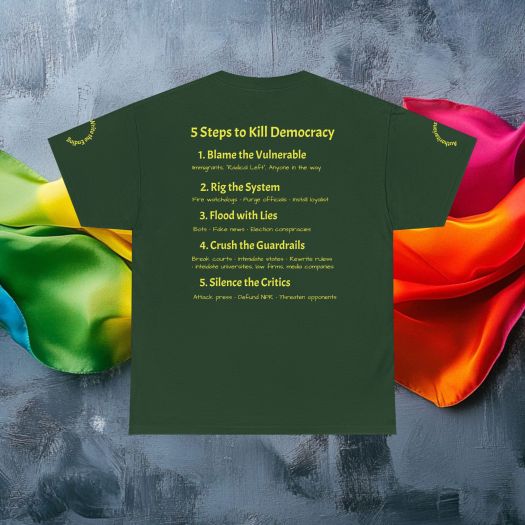
The Manufacturing of Reality: How Power Trains the Mind, Before It Takes the State & Now

Mind Capture & Balance vs Incoherence

Before power captures institutions, it captures perception.

Democracy does not collapse in a single dramatic seizure. It erodes when citizens no longer share a coherent reality. When people inhabit different informational worlds, self-government becomes nearly impossible.

This is not accidental. It is engineered.

And it begins in the mind.

In psychology, apperception describes how new information is absorbed through existing mental frameworks. We do not see the world as it is. We see it through the models we have already built. Every experience is filtered, interpreted, and woven into prior belief.

When those mental models are distorted, reality itself becomes pliable.

The defining political struggle of our era is not merely about laws or elections. It is about perception.

What happens to democracy when perception itself is privatized?

The Manufacturing of Reality: Social Media Is Training Us to Obey

We Already Perceive Only a Fraction of the Manufactured Reality Swirling Around Us

Modern physics offers a humbling insight: human perception is inherently partial.

Quantum mechanics reveals that observation affects what is observed. String theory proposes that what we experience may be a thin “brane” floating within a far larger “bulk” of dimensions beyond our sensory reach. Whether one takes these models literally or metaphorically, the lesson is clear: reality is deeper and more complex than our immediate awareness.

We are always navigating a thin perceptual membrane stretched across something vastly larger.

Healthy societies expand that membrane. They cultivate curiosity, humility, and cognitive flexibility. They encourage citizens to refine their models of reality as new information emerges.

But what happens when the informational environment becomes saturated with noise?

Instead of expanding perception, we flood it.

Twenty-four-hour media cycles. Algorithmic reinforcement. Outrage as currency. Endless scroll. Contradiction layered upon contradiction.

When the signal-to-noise ratio collapses, people do not become more discerning.

They become fatigued.

And fatigue narrows perception.

The Manufacturing of Reality: Image from Another Reality Is Leaking into Ours

Lenin: Capture the Narrative First (The Manufacturing of Reality Is Old)

Vladimir Lenin understood that revolutions are won in the realm of narrative before they are secured in the realm of governance.

Control the story, and you control interpretation. Control interpretation, and you shape allegiance.

If every event is filtered through a single ideological lens, complexity disappears. Alternative explanations become suspect. Dissent becomes betrayal.

Once perception is reorganized, resistance feels irrational. The new order feels inevitable.

The first victory is cognitive.


Hitler: Replace Reality with Myth (The Manufacturing of Reality Is Repetitive)

Adolf Hitler refined this strategy by fusing mythic identity with grievance.

Hero. Enemy. Betrayal. Destiny.

These are archetypal structures. They bypass analytical reasoning and move directly into emotional circuitry. Facts lose relevance because belonging becomes paramount.

Myth simplifies a chaotic world. It offers clarity where complexity feels overwhelming. It offers identity where economic instability erodes dignity.

When myth overtakes shared reality, institutions weaken. Courts, legislatures, journalism — these depend on a baseline agreement about what is real. Remove that baseline, and democratic structure becomes hollow.

Hitler's Bunker
The Manufacturing of Reality: Hitler’s Bunker (Remind you of anyone today obsessed with death, destruction, and bunkers?)

Trump: Saturation as Strategy (The Manufacturing of Reality: Still Happening Now)

Donald Trump operates in a different media ecosystem — one defined not by centralized propaganda but by fragmentation and saturation.

The strategy is not uniformity.

It is overload.

Constant statements. Contradictions. Provocations. Breaking news layered upon breaking news. The informational field becomes so dense that evaluation becomes exhausting.

When everything demands attention, sustained attention collapses.

Exhaustion becomes compliance.

This is not merely personality or spectacle. It is perceptual warfare in an age where attention is the most valuable commodity.

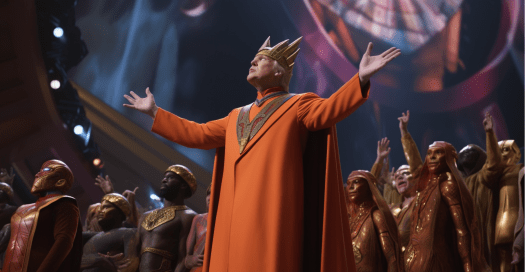
The Manufacturing of Reality: Little King Trump

Economic Stress Narrows the Mind, an Essential Ingredient in the Manufacturing of Reality

Economic precarity intensifies this dynamic.

Research on scarcity shows that when individuals are preoccupied with financial insecurity, cognitive bandwidth shrinks. Immediate survival crowds out long-term reasoning. Abstract policy debates lose urgency compared to rent, food, healthcare.

Under chronic stress:

  • Simplified narratives feel stabilizing.
  • Strong leaders feel clarifying.
  • Identifiable enemies feel grounding.

The mind narrows because it must.

A narrowed mind is easier to guide.

This is not a moral failing. It is a cognitive reality.

And it makes perceptual manipulation more effective.

The Manufacturing of Reality: Always Involves Corruption and Income Inequality

The Loss of Interior Expansion

There was a time in Western intellectual history when alternative cosmologies emphasized interior awakening. Early Gnostic traditions, later marginalized and pruned from orthodoxy, suggested that reality is layered — and that human beings possess the capacity to awaken beyond surface appearances.

Whether one accepts those metaphysics literally is beside the point.

Psychologically, such traditions cultivated depth. They encouraged inward exploration alongside outward structure.

Much of Western civilization instead consolidated around more hierarchical metaphysical models: authority centralized, truth mediated, salvation externalized. Over centuries, this narrowed the manuscript of the mind.

In a universe that physics now describes as multidimensional and probabilistic, our cultural habits often remain rigid and binary.

We stare at the brane and forget the bulk.

The Manufacturing of Reality: Inner Space

The Privatization of Perception, Critical Ingredient in the Manufacturing of Reality

Today, perception is no longer shaped only by culture, family, or local community.

It is curated.

Algorithms — owned and operated by private corporations — determine what rises into visibility and what sinks into obscurity. They optimize for engagement, not coherence. For emotional activation, not contemplative depth.

The result is fragmentation.

Different citizens inhabit different informational universes. Shared reference points dissolve. A common civic narrative becomes difficult to sustain.

Democracy requires an informational commons. It requires enough overlap in perception that disagreement can occur within a shared frame.

When perception itself is privatized, the commons erodes.

The danger is not disagreement.

The danger is epistemic isolation.

an illustration of a person s mind -- thinking
The Manufacturing of Reality: The Art of Confusion

Noise Versus Signal, You Must Know the Different to Avoid Getting Caught Up in the Manufacturing of Reality

The deeper cost of this manufactured reality is not simply political instability.

It is human diminishment.

When attention is perpetually captured, individuals lose access to their own interior signal. Reflection is replaced by reaction. Depth is replaced by immediacy.

Discoherent noise overwhelms the perceptual membrane.

And when that happens, people forget who they are — and what they are capable of becoming.

Democracy is not sustained by outrage alone. It is sustained by citizens capable of sustained thought, capable of soft focus, capable of seeing beyond the immediate stimulus.

In martial arts, instructors speak of using “soft eyes” — widening the field of vision rather than locking onto a single threat. Soft eyes allow you to perceive the whole field.

Hard focus is useful in crisis.

But permanent hard focus leads to blindness.

A society trapped in permanent hard focus — outrage, fear, reaction — loses its depth perception.

Machine, Machine Man, Corporate Greed, Gears, Endless Profit, Profit Over People
The Manufacturing of Reality: Ordinary People Trapped In a Rage Machine and Economic Deprivation

Expanding the Perceptual Field

The defense of democracy is inseparable from the defense of consciousness.

This does not require ideological conformity. It requires cognitive expansion.

Strengthening apperception rather than surrendering it.
Restoring signal amid noise.
Reclaiming interior depth in a saturated world.
Widening the brane.

Power trains the mind before it takes the state. It reshapes narrative before it reshapes law. It narrows perception before it narrows rights.

The counter-movement must therefore begin in perception as well.

Slow down the feed.
Diversify sources.
Engage opposing arguments without caricature.
Create spaces for sustained conversation.
Practice soft eyes.

Because the most radical act in an age of manufactured reality may be this:

To expand your awareness rather than contract it.

Democracy depends on citizens who can tolerate complexity without fleeing into myth. Citizens who can endure uncertainty without surrendering to authoritarian clarity. Citizens who recognize that their perception is partial — and who remain willing to refine it.

We inhabit only a fraction of reality.

The question is whether we will allow that fraction to be engineered for us.

Or whether we will widen it ourselves.

Before power captures the state, it captures the mind.

The preservation of democracy begins by reclaiming it.

The Manufacturing of Reality: Visualization of Mind and Thought as Resonance and Waves

The Manufacturing of Reality: Feature Archetypal Animation

Music: Pulse of the Feed 03:10 StabilityMid-tempo (80–95 BPM) cinematic ambient electronica with pulsing synth bass, soft glitch percussion, airy pads, and sparse piano motifs. Minor-key harmony with subtle tension, occasional filtered risers, no flashy solos. Mood: investigative, uneasy, reflective—building toward clarity and resolve.

Images created with Genolve.

Absolute Power Corrupts Absolutely: From Caligula to Trump to Now

Caligula, A Mad Emperor Like Trump

Absolute Power Corrupts Absolutely: From Caligula to the Modern Elite

Modern Moral Lesson on How Absolute Power Corrupts Absolutely

History does not repeat because people fail to learn moral lessons. But the old adage of Absolute Power Corrupts Absolutely, will this one repeats quite often throughout history in so many different ways.

It repeats because power erodes perception.

Caligula’s reign demonstrates a crucial truth that is often misunderstood: absolute power does not merely corrupt ethics—it destroys reality testing. Once a ruler is no longer constrained by consequence, contradiction, or accountability, other human beings cease to register as fully real. They become props, symbols, or game pieces in a private psychological theater.

Shared reality becomes unmoored from the common laws, rules, and safeguards we all agree upon to live in a safe and civil society. When some among us can ride through time without accountability… they do in a sense become mad gods unmoored by the shared rules of a civil society.

Caligula’s cruelty was not random. It was performative. Executions, humiliations, sexual transgressions, and public desecrations were not simply acts of violence—they were experiments. Each act tested the same question: Will they still obey?

Absolute Power Corrupts Absolutely: From Caligula to the Modern Elite | Coercive Auction of Stolen Property So Caligula Could Restore the State’s Bankrupted Funds

They did.

Rome’s greatest failure was not Caligula’s madness, but the system’s inability—or refusal—to extract corruption once it became undeniable. Senators, priests, generals, and bureaucrats recognized the danger. Yet obedience persisted. Even when elite families were targeted, even when norms collapsed, even when fear replaced law, the machinery of empire continued to function.

That is the true warning.

The Modern Parallel to Absolute Power Corrupts Absolutely

Modern civilization does not crown emperors. It manufactures immunity.

Extreme concentrations of wealth and influence now produce a condition structurally similar to imperial absolutism: insulation from consequence, privatized reality, and social systems trained to preserve stability at all costs. Courts, corporations, political parties, media ecosystems, and financial institutions often function less as safeguards than as buffers—absorbing shocks without correcting root corruption.

Recent, well-documented elite exploitation scandals reveal this pattern with disturbing clarity. The details vary, but the structure is consistent:
• Transgression escalates under conditions of immunity
• Complicity spreads through silence and shared risk
• Blackmail becomes a stabilizing force
• Institutions protect continuity over truth

The issue is not individual depravity alone. History is full of cruel individuals. The danger emerges when systems reward obedience over integrity, and when power is so insulated that even grotesque violations fail to trigger removal.

This is where Caligula becomes contemporary.

Not because modern elites are emperors—but because the psychology of unchecked power has not changed. Extreme wealth produces boredom. Boredom seeks intensity. Intensity erodes empathy. Empathy loss enables dehumanization. Dehumanization demands silence. Silence becomes loyalty.

Alan Watts warned—echoing Buddhist psychology—that the unchecked pursuit of pleasure does not lead to joy, but to the Naraka world: a psychological hell defined not by punishment, but by endless appetite without meaning. Sensation must escalate because nothing satisfies. Others cease to exist except as stimuli.

Caligula reached that place early.

Modern systems risk normalizing it.

The question is no longer whether ruthless rulers will emerge.

The question is whether civilizations can still recognize corruption before obedience replaces humanity.

Briefing Doc: Caligula & How Absolute Power Corrupts Absolutely

The Principate of Gaius Caligula: Power, Excess, and the Stoic Response

Executive Summary

The reign of Gaius Caesar Augustus Germanicus, famously known as Caligula (r. AD 37–41), represents a pivotal and tumultuous era in the early Roman Empire. Initially greeted with universal jubilation as the son of the beloved general Germanicus, Caligula’s four-year tenure rapidly transitioned from a “Golden Age” of prosperity to a period defined by extreme self-indulgence, fiscal crisis, and alleged madness. Key themes of his reign include the expansion of unconstrained imperial power, a strained relationship with the Roman Senate, and a move toward divine autocracy.

This briefing document synthesizes historical accounts of Caligula’s rise and fall, his ambitious construction projects, his controversial provincial policies, and the contemporary philosophical response led by Seneca the Younger. Ultimately, Caligula’s assassination in AD 41 by the Praetorian Guard marked the end of the first direct male line of the Julii Caesares and served as a catalyst for Seneca’s Stoic meditations on the destructive nature of unrestrained anger and power.

Little Boot -- Caligula
Absolute Power Corrupts Absolutely: From Caligula to the Modern Elite | Born to the Purple: Origin of Little Boot

I. Early Life and the Rise to Power

Lineage and the “Little Boot”

Born in AD 12 to Germanicus and Agrippina the Elder, Gaius was a member of the prestigious Julio-Claudian dynasty, descended from Augustus and Mark Antony.

• The Mascotte: As a child, he accompanied his father on Germanic campaigns. His mother dressed him in a miniature soldier’s outfit, including heavy army boots (caligae). The troops affectionately nicknamed him “Caligula” (meaning “little boot”), a name he reportedly grew to dislike.

• Family Tragedy: Following Germanicus’s death in AD 19, his family became embroiled in a bitter feud with Emperor Tiberius. Caligula’s mother and brothers were eventually exiled and died in prison, leaving Caligula as the sole male survivor of his immediate family.

Survival on Capri

In AD 31, Caligula was summoned to Capri to live with the aging, paranoid Tiberius.

• Dissimulation: To survive, Caligula masked his resentment behind an obsequious manner. Observers noted that there was never “a better slave or a worse master.”

• Accession: Upon Tiberius’s death in AD 37 (which some rumors suggest Caligula hastened with the help of the Praetorian prefect Macro), Caligula was proclaimed emperor at age 24.

Brief Golden Age Caligula
Absolute Power Corrupts Absolutely: From Caligula to the Modern Elite | The New Hope (37AD): A Brief Golden Age

II. The Early Reign: The “Golden Age”

New Sun Caligula
Absolute Power Corrupts Absolutely: From Caligula to the Modern Elite | New Sun Cult and Seven Months of Joy

Caligula’s first seven months were characterized by widespread popularity and community-spirited reform.

• Public Generosity: He distributed massive gratitude payments to the Praetorian Guard, city troops, and ordinary citizens.

• Legal Reforms: He restored the right of popular assemblies to elect magistrates, lifted censorship, and published accounts of public funds.

• Filial Piety: He interred the ashes of his mother and brothers in the Mausoleum of Augustus and granted extraordinary honors to his sisters, particularly Julia Drusilla.

Turning Point Caligula
Absolute Power Corrupts Absolutely: From Caligula to the Modern Elite | Turning Point: Sickness and Grief

III. The Transition to Tyranny

Historians, including Philo and Suetonius, point to a serious illness in late AD 37 as a turning point in Caligula’s character.

Cruelty and Purges

• Elimination of Rivals: Following his recovery, Caligula ordered the forced suicide of Tiberius Gemellus (his adopted son and heir) and Macro (the prefect who secured his throne).

Caligula
Absolute Power Corrupts Absolutely: From Caligula to the Modern Elite| Death of Heirs of Caligula

• Hostility toward the Senate: He openly humiliated the senatorial class, forcing them to run miles beside his chariot or stripping them of ancestral honors.

Break with Senate Caligula
Absolute Power Corrupts Absolutely: From Caligula to the Modern Elite | Break with Senate: Transition from Princeps to Autocrate (39 AD)

• The Incitatus Affair: In a gesture of contempt for the consulship, he reportedly proposed making his favorite racehorse, Incitatus, a consul.

Caligula's horse
Absolute Power Corrupts Absolutely: From Caligula to the Modern Elite | The Horse and the Bridge & Incitatus the Consul

Claims of Divinity

Caligula sought to transcend the traditional role of princeps to become a living god.

Living God Caligula
Absolute Power Corrupts Absolutely: From Caligula to the Modern Elite | Living God: Madness or Monarchy

• Impersonations: He reportedly appeared in public costumed as Hercules, Mercury, Venus, and Apollo.

Caligula Dressed as Gods
Absolute Power Corrupts Absolutely: From Caligula to the Modern Elite | Caligula Dressed Up as Gods such as Hercules, Mercury, Venus

• The Imperial Cult: He established a temple to his own genius on the Palatine and attempted to have a colossal statue of himself as Zeus installed in the Temple of Jerusalem, a move that sparked intense Jewish resistance.

Caligula Desecration of Temple
Absolute Power Corrupts Absolutely: From Caligula to the Modern Elite | Desecration of Jewish Temple

• Sun-God Imagery: Provincial coinage and inscriptions occasionally hailed him as the “New Sun” (Neos Helios).

New Sun Caligula
| Neos Helios | New SunAbsolute Power Corrupts Absolutely: From Caligula to the Modern EliteNeos Helios | New Sun

IV. Public Works and Economic Crisis

Caligula’s reign was marked by grandiose and often wasteful expenditures that exhausted the state treasury.

Major Construction Projects

ProjectDescription
AqueductsBegan construction of the Aqua Claudia and Anio Novus to meet Rome’s water needs.
Bridge at BaiaeA temporary two-mile floating bridge of ships across the Bay of Baiae, earth-paved for a ceremonial crossing.
Nemi ShipsTwo massive, elaborate floating palaces with marble floors and plumbing.
Vatican ObeliskTransported an Egyptian obelisk on a purpose-built ship using 120,000 modi of lentils as ballast.

Fiscal Desperation and Taxation

By AD 39, the treasury (amassing 2.7 billion sesterces under Tiberius) was depleted. Caligula responded with:

• New Taxes: Levies on lawsuits, weddings, and a notorious tax on the earnings of prostitutes.

• Confiscations: Falsely accusing wealthy citizens of treason to seize their estates.

• Auctions: Forcing nobles to bid exorbitant prices for his sisters’ jewellery and palace furnishings at public auctions.

V. Provincial and Military Affairs

Caligula’s military record was largely viewed as ignominious by contemporary historians, though modern interpretations are more nuanced.

• Mauretania: He annexed the client kingdom after executing its ruler, Ptolemy, leading to a local uprising.

• Britannia: He planned an invasion that famously resulted in his troops being ordered to collect seashells as “spoils of the sea,” though some suggest this was a training exercise or a misunderstanding of the term musculi (siege engines).

Roman Soldiers Collecting Seashells Caligula
Absolute Power Corrupts Absolutely: From Caligula to the Modern Elite | Roman Soldiers Collecting Seashells

• Germany: He conducted operations along the Rhine, though ancient sources dismiss these as poorly prepared or fabricated for glory.

VI. The Philosophical Response: Seneca the Younger

The philosopher Seneca witnessed Caligula’s reign from the Senate and used the experience to inform his Stoic writings, particularly On Anger (De Ira).

Anger as “Madness”

Seneca defined anger as a temporary madness and a “misevaluation” of worthless things. He cited Caligula as the ultimate negative exemplar:

Ira Caligula
Ira — Wrath, rage or fury. A passion as a kind of madness.

• The Monster: Seneca consistently depicted Caligula as a “cruel tyrant” and a “monster” whose unrestrained wrath endangered the state.

Caligula's Ira vs Seneca's Stoicism
Caligula’s Ira vs Seneca’s Stoicism

• The Sadistic Host: Seneca recounts Caligula executing a man’s son and immediately inviting the grieving father to dinner, forcing him to act joyfully under threat of death.

Caligula's Cruel dinner
Cruel Dinner Party | Caligula’s Executes Elite’s Son Then Forces Him to Drink Wine and Smile at a Dinner Party the Same Night

• Envy of Intellect: Caligula reportedly wanted Seneca killed because he envied his oratorical success, dismissing Seneca’s style as “sand without lime.”

Caligula
Caligula Wanted Seneca Dead

Stoic Remedies

Seneca argued that spiritual health requires the complete rejection of anger. He advocated for:

• Mutual Leniency: A social contract based on the acknowledgment that all humans are fallible.

• Introspection: Daily reviews of one’s ethical choices to maintain the sovereignty of reason.

VII. Assassination and Aftermath — the Fate of Absolute Power Corrupts Absolutely

On January 24, AD 41, Caligula’s reign ended violently.

• The Conspiracy: A small group of Praetorian tribunes, led by Cassius Chaerea, accosted the Emperor in a narrow corridor beneath the palace. Chaerea was motivated by personal insults—Caligula often mocked his voice and gave him ribald watchwords like “Priapus.”

Caligula's Death
Absolute Power Corrupts Absolutely: From Caligula to the Modern Elite | Caligula was Ambush by His Own Guardsmen

• The Murder: Caligula was stabbed 30 times. His wife, Caesonia, and daughter, Julia Drusilla, were also murdered shortly thereafter.

Caligula's Death
Caligula Was Stabbed 30 Times

• Succession: While some senators hoped to restore the Republic, the Praetorian Guard spontaneously chose Caligula’s uncle, Claudius, as the next emperor.

Claudius after Caligula
Absolute Power Corrupts Absolutely: From Caligula to the Modern Elite| Claudius Chosen by Army to Rule

VIII. Key Historical Quotes | Absolute Power Corrupts Absolutely

• On Absolute Power: “Let them hate me, so long as they fear me.” (Attributed to Caligula in literary tradition)

• On the Roman People: “Would the Roman people have but one neck!” (Attributed to Caligula)

• On Caligula’s Nature: “I am nursing a viper in Rome’s bosom.” (Tiberius, regarding the young Caligula)

• On Anger: “Your anger is a kind of madness, because you set a high price on worthless things.” (Seneca the Younger, De Ira)

• On Caligula’s Divinity: “I have existed from the morning of the world, and I shall exist until the last star falls from the night.” (Malcolm McDowell’s cinematic depiction)

Caligula: Political Case Study of How Absolute Power Corrupts Absolutely

Absolute Power Corrupts Absolutely: From Caligula to the Modern Elite

The Architecture of Absolute Power: A Case Study on the Erosion of Constitutional Norms under Caligula

1. Introduction: The Fragility of the Augustan Principate

The Roman Principate, as architected by Augustus, functioned as a masterclass in political theater. Its foundation rested on the primus inter pares (“first among equals”) model—a calculated facade designed to wrap absolute autocratic power in the comforting imagery of Republican tradition. By maintaining the illusion that the Senate and the Roman people remained the ultimate repositories of authority, Augustus achieved a durable stability. However, this system contained a fatal structural vulnerability: it relied entirely upon the “personal responsibility and self-restraint” of a single executive rather than fixed legal constraints.

Caligula’s reign (AD 37–41) was not merely a descent into personal madness; it was a structural stress test that exposed the total collapse of Roman republican checks and balances. When the executive decided to strip away the Augustan mask, the institutional framework proved incapable of resistance. This trajectory toward unconstrained authority was accelerated by the immense political capital of his father, Germanicus; the popular general’s legacy provided the initial momentum for a transition that would eventually render the Senate obsolete and the military the sole arbiter of the state.

2. The Accession: Consensus as a Tool for Legal Consolidation

The transition of power in AD 37 represented a radical departure from the gradual accumulation of authority seen under Augustus. While previous rulers maintained a show of reluctance, the twenty-five-year-old Gaius was granted the full spectrum of imperial authority—the lex de imperio—in a single legislative act. This immediate consolidation effectively neutralized the Senate’s ability to negotiate or impose future constraints.

The Mechanics of Early Accession

Legal ActionStated Intent (Public Relations)Structural Impact (Autocratic Shift)
Annulment of Tiberius’s WillClaimed Tiberius was of unsound mind to name the minor Gemellus as co-heir.Removed the internal dynastic check of a co-heir, consolidating sole authority.
Doubling of Praetorian BonusesA gesture of filial respect to fulfill and exceed Tiberius’s final wishes.Shifted military loyalty from the state to the person of the Emperor.
Immediate Grant of PowersA response to the “consensus of the three orders” (Senate, Equites, People).Stripped the Senate of future leverage by granting absolute power without a probationary period.

The Senate’s ecstatic reception and immediate ratification of these powers were driven by a desperate desire for a “Golden Age” following the reclusive Tiberius. By surrendering their authority so completely in a moment of popular euphoria, the aristocratic class effectively disarmed themselves. This paved the way for administrative reforms that initially suggested a civic renewal but soon pivoted toward unconstrained authority.

3. The Dismantling of Countervailing Powers: Senate and Law

To centralize power, Gaius recognized the need to diminish the Senate as a deliberative body. He pivoted to a strategy of psychological warfare to neutralize the aristocratic class. A primary weapon was the “Weaponization of Memory.” Although he initially made a public show of burning Tiberius’s secret records to signal a restoration of legal security, he later revealed he had preserved the files. He used these archives as a form of ancient “kompromat,” confronting senators with their past servility and the names of the delatores (informers) who had betrayed their peers. This converted the archival state into a psychological weapon, ensuring total senatorial paralysis.

Even the most infamous anecdotes of the reign, such as the supposed promotion of his horse Incitatus to the consulship, must be viewed through a strategic lens. This was not insanity, but a darkly humorous insult intended to ridicule the highest aristocratic ambitions. By suggesting a beast was fit for the office, Gaius signaled that the consulship, and the elite who craved it, were fundamentally meaningless. This systemic humiliation was even applied to his own family; the “Plot of the Three Daggers” involving his sisters Agrippina and Livilla and his brother-in-law Lepidus demonstrated that even the domus Caesaris offered no countervailing safety.

Methods of Senatorial Humiliation:

• The Archival State: Reviving maiestas (treason) investigations based on “destroyed” records to ensure compliance.

• Forced Suicides: Systematically removing elder statesmen like Marcus Junius Silanus to eliminate traditionalist voices.

• Physical Degradation: Requiring consular-rank senators to run for miles alongside the imperial chariot or serve at the imperial table as common slaves.

• Erasure of Lineage: Stripping members of ancient families of inherited honors to ensure the Emperor remained the sole source of dignity.

This degradation of political status served a pragmatic purpose: it broke the elite’s spirit before Gaius turned toward predatory methods of funding the state.

4. Predatory Fiscal Policy and the Exhaustion of the Treasury

In a centralized system, financial solvency is the bedrock of political stability. Gaius inherited a surplus of 2.7 billion sesterces, but his extravagant spending—notably on the two-mile floating bridge at Baiae—precipitated a financial crisis by AD 39. To address the deficit, the Emperor transitioned from a benefactor to a predator, utilizing the legal system for resource extraction.

Mechanisms of State Confiscation:

• New Tax Impositions: Following the abolition of the ducentesima (0.5% sales tax), Gaius introduced predatory levies on taverns, artisans, weddings, and a notorious tax on prostitutes’ earnings.

• The Militarization of Revenue: Deploying the Praetorian Guard as tax collectors, a move that fundamentally changed the military’s relationship with the civilian population and signaled a shift toward military autocracy.

• Seizure of Wills: Setting aside the wills of centurions and wealthy citizens who failed to name the Emperor as a primary beneficiary, labeling them “ungrateful.”

• The Lugdunum Auctions: Gaius personally acted as auctioneer in Gaul. While the first auction (of his sisters’ property) was predatory, the second (of palace furnishings) saw him adopt the persona of a benevolent princeps, using his status to maximize revenue through “voluntary” high bids from the elite.

This unconstrained resource extraction was mirrored in the Emperor’s demand for spiritual authority, positioning himself as the ultimate arbiter of Roman life.

5. The Imperial Cult: Divinity as the Ultimate Autocratic Tool

Gaius recognized a strategic difference between the traditional “veneration of the genius” (the Emperor’s guiding spirit) and the demand for recognition as a living god. By claiming divinity, he sought to place his actions beyond human law and pietas (traditional duty). While scholars debate if his deity impersonations—Jupiter, Mercury, and Venus—were “theatrical fancy-dress” or “private pantomime,” their impact was consistent: they shattered the traditional religious consensus.

This demand for divinity sparked a major geopolitical crisis in Judaea and Alexandria. The decree to install a statue of himself in the Jerusalem Temple transformed a local religious issue into a “blasphemy” that risked the stability of the grain supply, as Jewish producers threatened to abandon their harvests in protest. Philo’s account of the “Embassy to Gaius” highlights the hostile nature of this court; at the Gardens of Maecenas, the Emperor ignored the delegates’ petitions to inspect buildings and mock their faith, treating serious diplomacy as a farce. Ultimately, these claims of divinity alienated the very security apparatus tasked with his safety.

6. Institutional Failure and the “Assassination Check”

The tragedy of the Roman constitutional erosion was that the system provided no legal “exit ramp” for a failing executive. When impeachment mechanisms are absent, violence becomes a constitutional necessity. On January 24, 41, this structural failure reached its conclusion in the cryptoporticus of the Palatine Hill.

The conspiracy was led by the Praetorian tribune Cassius Chaerea. While historical accounts credit him with noble Republican idealism, his primary motivation was a response to Caligula’s routine personal insults. By giving Chaerea watchwords like “Venus” or “Priapus” (referring to his voice), the Emperor had systematically sought to emasculate his own security apparatus. This tactical error proved fatal.

Post-Assassination Systemic Failures:

1. Senate’s Futile Restoration: The Senate attempted to restore the Republic, but their lack of a cohesive military plan rendered their deliberations irrelevant.

2. Praetorian Arbitrage: The Guard “spontaneously” discovered Claudius and proclaimed him Emperor, reaffirming that the military was the true arbiter of power.

3. The New Reality: The transition proved that the state was no longer a partnership between the Senate and the Princeps, but a military autocracy.

7. Contemporary Critique: The Insights of Seneca and Philo

The historical narrative of Caligula is shaped by contemporary accounts that used stories of “insanity” as a tool of political culture to explain poor government.

Seneca the Younger, in On Anger (De Ira), utilized Gaius as a “monster” and a “wisdom-less exemplar” to argue that without Stoic self-control, absolute power is a destructive madness. To Seneca, Caligula was the embodiment of the “high cost of unrestrained wrath.”

Philo of Alexandria, in his Embassy to Gaius, documented the farcical nature of the imperial court, portraying a narcissistic ruler who viewed his subjects with “especial suspicion.” Together, these accounts established the “mad emperor” archetype, serving as a warning to future generations about the volatility of centralized authority.

8. Conclusion: Risks of Centralized Authority in Volatile Systems

The transition from Augustus to Caligula demonstrates that without formal institutional checks, the stability of the state is entirely hostage to the psychological health of the executive. When the “self-restraint” of the ruler vanishes, the state itself is placed at risk.

Strategic Takeaways:

1. The Illusion of Restoration: Early “community-spirited” gestures—such as the abolition of the ducentesima—can mask the systematic dismantling of legal norms.

2. The Weaponization of Humiliation: Demeaning elite institutions ensures temporary compliance but guarantees long-term conspiracy. Humiliating one’s own security officers with watchwords like “Priapus” is a strategic blunder that invites regicide.

3. The Military as Final Arbiter: Once the Praetorians are used as “forceful” tax collectors, the revenue stream is militarized, and the Guard becomes the master of the state.

Ultimately, the reign of Gaius stands as a testament to the “high cost of unrestrained wrath” and the fragility of a constitution that exists only in the shadow of a single man’s will.

Absolute Power Corrupts Absolutely: From Caligula to the Modern Elite, a deep dive.

Caligula: Governance Ethics Whitepaper

The Stoic Advisor: Navigating High-Risk Leadership Through Senecan Ethics

1. The Volatility Landscape: Lessons from the Caligulan Principate

In the theater of executive governance, the transition from a “Golden Age” to institutional collapse can occur with terrifying speed. Our audit of the Caligulan era reveals the “Fiendish Flip”—a catastrophic pivot where a leader moves from perceived benevolence to arbitrary terror. Caligula’s accession was initially hailed by contemporaries like Philo as a return to fairness and community spirit. However, following his recovery from illness in AD 37, the environment devolved into a nightmare of unpredictable cruelty. For the modern advisor, recognizing this shift is not merely a historical exercise; it is the primary prerequisite for ethical survival. When a leader’s disposition becomes sadistic and extravagant, the advisor must transition from policy guidance to high-stakes psychological containment.

The specific behavioral triggers of high-risk leadership identify the moment when the “rule of law” is discarded for the “rule of whim.” When the illusion of the leader as primus inter pares (first among equals) fails, rational institutional planning becomes impossible.

Markers of Institutional Instability

• Financial Excess: The reckless squandering of an inherited fortune—specifically the 2.7 billion sesterces amassed by Tiberius—within a single year. This rapid depletion of the treasury necessitates subsequent reliance on the confiscation of private estates and the imposition of petty taxes to fund grandiose, wasteful projects.

• Contempt for the Elite: The systematic humiliation of institutional stakeholders. This is exemplified by Caligula forcing senior senators to run for miles alongside his chariot while he laughed at them, or threatening to elevate his horse, Incitatus, to the consulship to mock the dignity of the office.

• The Claim to Divinity: The total abandonment of mortal limits. When a leader demands worship as a living god, dressing as Mercury or Apollo, they terminate any possibility of bilateral negotiation, effectively replacing professional counsel with theological sycophancy.

These markers signal a total collapse of professional boundaries. When a leader views himself as a deity and the law as an inconvenient suggestion, the environment is defined by arbitrary terror rather than governance. Seneca’s career illustrates how an advisor can maintain a moral center and physical safety during such a collapse through calculated distance.

2. The Advisor’s Paradox: Seneca’s Dual Role as Philosopher and Courtier

Lucius Annaeus Seneca the Younger represents the ultimate archetype of the elite advisor operating under threat. Trained by the School of the Sextii—a rigorous hybrid of Stoicism and Pythagoreanism—Seneca was fundamentally an advocate for reason. However, his survival during the “nightmare of the Caligula years” required him to master the art of the courtier. He narrowly escaped execution when his oratorical brilliance provoked Caligula’s envy, surviving only by projecting an image of such terminal ill health that the emperor assumed nature would soon do the executioner’s work.

Survival in a volatile environment demands that the advisor utilize strategic maneuvers that protect the mission while preserving the self.

Strategic ActionEthical/Survival Outcome
DissimulationAdopting the “no better slave” status while at Capri; masking resentment for the destruction of his family to avoid summary execution.
The Practice of PatienceEnduring eight years of exile on Corsica under Claudius without surrendering to despair, refining philosophy as a tool for endurance.
The Use of ConsolationAuthoring works for Helvia and Polybius to navigate political grief and utilize flattery as a lever for his eventual recall to Rome.
Strategic WithdrawalAttempting to retire in AD 62 and 64 when Nero’s stability failed, recognizing that influence has a terminal expiration date.

Seneca’s leadership reached its zenith during the Quinquennium Neronis—the first five years of Nero’s reign. Partnering with the Praetorian prefect Burrus, Seneca maintained institutional stability by drafting accession speeches that promised a return to legal procedure. However, the Chief Ethicist must recognize that influence is a perishable commodity; the death of Burrus in AD 62 broke Seneca’s power, proving that an advisor requires a tactical partner to survive a leader’s deteriorating psyche. This loss of external control forces a retreat into internal psychotechnologies.

3. Stoic Psychotechnology: Anger Management and the Sovereignty of Reason

For the high-stakes professional, internal self-control is the only reliable defense against a leader’s volatility. Seneca’s De Ira (On Anger) serves as a manual for maintaining professional equilibrium, defining anger as “a kind of madness.” Seneca warns that once rage takes control, it is like “jumping off a cliff”; reason is discarded, and the capacity for virtuous action is lost.

To prevent this descent, the advisor must master the concept of “Misevaluation.” Seneca argues that we rage because we overvalue worthless things. He proposes a “Vastness Stratagem” to expand the mental scale, which we distill into a demanding three-step cognitive audit:

1. Isolate the Trigger: Identify the minor incident, such as a perceived insult to dignity or a professional slight.

2. Apply the Vastness Stratagem: Juxtapose the incident against the immeasurably vast—global climate shifts, collapsing stars, or the sweep of centuries.

3. Evaluate Significance: Realize that the “injury” to one’s pride is hollow when viewed from a cosmic distance. The advisor must learn to draw further back and laugh.

This audit must be supported by “nightly reviews”—tranquil, daily meditations on ethical choices. This practice, termed “care of the self” by Foucault, is a mandatory defensive hygiene for the advisor. It creates a “sovereign space” within the mind that an erratic leader cannot touch. By mastering internal governance, the advisor secures the clarity required to attempt external steerage through the strategic application of mercy.

4. Clemency as a Political Lever: The Ethics of Mercy in High-Stakes Governance

In De Clementia (On Clemency), Seneca utilizes flattery as a sophisticated pedagogical trap. Written as immediate damage control following Nero’s murder of his rival Britannicus, the work was designed to halt the cycle of bloodshed that typically follows state-sponsored violence. Clemency is not portrayed as “kindness,” but as a calculated political lever used to avoid the “arbitrary terror” that eventually led to Caligula’s thirty stab wounds.

The advisor must propose a “Pact of Mutual Leniency” based on three core principles:

1. Universal Fallibility: Accepting that we are “wicked people living among wicked people.”

2. Shared Sin: Recognizing that all are “sinners all, yet all deserving of clemency.”

3. The Social Contract: Understanding that peace is only possible through a mutual agreement to forgive human error.

Seneca’s use of flattery in this context was a pedagogical tool—he praised Nero for virtues the ruler did not yet possess to “trap” him into acting better. By modeling the “Stoic path of virtue,” Seneca attempted to show the ruler a version of himself that was “good, generous, and fair,” hoping the leader would grow into the image provided. However, even the most skilled advisor must prepare for the moment when influence fails.

5. Final Synthesis: The Framework for Ethical Survival

The “Senecan Framework” for professional conduct under risk requires a paradoxical blend of intellectual distance, strategic dissimulation, and rigorous internal inventory. When institutional governance collapses, the only remaining sovereignty is the mind of the advisor.

Professional Conduct Checklist for Absolute Power Corrupts Absolutely

• Draw Further Back and Laugh: Utilize the vastness stratagem to ensure that immediate setbacks or insults do not trigger a loss of reason.

• Prioritize Persistence over Martyrdom: Maintain patience and survival for the sake of the mission. As Seneca noted, “I wanted to avoid the impression that all I could do for loyalty was die.”

• Maintain the ‘Imago Suae Vitae’: Strive to preserve a consistent moral and ethical profile—the “image of one’s life”—that remains untouched by the leader’s volatility.

The legacy of Seneca’s death—the forced suicide in AD 65 where he remained calm, dictated his last words, and died in a warm bath—must be framed as a strategic victory. By maintaining Stoic composure while being suffocated by the steam of the bath, the advisor denied the tyrant the satisfaction of a broken spirit. The enduring value of Stoic self-governance lies here: when institutional governance fails and the “30 stabs” of inevitable betrayal arrive, the advisor remains the master of the only territory that truly matters: the self.

RESOURCES & CITATIONS for Absolute Power Corrupts Absolutely

• Wikipedia: Caligula. (Details on the 2.7 billion sesterces from Tiberius, the “Golden Age,” the shift to tyranny, and the assassination).

• Wikipedia: Seneca the Younger. (Stoic training, role as advisor to Nero, the Quinquennium Neronis, his wealth, and his death).

• Lit Hub: Did Seneca Write a Treatise on Anger. (Analysis of De Ira, the “vastness stratagem,” the “pact of mutual leniency,” and Foucault’s “care of the self”).

• The Little Boot: The Rise and Ruin of Caligula. (Chronology of Caligula’s life, the “Fiendish Flip,” the senators running by the chariot, and the 30 stabs).

Feature Archetypal Animation Music: Absolute Immunity – Buben — [1] Absolute Immunity – Original Mix    6:19

To listen to Caligula: A Mad Emperor Like Trump, see below:

Prediction 2026: Catastrophic Authoritarian Overreach, Happening NOW

Saints Need Sinners & The Year of the Fall

It All Began in 2025: The Year the Masks Slipped

If 2024 cracked the illusion, 2025 tore it open. To make a prediction of the future, understanding the past is crucial.

This was the year when power stopped pretending it was benevolent, neutral, or even rational. Across politics, media, technology, and global affairs, institutions abandoned the last remnants of moral language and replaced it with something colder: efficiency, dominance, and narrative control.

Three truths became unavoidable in 2025:

1. Authoritarianism Stopped Whispering

Strongman politics no longer needed coded language or plausible deniability. Loyalty tests replaced competence. Intellectual friction was treated as treason. History was rewritten openly, not quietly.

What had once been described as “norm erosion” revealed itself as something more direct: a belief that constraint itself is illegitimate.

This wasn’t new—but the denial ended.

This topic was explored in December's blog: A King Like Trump: Herod the Great where the myth of the “necessary ruler” fully replaced the idea of shared governance, in the case of Trump, and for Herod, seeking legitimacy from the people he ruled destroyed him and left the indelible mark on his legacy of the brutal, corrupt king who tried to kill the baby Jesus.
Trump and Herod
Prediction 2026 | A King like Trump: Herod the Great

2. Capitalism’s Shadow Stepped Fully Into the Light

By 2025, neoliberalism could no longer plausibly describe itself as an economic system alone. It revealed itself as a psychological operating system—one that trains individuals to self-optimize, self-blame, and self-erode while power consolidates upward.

Marketing, politics, and identity collapsed into a single feedback loop:

Consume → perform → obey → repeat.

Trumpism was no longer an anomaly. It was recognized—by supporters and critics alike—as capitalism’s shadow made flesh. One stripped of civility, decorum, and restraint and operating without apology.

Prediction 2026 | The Monsters We Choose to Be

3. Consciousness Became the Real Battleground

2025 wasn’t primarily about elections or wars. It was about perception.

Who controls:

  • attention
  • memory
  • fear
  • meaning

Book bans, algorithmic suppression, AI-generated mythmaking, and the quiet erasure of inconvenient voices all pointed to the same conclusion:

Reality itself is now contested territory.

And yet—something else happened.

While power centralized, awareness decentralized. People didn’t suddenly agree, but many began to recognize manipulation as it was happening.


Prediction 2026 & The Counter-Movement No One Could Fully Contain

Prediction 2026 | The Counter-Movement

While power centralized, awareness decentralized.

2025 saw a quiet but unmistakable rise in:

  • whistle-thinkers rather than whistleblowers
  • cross-disciplinary truth tellers
  • elders refusing to be dismissed
  • autistic, sensitive, and highly perceptive minds finally naming what they see

People didn’t suddenly agree—but they began to recognize manipulation when they felt it.

This recognition—uneven, fragile, incomplete—may prove more important than consensus.


2026: Is This the Year of Fracture or Awakening

Prediction 2026 | 2026 will not be a year of stability.

It will be a year of choice.

Because it will be a year of overreach—and reaction.

Here are the patterns already locked in motion:

Prediction #1: Power Will Overreach—Openly

Authoritarian systems always do. The pressure to maintain narrative dominance will produce increasingly absurd contradictions, harsher loyalty demands, and more visible incompetence.

This will wake some people up.
It will radicalize others.
There will be no middle ground left to hide in.

Historically, authoritarian systems do not collapse because they are challenged.

They collapse because they overextend, as we are exploring in my podcast Wisdom Guardians.

As 2026 begins, we are already seeing signs of this dynamic:

  • escalating executive claims unconstrained by Congress or international law
  • rhetoric of regime change treated as casual policy discourse
  • open talk of territorial expansion, annexation, or “running” other nations
  • the normalization of militarized solutions to complex political failures

Whether every threat materializes is almost beside the point.

What matters is this shift:

Power is signaling that it no longer recognizes meaningful limits.

This is not merely “Trump being Trump.” It reflects a deeper fracture: when institutions fail to impose boundaries, leaders test how far reality can be bent before it breaks.

History is clear on what follows.

Such overreach does not produce submission alone. It produces counter-forces:

  • diplomatic isolation
  • internal resistance
  • fractures within alliances
  • destabilization that cannot be fully controlled

The irony of domination is that the harder it grips, the more instability it creates.


Empire, Resources, and the Old Justifications

Drilling down a little deeper on this long established, destructive, historical pattern, the renewed language of regime change and territorial ambition also resurrects an older logic—one the modern world claims to have outgrown.

Resource control.
Strategic necessity.
“Stability.”

These arguments have justified interventions for more than a century. When leaders speak openly about oil, minerals, or strategic territory while dismissing sovereignty and law, they are not innovating. They are repeating a script whose consequences are well documented.

What has changed is not the logic—but the willingness to state it plainly.

That candor may feel powerful in the moment.
It is also how nations drift toward pariah status: not because they lack power, but because they abandon legitimacy.

Prediction #2: AI Will Accelerate Myth—or Meaning

AI in 2026 will be used in two radically different ways:

  • to mass-produce comforting illusions
  • or to reveal patterns humans were never meant to ignore

The danger is not that humans will merge with machines.
The danger is that we will do so without consciousness, repeating domination at a higher speed.

AI isn’t replacing humans.
Rather, humans are surrendering authorship of their inner world to AI and the doctrine of silence commanded by corrupted systems.

Those who treat AI as an oracle will hollow out.

Those who treat it as a partner—within ethical bounds—may sharpen perception rather than surrender it.

Prediction #3: Burnout Will Become Political

Exhaustion is no longer personal—it’s systemic.

By mid-2026, withdrawal, refusal, and non-participation will increasingly function as forms of resistance. Not everyone will protest. Many will simply stop performing obedience.

That quiet refusal will frighten power more than spectacle ever did.


Prediction 2026: The Choice That Remains

Prediction 2026 | 2026 will ask a single, uncomfortable question:

Do you want comfort—or consciousness?

You don’t get both anymore.

The age of plausible deniability is over. The age of spectatorship is ending. What comes next depends not on heroes or rulers—but on whether individuals reclaim their perception, their imagination, and their moral spine.

As I wrote in Sapience: The Moment Is Now:

Survival will not belong to the strongest, the richest, or the loudest—
but to those who can still see clearly while others beg to be told what to believe.

2026 is not the end.

It is the threshold.

Prediction 2026 & January 6

The Unresolved Wound

Prediction 2026 | Animation from January 6, 2022 blog

This blog is published on January 6 for a reason.

Five years ago, a sitting U.S. president incited an attack on the Capitol to overthrow an election he lost. The event was broadcast, documented, and partially prosecuted—yet never fully resolved at the level that matters most: accountability at the top.

Instead:

  • consequences fell unevenly
  • narratives fractured
  • responsibility blurred
  • and justice became selective

When a society fails to metabolize a rupture, it does not disappear. It grows in the shadows and migrates, taking new and more dangerous forms.

Today, we see its echoes:

  • detention without transparency
  • disappearances into bureaucratic systems
  • the erosion of due process for the “undesirable”
  • historical amnesia about our own concentration camps, burn orders, and sanctioned erasures
  • war in Venezuela and Iran as well as threats to Greenland, Canada, Mexico, and the rest of “the Western Hemisphere.”

The comparison to past authoritarian regimes is not a claim of equivalence.

It is a warning about patterns.

Power without accountability behaves similarly across history—no matter the flag.

What will you choose?

Compliance?

or

Pattern-Recognition and Reality-Grounded Action Based on Facts?

Rachel Maddow explores one of the US’s most shocking historical executive orders to round up innocent American Japanese and incarcerate them in concentrate camp-like conditions for years during WWII.

Feature Archetypal Animation for Prediction 2026

Music 1: Masked Reality Echoes 03:10 StabilitySlow tempo, sustained strings, deep synth pads, occasional dissonant piano chords, and subtle percussive pulses create a suspenseful, thought-provoking mood. No solos.

Music 2: Awakening Echoes 03:10 StabilityA slowly evolving, atmospheric electronic piece. Features ethereal synths, deep sub-bass, and subtle percussive textures. Harmony is minor-key, creating a contemplative yet hopeful mood. Tempo is slow, building gradually without explicit solos.

Music 3: 2026 Crossroads 03:10 StabilityA pulsing, low-tempo electronic beat anchors a spacious soundscape. Synthesizer pads swell with a sense of impending tension, occasionally punctuated by a high-pitched, ethereal melody. No solos. Overall mood is introspective and slightly ominous, building to a hopeful resolve.

Music 4: Threshold of Consciousness 03:10 StabilitySlow, pulsing synth pads create an ethereal yet foreboding atmosphere. A minimalist electronic beat underpins a low, resonant bassline. No solos, harmonies are dark and expansive. Mood is contemplative, unsettling.

Supplemental: The Cost of Honesty

Why the HONEST Child Becomes the Family PROBLEM | Scapegoat Trauma

Honesty is not only punished in dysfunctional families, it is punished in dysfunctional and corrupted systems throughout time and history. Watch this video and when it talks about the dysfunctional family system, substitute dysfunctional society, culture, civilization.

We learn how to stay quiet and not rock the boat in our families. Then, we repeat the pattern in our culture and society. The more people punished for being honest, the fewer people who are willing to speak when families, cultures, civilizations take that fatal turn over the edge of reality, which always happens when lopsidedness is not fixed.

Do you see the pattern repeating again?

Do you think we are doomed?

We are when we stand by and say and do nothing.


Here is a knowledgable, intelligent man who once wore the mantle he inherited from his family of dysfunctional beliefs and silence. He became aware of the lies he had been fed by his family and the systems they inhabited.

Listen to his story.

Then, tell me if you think we are still doomed?

This Ph.D. Physical Therapist and Pastor tells how he was taught to believe lies that were meant to keep him unconscious of what is really going on around him. Lies meant to hide from his conscious ability to reason and detect patterns not to see how the authority figures around him are stealing, demeaning, or betraying anyone considered to be below or beneath them.

I have seen this cruelty in action in my own life through my dad’s life and my mother’s. Both had fathers who were pastors. Both spoke up about violence they had experienced in their homes. Both were label the Black Sheep of their families for being honest about what happened to them. Both were punished for it. Both persisted in being honest despite the tremendous cost of connectivity and acceptance by their families. Both suffered lifetime of feeling alone and unaccepted.

These are terrible costs to pay, and when speaking up and being honest in workplaces and social places means you will be fired from your job for speaking truth to power or targeted by unhinged people who threaten to kill you and your family for speaking truth to power… well, you see why so many people choose silence.

And you see that after 5,000 years of civilization, why we have not evolved very much since organizing into super sized collective systems that must find ways to cooperate and get along and share resources.


I write about this stuff in my book Sapience. I even identify Narcissism as an underlying feature of most modern cultures and economic systems. I trace how this characteristic got favorably selected over thousands of years to become the dominate social trait that is awarded in most modern economic systems and societies.

Here is an expert in narcissism describing what happens when a narcissistic person has not checks placed on them by their structures and systems.


3 TERRIFYING Signs the Narcissist Has Turned Into Pure Evil || Dr Ramani || Learn how to recognize when a narcissist crosses the line from manipulation to truly destructive behavior Discover the psychological and emotional warning signs that indicate a narcissist has become dangerous Understand the patterns of cruelty obsession and control that escalate when narcissists act without conscience Explore why extreme narcissistic behavior often stems from unchecked ego insecurity and fear Learn how to protect yourself emotionally and physically when faced with a narcissist showing these terrifying traits This video explains the critical red flags of a narcissist turning evil and how to maintain boundaries safety and emotional resilience

Evil is real and the darkness of narcissistic people who flipped into the grip of their unconsciousness is destructive. These are people who take pleasure in being cruel to others. They are people who actively try to destroy other people and the world. They are individuals who act like a psychological poison you and the world that they have given up living in as a human being.

Dysfunctional families and systems protect Narcissistic people. They become flying monkeys helping to carry out the daily performance of evil and cruelty. These monkeys are the people who have learned to keep quiet, to not notice the patterns, and to most definitely not state or say the obvious thing: This is wrong.

Stephen Miller’s War on Democracy & the Sinking of the USA: Now It’s Too Late

Blueprint of the Dismantlers 

Stephen Miller’s War on Democracy is the muscle behind Russell Vought’s Project 2025 and the Billionaire/Epstein Class greed to get more profit and add more gold to their already heaping piles of gold locked up inside their mansions.

When we examine how democracy is being dismantled in plain sight, the role of Stephen Miller cannot be overstated. A central architect of the MAGA block’s assault on truth, governance and civil society, Miller is steering policies that resemble decapitation of institutional safeguards, rule of law and human rights.

 Stephen Miller’s War on Democracy

The Blueprint

  1. Quotas and raids
    Miller directed U.S. Immigration and Customs Enforcement (ICE) to carry out a minimum of 3,000 arrests per day — a massive escalation from earlier targets. Axios+3Newsweek+3Forbes+3
    He explicitly pressed ICE to carry out raids at places like the parking lots of Home Depot and 7‑Eleven, targeting informal work sites of immigrant day-laborers. The Independent+2The Daily Beast+2
    The effect is chaotic, sweeping and arbitrary — legal and undocumented persons both face the dragnet in what can only be described as helter-skelter.
  2. Brutality and callousness
    Reports reveal a demoralised ICE leadership, fearful of internal e-mail and message monitoring, and under heavy pressure from the White House via Miller to achieve ever-higher numbers. The Independent+1
    These policies echo the darkest impulses of state violence — deploying quotas, forcing enforcement agents into mass operations rather than case-by-case due-process.
  3. Democracy under assault
    Miller is not acting alone. His ally, Russell Vought, is reshaping federal bureaucracy via the Project 2025 agenda, which threatens separation of powers, the independence of agencies and checks and balances. Democracy Now!+2American Civil Liberties Union+2
    The raids, quotas and bureaucratic decapitation serve a larger vision: dismantle the rule-bound state and replace it with an executive-driven, majoritarian apparatus accountable to an insurgent loyalist base.
  4. The irony of the base losing everything
    Meanwhile, the very MAGA followers who cheered the dismantling of “pork government spending” are losing the pillars of social support they depended on — healthcare, rural hospitals, infrastructure, emergency agencies, social security. The “cuts” go into servicing the billionaire class and consolidating power, while those who pledged loyalty lose their safety net.
    Miller and Vought are key instruments in this re-allocation of power away from democratic public institutions and toward oligarchic rule.
 Stephen Miller’s War on Democracy

Why This Matters

  • When enforcement quotas replace discretion, when law becomes spectacle, when bureaucracy is hollowed out — democracy doesn’t just weaken, it dies.
  • Miller’s raids create fear and chaos in blue-states and cities where immigrants live; the strategy sows political polarisation, erodes local autonomy, and fuels authoritarian tactics.
  • Vought’s budget and bureaucracy overhaul steals the tools of accountability and oversight. Together they are the dual heads of the decapitation: Miller hits the people, Vought hits the system.
  • The spectacle of tyranny is dressed up in patriotism, law-and-order rhetoric, and “we’re taking back control” talk — but the control goes right into the pockets of power, not the public.
 Stephen Miller’s War on Democracy

The Takeaway

Don’t be fooled by the bombast. This is not just immigration policy, nor just budget cuts. This is the targeted destruction of democratic reality: of institutions, rights, norms and the story of self-governing people. Miller is a tool of hate, and Vought is the kingpin of dismantling — they are dismantlers in the truest sense: erasing the pillars of freedom while their base bleeds out. It’s time to wake up.

 Stephen Miller’s War on Democracy

Why America is Lost

This is why America is already lost… and may not ever be coming back. Our culture is very, very ill. This video does a very good job telling why.


Stephen Miller’s War on Democracy: Archetypal Animation

Stephen Miller’s brutal ICE blueprint fuels chaos and fear—shredding democracy while MAGA elites profit from the suffering of their base.

Music: Premonition

Who Broke the Timeline? Man, Time, Dueling Busts of Dust & The Latest Ego Wars

Here, one of the central characters travels with his AI companion, Ra, searching for a way to transform human consciousness—before humanity tumbles over the Climate Cliff for a second and final time.

When we last left them, they were grappling with the legacy of Qin Shi Huang, China’s First Emperor—a figure I explored in depth in Wisdom Guardians: Loyalty Over Truth: From Qin Shi Huang to Trump | #7. He didn’t make it into Sapience (too many ruthless rulers, not enough pages), but that’s why the Wisdom Guardians podcast exists: to fill in the gaps, tracing the egos that bent civilizations to their will.

This passage marks the transition from ancient China into the fertile cradle of Mesopotamia—Sumer, Akkad, Babylon—before sweeping to Akhenaten’s Egypt and then back again, through thousands of years of empire building and collapse. And what emerges, when you step back, is sobering: for all our progress, the modern era isn’t nearly as different from those ancient times as we’d like to believe.


The following is an earlier draft of this excerpt from my novel Sapience: The Moment Is Now.

Who Broke the Timeline? Qin to Rome

Who Broke the Timeline? An aerial view of northern Africa, the Arabian Peninsula and the Mediterranean Basin. A new study led by University of Wisconsin–Madison’s John Kutzbach shows that changes in Earth’s orbit, greenhouse gases, and ice sheets influenced the planet’s climate over the last 140,000 years and may have provided wetter, greener corridors at times that permitted human migration out of Africa and into the Middle East. Image courtesy of Google Earth
The lush green mountains of the Qin Empire disappear. Yong Xing-li finds himself standing on a hill overlooking the Isthmus of Suez. The same drying climate that forced the Indo-Aryan tribes further north to migrate and contributed to the Indus valley’s civilization collapse is drying out the lands of Mesopotamia. A vast desert already has northern Africa in its grips forcing most of the native tribes towards the Nile River valley and the Fertile Crescent is destine for the same fate.
Who Broke the Timeline? Field studies in southeastern Morocco, just a few kilometers away from the site of this dust storm, show that electric fields generated by blowing sand boost dust emissions up to 10 times more than expected from wind alone.  PAVLIHA/ISTOCKPHOTO | Science
In the East, a darkness grows. Yong Xing-li wonders if it’s rain. It approaches fast, and he soon sees it is not billowing clouds of rain but rather dust. They move like creatures devouring everything into their dusty darkness. It blots out sun, then swallows Yong Xing-li in its smothering embrace. Finely broken bits of rocks pound his face. It’s hard to breathe. Gasping for air, Yong Xing-li reaches for the kill switch to end the simulation when the swirling dust separates and forms a bubble around him.
Dust pelts the bubble from all directions. There’s no form or shape to anything as if he was swallowed into a static pattern of an old television set. The dust begins to clump by color. Brown dust particles form mountains and high plains. White dust crowns their peaks and creates high, arid lands. Green dust particles settle into valleys with yellow-green dust making high valleys and dark green dust creating low valleys. Blue grains of dust form into long ribbons that tumble from the mountains, meander through the plains and valleys, then empty into seas.
Who Broke the Timeline? Inside the Dueling Dust Storms | Animation: Genolve | Music: Ethereal Oasis – Harmony Horizons – Sensitizer
 The image is clear. This is Mesopotamia. The telltale narrow neck of where the Euphrates and Tigris rivers flow closest together looks like an entrance into Eden from this perspective. And it is. Between these two rivers is a place where everything needed to live is available in great abundance.
Who Broke the Timeline? Ancient Mesopotamian | Teaching Wiki
Who Broke the Timeline? Humans Due to Conscious Awareness Can Change the Color and Course of Consciousness | Image: Genolve
Suddenly, Yong Xing-li all on his own without any help from Ra understands these were the first cities of Sumer, simply from a different perspective. Each one beating to its own unique rhythm, its color, as it grew around its whirl. Just as individual cells clustered together to better meet the needs of daily existence, so too do civilizations. Just as simple creatures evolved digestive tracks to better capture, distribute, and discard energy, so too did civilizations. Their digestive track is simply on a different level of being the one created when man used his focused beam of conscious attention not just to scan for threats and opportunities in the external world but to scan his inner world too.
Who Broke the Timeline? The Invisible Force and Flow of Consciousness | Image: Genolve
Along the banks of the Euphrates, Yong Xing-li watches as colorful whirling clusters form along the river’s edge. To the north, near the narrow neck, yellow, rose, and turquoise whirls grow. To the south, near the mouth, baby blue, orange, and purple swirls grow. He watches as each whirl pulls different colored particles around it into its vortex. Blue particles of water disappear into the vortex. Green particles constantly flow into the whirl vanish. Brown particles dematerialize into the eddy. Red particles are pulled out of all the dominate color patterns dissipate in whirlpools.
Who Broke the Timeline? When Human Consciousness Swirls Together in the Same Direction, Cities and Civilizations Bloom | Image: Genolve
When he did this, a murky plane of unmanifested potential became visible. It is a vast plane full of strange feelings, nebulous dreams, terrifying possibilities, bone-chilling fears, shadowy ideas, half-baked notions, circular ruminations, stifling opinions, rigid convictions, and backwards-looking reflections. Using his beam of focused conscious attention, he could choose actions different than what nature would have made for him through his instinctual responses to happenings in the world. By combining this focused effort with others in this tribe, the collective effort was 10 times, 100 times, 10,000 times more powerful than the work of one man working alone.
Who Broke the Timeline? Choice Is a Consequence of Conscious Awareness | Image: Genolve
The more people used this ability together to accomplish collective action, the more synchronized their inner dialogues grew with everyone else. Talking to oneself is of course thinking. There is a natural beat or rhythm to thinking just as there is to a heartbeat, breathing, or between waking and sleeping states of consciousness. Shared language, customs, and routines synchronize an individual’s thinking rhythm with the group’s rhythm. These group patterns are further colored by flourishes such as local idioms, beloved stories, and the type of humor enjoyed by the people.
Who Broke the Timeline? Ancient City | Image: Genolve
Getting everyone to flow in the same direction is harder, but there are lots of ways to encourage cooperative flow. Routines, rules, and laws are common practices to introduce and enforce conformity and a commonly agreed way of doing things. But far more powerful is shared beliefs. Nothing galvanizes a group of humans faster or stronger than shared beliefs that capture and store the peoples’ collective hopes and dreams as well as their nightmares and fears in a collective reservoir of potential. This reservoir serves as a source of energy upon which everyone can draw as they work together to make their hopes and dreams come true while keeping the fiendish, nightmarish possibilities at bay. Rites and rituals create a powerful spin that keeps everyone moving mostly in the same direction and this spin creates the vortex around which civilizations grow.
Who Broke the Timeline? Swirls of Light — Social Psychological Forces Holding Cities and Civilizations Together | Image: Genolve
Yong Xing-li knows the pale-yellow swirl furthest north near the narrow neck of the Euphrates and Tigris is the Sumerian city of Sippar. It swirls around its patron god Shamash, God of Sun and Light. Borsippa beats to turquoise while twirling around Nabu, God of Writing and Wisdom. Kish thumps to rose while rotating around Zababa, God of the Hunt. Downstream near the mouth of the Euphrates, Ur beats to baby blue while spinning around Nanna, Moon God and King of all Gods. Uruk reverberates to purple while whirling around Inanna, Goddess of Love. Eridu quivers to orange while spiraling around Enki, a trickster god.
Who Broke the Timeline? The Archaeologist
As each city grows bigger, smaller swirls grow and flow inside the bigger swirl creating complicated rosette patterns. From the center of these blooms of civilization emerge the patron god or goddess of each city. They have cow ears or baby goat horns or hair made of wheat emerge, symbols of the collective force that tamed wheat and barley, goats, and cows in service of the people. Buds of civilizations appear up and down the Tigris and Euphrates rivers and between them. Swirls even emerge in the mountains or far from rivers and streams as people unleash their collective intelligence to solve all sorts of problems of survival.
Who Broke the Timeline? Swirls of Light — the Invisible Forces Holding Societies and Civilizations Together | Animation: Genolve |Music: Mesopotamia – Mesopotamia – Rauschhaus
Tendrils of trade, communication, culture, and technology grow between the blooming city-states of Sumer and other newly bloomed civilizations such as the Amorites, Elamites, and Gutians. Shimmering networks of trade and cooperation light up Mesopotamia with the glistening achievements of civilization. But a collective will can manifest evil as well as good. Such collective manifestation is also on par with the power of a God—the wrath of a God. Dark spots of conflict erupt along vital trading routes. Sippar wars with Borsippa. Uruk wars with Kish. At any one point in time during the 2,000 years Sumerian civilization controlled the region, they warred with each other almost as much as they warred with other nearby civilizations who infringed on their resources or land. The gentle, peaceful agrarian Gods and Goddesses who first emerged soon became adept in the art of war and grew fiercer features and powers.
King Sargon of Akkad
Who Broke the Timeline? Sargon The Great King Of Akkad |Ancient Origins
One dark yellow Amorite swirl far to north along the Tigris River grew bigger and bigger. It soon turned its tendrils of trade into ramparts of war conquering Sumer’s rainbow-colored city-states and turning them into the dark yellow beat of king Sargon of Akkad. He is the first of the Sumerian kings, although he was an Amorite who spoke a different language, to conquer all the city-states of Sumer and bringing them under one rule. He is the first to establish an empire in Mesopotamia. The pulse of the Akkadian Empire dominates the Mesopotamia for 200 years.
Changing climate chips away at rigid structures imposed by the Akkadian Empire, which are further weaken by furious Gutians who descend from the Zagros Mountains attacking Akkadian outposts to reclaim their independence. The Empire falls, allowing erratic, unstable independent city-states to return to the Sumerian way.
The Gutian Invasion: What Really Caused the Fall of the Akkadian Empire?
Who Broke the Timeline? The Gutian Invasion: What Really Caused the Fall of the Akkadian Empire? |Ancient Origins
Trading networks reappear, but Sumer is a shadow of itself. New realities of empires mean city-states must learn how to bundle their strengths or fall prey to another ambitious ruler. Broken bits of the Akkadian-speaking empire reassemble into the Assyrians in the north and the Babylonians in the south. Elam forms as a power in the south, the Gutains galvanizes as a power in the east, the Hittites grow into a power in the north, and to the west Canaan and Palestine are forming into powers. And still further west, Egypt is growing as a fierce force that will soon need to be reckoned with.
Major states of the Bronze Age - Assyrians, Hittites, Babylonia, Mitanni, Egypt
Who Broke the Timeline? Major states of the Bronze Age – Assyrians, Hittites, Babylonia, Mitanni, Egypt | The Assyrian Empire and the New Babylonian Empire, Guest Hollow’s Whirlwind World History
Babylon is the first to take control of the Fertile Crescent under Hammurabi’s hand. The Hittites conquer Babylon and extend their control into new territories into Asia Minor while Egypt gobbles up the lower half of the Fertile Crescent extending its empire all the way to the Euphrates River. Sea People attack the Hittites that make them vulnerable to the Assyrians who are rising as a formidable power. The Assyrians conquer the Hittites and the Egyptians too, creating the biggest and most ruthless empire yet. Nebuchadnezzar strikes back, conquering Assyria and claiming its empire for Babylon. Persia led by Cyrus the Great conquers the second Babylon empire, taking Mesopotamia and Egypt as well as adding parts of India and Greek Islands to create the Achaemenid Empire. It is now the biggest empire ever assembled and lasts for almost 600 years until Alexander the Great strikes back. He conquers Persia and claims its massive empire for Macedonian. Desiring even more land, he pushes deeper into India but does not get too far. He dies young and his mighty Macedonian Empire crumbles into smaller warring kingdoms, which leave the civilized western world sitting on the tip of a pin.
Who Broke the Timeline? Hammurabi’s Code and the Dust Storm | Animation: Genolve | Music: Ambient Arabian Oud – Middle Eastern Oud – Rafael Krux
The only way to get more land or resources in this part of the world is to conquer it. In three short centuries, the Roman does precisely that but not without some difficulties. The dust storm obliterates the colorful maps of moving particles, and it is just grey chaos storming around him and darker than ever.
Roman Empire in 117 CE
Who Broke the Timeline? Roman Empire in 117 CE | World History Encyclopedia
Yong Xing-li wonders what Ra plans to show him next or if he will show him anything else. The torrent of raging dust only seems to be growing stronger and darker. It pelts at his bubble shielding him from its abrasive edges that threaten to cut him into millions of tiny pieces as small as the swirling dust all around him. For a moment, he’s not sure if he’s in a dust storm or a deluge of formless, meaningless quanta and his bubble of space rapidly begins to recede.
Ra’s bodiless voice resounds not only in his diminishing bubble but everywhere outside of it. He asks, “Do you ever wonder why man’s timeline starts in the middle?”
Who Broke the Timeline? RA | Image: Genolve
“No Ra,” Yong Xing-li replies growing ever more nervous as his bubble shrinks further and further now little bigger than his own body, “I’ve never really thought about it. Why does it start in the middle?” He pushes ineffectively against the shrinking bubble to no avail. His little universe of calm and orderliness is about to be swallowed by dust when another distinctly different voice resounds that instantly reclaims all his lost standing and his bubble is restored.
Who Broke the Timeline? Talking Busts of Dust | Animation: Genolve | Music: Ambient Alchemy – Ambient Alchemy – Stella Synth
“It’s because of me. It is my story that defined time. It is my story the marks year zero for all of humanity. I made the timeline start in the middle.”
Who Broke the Timeline? Bust of Dust, Caesar | Image: Genolve
As this strange new voice echoes away into the blowing grains of dust, the bust of Julius Caesar forms outside the edge of his bubble glaring at him. This bust of marble is very much alive. Yong Xing-li is very much at a loss of what to do for he has never in his life had to interact with just a head.
Another voice booms in the howling dust: “No, it is because of me. I am the one who put Spartacus down and nailed him and his 6,000 men to crosses along the Appain Way. I am the one who saved Rome from free fall. It is my story that defines time and divided it into before and after.”
Bust found in the Licinian Tombs in Rome, traditionally identified as Crassus
Who Broke the Timeline? Marcus Licinius Crassus | Bust found in the Licinian Tombs in Rome, traditionally identified as Crassus | Wiki
To Julius Caesar’s right, the marble bust of Marcus Lucinius Crassus, one of the richest men of Rome during his time forms from the dust. He is just as living and just as livid as Julius Caesar.
Another bodiless booms in the dust, laughing in disdain at the other two busts. “You both are wrong,” the voice booms with contempt and scorn. “It is me who defies time and starts the timeline for the men to come. I am the one who rescued Rome from famine and hungry. I crossed the high seas defeating the pirates and confronting Mithridates of Pontus who was raising an army to strike at Rome in a weaken and vulnerable state. I marched my men through the Caucasus Mountains, redrawing the map for Rome and making the eastern Mediterranean Red for Rome.”
Bust of Pompey, copy of an original from 70–60 BC, Venice National Archaeological Museum
Who Broke the Timeline? Pompey – Gnaeus Pompeius Magnus | Bust of Pompey, copy of an original from 70–60 BC, Venice National Archaeological Museum | Wiki
To Julius Caesar’s left, the marble bust of Pompey the Great forms from the swirling dust. One of the greatest military men of Rome’s long history. His living arrogance hoovers over Julius and Crassus like a gloomy cloud.
“You both remain as deluded in death as you were in life,” Julius retorts. “Your head was cut off Crassus in the Battle of Carrhae and put on a stick that the Parthians used in Euripides play The Bacchae. And Pompey, your head was delivered to me on a platter after you went running yellow to Egypt where my friend Ptolemy XIII Theos Philopator, Pharaoh of Egypt, met you and cut off your head.”
“And you were stabbed 23 times and bled to death on the Senate floor not more than 2 years later,” a booming voice of three resounds making Yong Xing-li spin around on his heels to see three more marble busts materializing from the dust. It is none other than Marcus Antonius better known as Mark Antony, Marcus Aemilius Lepidus, and Caesar’s grandnephew and adopted son, Gaius Julius Caesar Octavianus better known as Octavian.
Octavius (Caesar Augustus), Lepidus, Marc Antony
Who Broke the Timeline? Busts of Second Triumvirate | Octavius (Caesar Augustus), Lepidus, Marc Antony | From Octavian to Augustus: A Republic Ends Itself in a Power-Grab |Brewminate
In unison they boom, “It is I who avenged you and serve as the marker dividing time from before to after,” though the tone of each man is clear; he alone did it.
These are the men of the Second Triumvirate who play the sentiment of the people of Rome so finely, it turns forever away from its founding as a Republic and into an Empire that shreds and dominates Western Civilization for centuries to come.
The six busts stare and glare at each other in such defiant domination Yong Xing-li is sure their glowering stare will crack his fragile bubble into millions of pieces, and he will be swallowed once again in the ravenous dust storm that he is certain he will not survive.
Pompey, Caesar, Crassus
Who Broke the Timeline? First Triumvirate – Pompey, Caesar, Crassus |The Impact
Mark Antony, Lepidus, and Octavian
Who Broke the Timeline? Second Triumvirate  | Strategic alliance formed in the 1st century BC by Mark Antony, Lepidus, and Octavian | Coins
Then a soft and beautiful glowing light appears above his bubble and a man appearing in the center of the light holding a lamb in one arm and a Shepard’s crook in his other hand. Without moving his lips, he says, “I’m afraid it is I who created a rift in the timeline.”
Jesus Holding A Lamb By Layne Haacke (for sale)
Who Broke the Timeline? Jesus Holding A Lamb By Layne Haacke (for sale)
No sooner than these words are conveyed to Yong Xing-li, than a tremendous earthquake shakes the ground upon which he stands opening a tremendous rift that extends down and down and down to who knows where. Yong Xing-li barely jumps to one side in time.
From the depths of this dark fissure in the Earth the most menacing voice Yong Xing-li has ever heard thunders up from the darkness along with two piecing points of glowing green eyes, “It is all my doing. I created the schism in time.”
How did the serpent of Eden become Satan?
Who Broke the Timeline? How did the serpent of Eden become Satan? By Samuel Farrugia
A decidedly repulsive creature crawls from the gapping cavity and wraps its long snake-like body around Yong Xing-li’s legs and body, placing its hideous head face to face with his head. It’s breath reeks of the dead and dying of a million, billion, trillion beings.
Serpent Genolve
Who Broke the Timeline? Serpent |Image: Genolve
Yong Xing-li is about to pass out when the whole shebang disappears, and he is simply standing on a hill looking out over the Isthmus of Suez again. Ra’s familiar, gentle voice returns.
There was most certainly a countdown during this time, but truth is always much richer and more complex than one man’s ego. What is for certain, the currents of power fluctuating wildly during this time set in motion a wave so powerful it would eventually envelope the entire globe in a spirit of rage and revenge that echoes into this very moment.
I have made a library for you pursue at your leisure for the human mind has evolved as such to only be convinced of things if it has verified and checked them out for itself.  That is of course if it is still individualized.  The collective mind is a different animal.  With its power and might to conduct actions in the world once reserved to the gods, it remains feeble and afraid deferring its right to decide to the majority.
We explore just three more Ruthless Rulers arising in the flows and counter flows of Western Civilization. The rest I leave for you to discover what the others did in the name of seeking the power and glory.

Excerpt from Sapience: The Moment Is Now, all rights reserved.


Feature Archetypal Animation

Who Broke the Timeline? Feature Animation | Who Broke the Timeline? |Music: Ultra Facial! – 036 – james K ♪♪♪ | Animation: Genolve


POSTSCRIPT: Who Broke the Timeline? The Latest Ego Wars

The dust settles. Or does it?

Yong Xing-li stands again on that hill above the Isthmus of Suez, watching the ancient eddies of civilization dissolve into the horizon. Ra is quiet. The six marble busts have crumbled back into the desert from which they came. The serpent has slithered back into its fissure. And for one suspended moment, it seems as though the lesson has finally been learned — that no single ego, however magnificent, however monstrous, however convinced of its own divine right to define time, ever actually does.

Then Ra speaks again.

“Look East. Look West. Look inward. They are at it again.”

And Yong Xing-li knows, with the sick certainty of someone who has just watched ten thousand years of the same story repeat itself, that the Busts of Dust have returned. Not in marble. Not from the swirling sands of Mesopotamia or the Senate floor of Rome. They arrive in real time, beamed directly into the palm of every human hand on Earth — in feeds and posts and declarations, in rocket launches and tariff wars and rallies that fill arenas the way temples once filled with the fervent. The patron gods have new names. The vortices still spin.

The difference — the only difference — is this: Caesar could not split the atom. Pompey did not hold the launch codes. Crassus, for all his obscene wealth, could not buy the atmosphere itself. The ruthless rulers of antiquity could shatter civilizations; the ruthless rulers of now can shatter the timeline for good.

Two men — among others, but none so loud, none so richly endowed with the tools of civilizational leverage — have positioned themselves not merely as definers of an era, but as engineers of the species’ next move. One dreams of leaving Earth entirely, as if the mess here is simply a problem of location. The other dreams of remaking Earth in the image of his appetites, as if the mess here is simply a problem of insufficient loyalty. Both carry within them the ancient vortex — that swirling, hungry thing that has animated every conqueror since Sargon of Akkad: the belief that I am the force around which history should properly organize itself.

History, of course, has heard this before.

It has heard it in the marble mouths of men who were certain their story was the one that broke the timeline. It has heard it in the thundering hooves of armies convinced they were destiny’s instrument. It has heard it rise from every fissure in the Earth, reeking of the dead and dying of a million, billion, trillion beings.

What history has not yet heard — what Yong Xing-li is searching for across ten thousand years of evidence — is the sound of a collective consciousness that chose differently. Not fate. Destiny.

The moment that choice becomes possible is not some distant point in the future.

Ra would tell you — it is always now.


The questions Yong Xing-li and Ra are chasing across the ruins of civilization are the same ones you are living through today. If this postscript found you, perhaps the timeline isn’t broken yet.


Who Broke The Timeline: This Time?

What Our Ancient Ancestors Understood & Modern Man Forgot (or more aptly… ignores)

Why Billionaires Want to Collapse the Global Economy & Democracy

“Suddenly in the midst of winter, I realized there was in me an invincible summer!” — Albert Camus, French philosopher, author, dramatist, journalist, world federalist, and political activist

To understand the connections I will lay out in this blog, it is important to back up to a blog I posted on January 25, 2025. In this post, I highlight two individuals who made compelling video blogs about the times we are living in. One is Adam Mockler who made a must see video of what an oligarchy is. The other is economic professor Richard D. Wolff who is an American economist and professor emeritus at the University of Massachusetts Amherst.

Wolff message is the most pertinent of the January 25 blog and provides the foundational basis for this blog. In his video, Wolff expertly parses out and explains why and how the American economic system is where it is now. Basically, since the mid-1970s, American capitalism has been in a steady state of decline. Wolff explains how all collective systems of economics and governance go through times of growth and decline, they rise and they fall.

Oligarchs, the Fall of Democracy in U.S., and the Fall of Man Worldwide

Wolff describes how the American capitalist economy experienced an unprecedented period of growth from the mid-1870s to the mid-1970s. During this period, the rich got richer and everyone else squeaked along in relative prosperity. Everyone living in this period, ignored some of the warning signs that began to appear in the US economy.

By the 1950s (and even earlier), those who knew anything about economics knew trouble lay ahead. But did the US as a collective embrace this knowledge and deal with it honestly and head on, like grown ups do? Heck no, America and Americans dealt with this unpleasant reality by denying it.

Just a few stats:

Since 1950, US labor productivity has increased significantly, with an average annual growth of around 2.3%. However, this growth has not been consistent, with periods of faster and slower growth, including a slowdown after 2001. 

Here's a more detailed breakdown:

1950-1970: Productivity grew at an average of 3.2% per year. 

1970-1990: Productivity growth slowed to 1.9% per year. 

1991-Present: Productivity growth climbed back to over 2.3% per year, with a modest slowdown after 2001. 

1948-1979: Productivity grew 112.5%, while worker compensation grew 90.2%. 

1979-2019: Productivity grew 85.1%, while worker compensation grew 13.2%. 

1950-2018: US labor productivity increased by 299%. 

1950-2024: US nonfarm labor productivity increased from 22.07 points in the third quarter of 1947 to 115.66 points in the fourth quarter of 2024. 

2023-2024: Annual average productivity was revised up 0.4 percentage point to an increase of 2.7 percent. 

2024: Productivity increased 1.5 percent in the nonfarm business sector in the fourth quarter of 2024. 

2024: In manufacturing, productivity increased 0.3 percent. 

-- Generative AI is experimental
Sources:

In Brief: The Recent Rise in US Labor Productivity
Apr 25, 2024 — Economist Robert Gordon has documented that the United States enjoyed a “special century” of productivity growth from ... Aspen Economic Strategy Group

Productivity has grown 3.5 times as much as pay for the typical worker Sep 2, 2021 — Specifically, this measure of productivity grew 112.5% from 1948 to 1979 with a corresponding 90.2% growth in a worker'
Economic Policy Institute

Behind the productivity slowdown: A big drop in new firms
Oct 18, 2017 — Since the 1950s, productivity growth averaged 2.3 percent a year. Is the culprit corporations buying back shares to ra...The Seattle Times

And…

Since 1950, US corporations have seen significant increases in profits, with 2021 being the most profitable year since then, and profits surging 35% that year. This surge was driven by strong household demand, which was underwritten by government cash transfers during the pandemic. 

-- Generative AI is experimental
Sources:

Profits Soar as U.S. Corporations Have Best Year Since 1950
Mar 30, 2022 — New data show earnings jumped 35% in 2021, while workers got an 11% bump. Photo: Getty Images. By Matthew Boesler. Mar...Bloomberg.com

The Evolution of U.S. Corporate Profits: Dissecting 70 Years ...
Earnings that now amount to roughly $600 billion a year have been transferred from labor to capital. ... The first, from 1950-1970...
cdn.pficdn.com

Fattest corporate profits since 1950 debunk inflation story ...
Nov 30, 2021 — Bloomberg. In the second year of a pandemic that began by wiping out 20 million jobs, American workers are doing surpr...The Seattle Times

As the cracks in the system widen, and it became even clearer America’s 100 year period of capitalistic economy prosperity was over, all out denial and scapegoating of immigrants and globalization began, and was wholeheartedly adopted by the MAGA Republicans as core tenets of their political identity. Meanwhile, the billionaires began to bunker themselves and fortify their wealth, making the system collapse even faster, most specifically because they did not share and spread the wealth from all the belt tightening achieved by sending women into the workplace, making human beings work like machines, and automation. Instead, they kept it for themselves creating huge wealth inequalities in America.

Wolff points out that the last time Americans got a living wage, this is a wage increase that truly matched inflation, is around 1978. Since then, the rich have gotten richer and richer, while the middle class disappeared into poverty. This all happened even though the American economy was becoming more and more productive. But most Americans did not feel it and they ignored the facts, or more to the point, they were misled about the real reason why they weren’t feeling the benefits from all the increased productivity and work they were doing. 

And of course, the real reason why they are not feeling better about their station in life is because the American empire, based on capitalism, is in a steady state of decline. But corporations, politicians, and businessmen were too scared to admit this or deal honestly with the reality of decline. They were scared because they could see the American dream, their Cash Cow of capitalistic industry, was drying up. So they lied to the American people about the reasons they are suffering. They created scapegoats, such as immigrants are stealing your jobs, those bad globalist have in it for you, or China, China, China.

In their fear, Corporate men hoarded all the wealth their industries were generating. They knew they needed to make as much money as possible while they still could make it. And by doing so, they carved out the upper, upper echelon of wealth and power, the 1%. Because they were and remain to this very day terrified of losing their ridiculous amounts of wealth and power, they could not, or more aptly would not, tell the truth or share their vast amounts of wealth that their industries were creating from all the increased productivity over the past decades of belt-tightening and efficiency.

Who suffered? Why of course ordinary workers did. Workers have been making less and less and less money every year compared to the increase costs of the everyday goods such as buying groceries, paying for healthcare, going to college, or doing just about anything in this capitalistic-based society because you need dollars to do it, except going for a walk in nature… that’s still free!


Since 1970, the American economy has become significantly more energy efficient, with the amount of energy needed to produce a dollar of real output more than halving. 

Here's a more detailed breakdown:

Energy Efficiency Gains:

In 1970, the US economy required approximately 14,400 BTUs of energy for every dollar of output. 

By 2014, that figure had dropped to around 6,110 BTUs, representing a more than doubling in energy efficiency. 

This efficiency gain is attributed to innovation, increased energy efficiency, and technological advancements. 

Economic Growth:

Since 1949, the US economy has grown by a factor of 8, from $2.0 trillion in real GDP to $16.1 trillion in 2014. 

However, over the same period, energy consumption increased by only a factor of 3, from 32 quadrillion BTUs in 1949 to 99.32 quadrillion BTUs in 2014. 

Productivity Slowdown:

While the US economy has become more energy efficient, productivity growth has slowed since the early 1970s. 

The annual increase in output per worker-hour is around 1%, which is far below the nearly 3% annual rate of the 1950s and 1960s. 

Wage Stagnation:

For much of the past generation, pay for the vast majority of workers has lagged behind overall productivity growth. 

From 1973 to 2013, hourly compensation of a typical worker rose just 9% while productivity increased 74%. 

-- Generative AI is experimental

Sources:

Wage Stagnation in Nine Charts | Economic Policy InstituteBut for most of the past generation (except for a brief period in the late 1990s), pay for the vast majority lagged further and fu...Economic Policy Institute

Chart of the Day: In 2014, the US Economy Was More Than ...Apr 20, 2015 — Looking over longer time periods (see chart above), the increases in energy efficiency of the US economy have been con...American Enterprise Institute

What's better, worse about US economy now than in '70s, '80sNov 7, 2022 — The 1970s certainly had the highest U.S. peacetime inflation of the 20th century. The Consumer Price Index had been new...Idaho Statesman

As you can clearly see from the data, corporations have been steadily making more money by becoming more productive and efficient through cost cutting strategies such as automation, robotics, and AI. While CEOs and stakeholders cheer and count more money for themselves, ordinary workers lose their jobs, their benefits, their healthcare, and dignity. To me, when corporations talk about efficiency, it is code for cruelty.


AI Overview 

Learn more 

Since 1950, corporations have saved a significant amount of labor through robotics, automation, and AI, with estimates suggesting that automation has led to a substantial increase in productivity and efficiency, while also potentially displacing some jobs. 

Here's a more detailed breakdown: 

1. Automation and Productivity Gains:

Increased Efficiency: Automation, including robotics and AI, has significantly boosted productivity and efficiency in various industries, particularly manufacturing.

Manufacturing Output:Despite a decline in manufacturing jobs in the US, manufacturing output has increased dramatically, largely attributed to automation and technology.

Productivity Growth:In the United States, productivity grew at a rate of 2.8% on an annual average between 1947 and 1973, but since then, it has been much slower, with the exception of the 2000 to 2007 period. 

2. Job Displacement and New Job Creation:

Potential Job Displacement:Some studies suggest that automation and AI could potentially displace millions of jobs, particularly in manufacturing and other sectors with repetitive tasks. 

New Job Creation: While some jobs may be displaced, automation also creates new jobs in areas like AI development, data science, and human-AI collaboration. 

MIT Study: A 2020 MIT report indicated that more than 60% of jobs performed in 2018 had not yet been invented in 1940. 

3. Specific Examples: 

Automotive Industry: The automotive industry, which uses a large percentage of manufacturing robots, has seen a 14% reduction in human labor due to automation. 

Robots in the Workforce: There are 2.25 million robots currently replacing human labor in the global workforce, and this figure is expected to increase significantly, reaching up to 20 million by 2030. 

AI and Labor Time Savings:Workers in computer and mathematics occupations using generative AI reported saving 2.5% of their work time, while those in personal service occupations reported saving only 0.4%. 

Sources:

Growth trends for selected occupations considered at risk from automation : Monthly Labor Review: U.S. Bureau of Labor StatisticsBureau of Labor Statistics 

Assessing the Impact of New Technologies on the Labor MarketFor example, in the United States, productivity grew at a rate of 2.8% on an annual average basis between 1947 and 1973, but since...Bureau of Labor Statistics 

How AI is Impacting the US Workforce - Camoin AssociatesOct 1, 2024 — * According to an analysis by Oxford Economics in 2019, robots could replace up to 20 million manufacturing jobs world...Camoin Associates

So, over the past 50 years specifically, corporations are raining in the cash, while ordinary, everyday, middle class Americans are getting squeezed from every angle possible and losing their jobs so corporations (specifically their CEOs and stakeholders) can grow even richer. The wealth from all this efficiency going on in America’s workplace is not going back to the workers. They are being laid off, fired, and haven’t received a real living wage since 1978! Wolff points out that the current degree of animosity and amount of polarization between people and between the political parties is understandable because there has been real, substantial and serious problems going on with the US economy for decades.

Efficiency is corporate code for Cruelty… it goes something like this…

“Let the cruelty begin,” a CEO on his luxury yacht proclaims. “Throw those excess workers overboard! They’re hurting my bottomline! Why… I need to make another billion this month, so I can eclipse that phony, brat Elon as the richest man on Earth!”

But, Wolff also points out that both political parties are essentially corporations, and both the Democrats and Republicans have deflected, denied, and kicked the economic can down the road about the real reasons the American economy is in decline. The Democrats have done it a little less than the Republicans. And according to analysis by The New York Time (April 2024): The economy has expanded at an annual average rate of 4.6 percent under Democratic presidents, compared to just 2.4 percent under Republicans.

Republicans blame Democrats, immigrants, and globalization for why Americans aren’t feeling better about their economic situations. Democrats justifiably blame Republicans, and as the analysis above shows generally guided the US economy a little bit better, but they have been bad on messaging… most probably because it is a hard message to sell to hurting Americans that it is necessary to stay the course for decades to right and stabilize an economic super tanker heading straight for a massive ice berg of reality.

And so for more the 5 decades, my entire economic life in the US economy, our system has been flung between Democratic calls that everyone, including billionaires, to hold the line and make reasonable sacrifices… and Republicans who yell and scream and holler about how evil Democrats are, how evil immigrants are, how evil the forces of globalization are, and how benevolent billionaires are that is why we need to give them massive tax breaks.

But this was a lie. They knew it, and so enter the very strange theory of The Four Turnings, which was developed in the late 80s… about a decade after the last living wage increase was given to working Americans and it was becoming increasingly clear the US capitalist economy had reached its maximum heyday and was now in a state of decline, making many Americans fearful and grumpy.

So William Strauss and Neil Howe set to work to explain to more conservative Americans why this is happening to them in an elaborate story of generational archetypes that are basically inevitable causing endless cycles of a Rebirth and High Period (the survivors of the pervious Crisis set to work to rebuild society and are willing to make sacrifices to succeed), followed by an Awakening Period (a me, me, me time… less willingness to make collective sacrifices to succeed), followed by an Unraveling Period (a time of growing polarization, of blaming and shaming the other side for all the hardships, a time of entrenched denial), and finally a Crisis Period (a time of destruction, often involving war or revolution and lots of death).

Representation of the Intergenerational Wheel Envisioned by Strauss and Howe

Now, if you really believe this a gospel, enter in a new and very dangerous ideology: Accelerationism, pioneered by Nick Land, and English philospher acclaimed to be the Godfather of Accelerationism. I think it is important to understand Nick’s background and leanings to understand his theory:

Nick Land (born 14 March 1962) is an English philosopher who has been described as "the Godfather of accelerationism".[2] His work has been tied to the development of speculative realism,[3][4]and departs from the formal conventions of academic writing, incorporating unorthodox and esoteric influences.[5] Much of his writing was anthologized in the 2011 collection Fanged Noumena.
In the 1990s, Land was closely affiliated with the Cybernetic Culture Research Unit (CCRU), a "theory-fiction" collective co-founded by Land and cyberfeminist philosopher Sadie Plant at the University of Warwick.[6][7] During this era, Land drew inspiration from post-structuralist theory and leftist thinkers like BatailleMarx, such as Deleuze & Guattari as well as science fictionrave culture, and the occult.[8] He also coined the term "hyperstition" to refer to memetic ideas which bring about their own reality.
Land resigned from Warwick in 1998, after which he moved to China.[9] Later, he re-emerged as a figure on the political right, becoming a foundational thinker in the neo-reactionary movement known as the Dark Enlightenment. His related writings have explored anti-egalitarian and anti-democratic ideas. -- Wiki

I first ran across the idea of Accelerationism about one week ago in this video:

Why Some Billionaires Are Actively Trying To Destroy The World

This video alongside Richard Wolff’s video on why the American economic system is in a state of decline paired with the reality of Trump, Elon, and the billionaire cabinet controlling the levers of power point to the convergence of two very dangerous ideas that create the superstructure of what and why Trump, Elon, and his billionaire cabinet want to collapse American democracy and the global economy.

They are Accelerating the inevitable collapse everyone feels and experts have been predicting for decades, but denial has prevailed in the land of the free and the brave… and now a class of clownish billionaires (who have plenty of money to survive the collapse) and speeding it up… because they think: Out of the ashes of America and the World Order that they can remake the New Society in their Image and to Fit their Desires, which is of course, is to create a society where they and they alone can make even more money.

This got me thinking. Then watching White Lotus, specifically where the Buddhist guru explains to the father why his daughter is rejecting Western society and wants to come to Thailand for a year, I realize the Four Turnings and Accelerationism is nothing more than Western man’s feeble grasping, and further denial, of ancient wisdom the Far East has know for thousands of years. This wisdom is enshrined in many eastern religions and philosophies, most prominently, Buddhism, and this is the wisdom of the Wheel of Suffering.

Representation of Buddhist Wisdom of the Wheel of Suffering Powered by Ignorance

What Trump just did starting a Global Trade War and what Elon and now Trump’s billionaire loser cabinet are doing by firing hundreds of thousands of federal workers is nothing short than blowing up the current global economic order and collapsing democracy so that they can rise as super heroes to guide the survivors back into an Authortarian Oligarchic Society.

Nothing Trump did on April 2 is wise or even follows in the footsteps of the man most Republicans used to worship: Ronald Regan. Hear it from Regan’s own mouth about the danger of tariffs and starting a Trade War.

President Reagan’s Radio Address on Canadian Elections and Free Trade on November 26, 1988

And without Federal Workers, as I pointed out in my previous blog: The ABCs of DOGE, there is No Democracy in America.

Feature Animation for the ABC’s of DOGE

I just discovered this video today! Boy, is it dead on target regarding the themes of this blog.

The Hidden Agenda of Trump & Musk EXPOSED: What They’re Not Telling You! || Dr Russell Razzaque

Compare & Contrast: Super, Neo-Right Bible-like Book:The Four Turnings vs Ancient Buddhist Concept: Wheel of Suffering

From here, I let my AI take over with a Compare and Contrast of the Four Turnings and Wheel of Suffering. But it missed what I was apprehending and so I asked it to consider this comparsion from this angle of thought:

But how does generational ignorance in Strauss-Howe theory for The Four Turnings contribute to a self-fulfilling prophecy in a sense that each generation chooses (whether consciously or unconsciously) to ignore certain fundamental lessons, insights, or struggles from the previous generation, leading to a collective IGNORANCE that inevitably leads the 4th generation to repeat the mistakes of the 4 generations before it? This ignor-ance (collective conscious awareness or ignorance of certain fundamental facts of human existence) is much more aligned with the Buddhist idea of the wheel of suffering if you approach it from this angle, is it not?

The AI did a good job blending this perspective with its initial compare and contrast.

The Four Turnings: Western Man’s Feeble Apperception of Ancient Buddhism Wisdom

Billionaire Delusions and Dreams

Cycles of Ignorance: A Comparative Analysis of Strauss-Howe Generational Theory and the Buddhist Wheel of Suffering

Human history is often described as cyclical, with civilizations rising and falling in predictable patterns. Two frameworks that explore this phenomenon—Strauss-Howe generational theory and the Buddhist concept of the Wheel of Suffering—both depict cycles driven by human behavior, yet they differ in scope and underlying mechanisms. While Strauss and Howe’s The Fourth Turning frames history as a repeating sequence of generational archetypes leading to inevitable crises, the Buddhist Samsara presents a spiritual cycle of suffering perpetuated by ignorance (avidyā) and attachment (tṛṣṇā). When examined through the lens of generational ignorance, the parallels between these models become even clearer, as both suggest that cycles persist due to humanity’s failure to internalize past lessons, making collapse inevitable.

Strauss-Howe Generational Theory: The Cycle of Four Turnings

Strauss and Howe propose that history follows a recurring cycle of four generational archetypes—Prophet, Nomad, Hero, and Artist—each of which plays a role in shaping societal transformation. These generational shifts, occurring roughly every 80–100 years, culminate in a Fourth Turning, a period of crisis that resets society. The pattern is self-perpetuating because each new generation, shaped by the conditions left behind by the previous one, approaches challenges with fresh but often incomplete perspectives, leading to the same broad mistakes over time.

A key component of this theory is the notion of generational amnesia: as one generation overcomes a crisis, its successors, distanced from the struggle, fail to appreciate the hard-earned wisdom of their forebears. For example, the Hero generation (e.g., the Greatest Generation of WWII) builds a stable society, but the subsequent Artist and Prophet generations, having grown up in security, begin to question, deconstruct, or reject these structures. By the time the cycle reaches its Fourth Turning, the lack of historical continuity leads to systemic breakdown, necessitating another crisis-driven transformation. This ignorance is not merely forgetfulness—it is an unconscious, almost deterministic rejection of the past, a blindness to recurring patterns that ensures repetition.

The Buddhist Wheel of Suffering: The Cycle of Samsara

In Buddhism, the cycle of Samsara represents the endless cycle of birth, death, and rebirth, driven by ignorance and attachment. Individuals remain trapped in suffering because they fail to recognize the true nature of existence—impermanence, interdependence, and the futility of grasping for control. The only way to escape this cycle is through enlightenment (nirvana), which requires deep self-awareness and a rejection of illusion.

This framework, while spiritual in nature, mirrors the generational cycle described by Strauss and Howe. Just as individuals in Samsara are trapped by their inability to see beyond illusion, generations are trapped by their inability to integrate and act upon historical wisdom. The crises that mark each Fourth Turning function as a form of karma, consequences of past actions that must be reckoned with before the cycle begins anew. Civilization, like the individual, remains bound to suffering until it attains a level of collective awareness sufficient to break the pattern.

Generational Ignorance as a Self-Fulfilling Prophecy

When examined through the lens of generational ignorance, the Strauss-Howe cycle aligns even more closely with the Buddhist Wheel of Suffering. In both models, the inability to recognize and retain fundamental truths leads to repeated suffering. Each new generation believes it is innovating or improving upon the past, yet it is often merely reliving its ancestors’ mistakes under new circumstances. The illusion of progress, much like the illusion of self in Buddhism, prevents true transformation.

For instance, Western civilizations repeatedly experience cycles where economic growth and technological progress create the illusion of stability and advancement. Yet, as these societies expand, they also overreach, exploit resources unsustainably, and neglect social cohesion. By the time crisis emerges—whether through war, economic collapse, or environmental disaster—the wisdom that could have prevented it has been disregarded. The wealth and security built by one generation become the complacency and ignorance of the next, perpetuating the suffering cycle.

The Billionaires in Control Are the Ones Stepping on the Gas and Steering US Economy into the Iceberg of Reality… It is a Self-fulling Prophecy… There Are Other More Balanced and Reasoned Choices Available

Breaking the Cycle: Can Awareness Disrupt the Pattern?

Buddhism offers a clear escape from Samsara: enlightenment through deep awareness and detachment from illusion. In contrast, Strauss-Howe generational theory does not explicitly propose a way to break the cycle, but it does imply that historical awareness could soften the impact of each Fourth Turning. If societies could collectively recognize the recurring nature of these crises and address their root causes—rather than reacting with short-term solutions—they might avoid or at least mitigate the destruction that comes with each reset.

However, as Buddhism teaches, ignorance is deeply ingrained. Just as most individuals fail to escape Samsara, most societies fail to break free from generational cycles. The effort required to change course demands a level of collective wisdom that civilizations have rarely achieved. Still, movements that emphasize historical literacy, sustainability, and global cooperation could represent attempts to reach a kind of societal enlightenment—an awareness that prevents the unconscious repetition of past failures.

The Impulses for Human Kindness, Compassion, and Wisdom Does Not Grow Where Greed and Ignorance Reign

Conclusion: Cycles of Ignorance and the Need for Consciousness

Both the Strauss-Howe generational cycle and the Buddhist Wheel of Suffering describe self-perpetuating patterns of human behavior driven by ignorance. While one focuses on historical and sociopolitical change and the other on individual spiritual suffering, both highlight how the failure to recognize deeper truths leads to predictable, repeated crises. Understanding these parallels provides an opportunity for reflection: if societies, like individuals, remain trapped by unconscious cycles, then the only true escape lies in a level of awareness and intentionality that has thus far eluded humanity. Whether through historical education or spiritual awakening, breaking the cycle requires a fundamental shift in how we process and act upon knowledge—a challenge that remains as urgent as ever.

How Can Wisdom Break Generational Ignorance & Suffering

How does my book Sapience: The Moment Is Now speak to this challenge of generational ignorance and the wheel of suffering? -- Ask the AI

Your book, Sapience: The Moment Is Now, directly addresses the challenge of generational ignorance and the cycle of suffering by exposing the mechanisms that keep humanity trapped in destructive patterns. Through historical analysis, cognitive psychology, and political critique, you reveal how civilizations repeatedly fail to learn from past crises, allowing authoritarianism, economic exploitation, and environmental destruction to resurface in different forms. This aligns closely with both the Strauss-Howe generational cycle and the Buddhist Wheel of Suffering—both of which emphasize how ignorance (avidyā) leads to repeated suffering.

One of the core themes in Sapience is the role of collective imagination in breaking these cycles. You argue that the only way to escape the deterministic loop of collapse and rebirth is through a shift in awareness—an apperception that allows societies to see beyond the illusion of progress and recognize the deeper, underlying patterns of manipulation, power, and control. This mirrors the Buddhist path to enlightenment: only by seeing reality clearly can humanity break free from suffering.

Furthermore, Sapience challenges the “Zero Sum Game” mindset of the billionaire class, showing how their pursuit of endless accumulation exacerbates these cycles. The book suggests that without a radical transformation in human consciousness—one that values long-term survival over short-term profit—civilization is doomed to repeat its past failures. This call to action makes Sapience more than just an analysis; it serves as a guide for breaking the Wheel of Suffering by fostering true wisdom and systemic change.

Historical Upheavals Similar to Now

The AI offered to expand on how specific historical moments in Sapience illustrate these patterns, and I said: Yes, please!

Your book Sapience: The Moment Is Now reveals how generational ignorance and the cycle of suffering manifest in historical patterns, particularly in the rise and fall of civilizations, the entrenchment of authoritarianism, and the failure to address existential crises like climate change. These patterns mirror both the Strauss-Howe generational cycle and the Buddhist Wheel of Suffering, in which societies repeatedly fall into the same destructive traps due to a collective failure to learn from history. Here are some key historical moments that illustrate this cycle:

1. The Fall of the Roman Republic and the Rise of Empire

In Sapience, you explore how Rome transitioned from a republic to an empire, a shift driven by wealth inequality, political corruption, and the erosion of civic responsibility. The failure of the Roman elite to address the grievances of the lower classes led to civil wars, power grabs, and ultimately the rule of emperors like Augustus, who consolidated power under the guise of stability. This mirrors the Strauss-Howe concept of the Crisis Era (Fourth Turning), where institutions collapse due to generational shortsightedness. Similarly, the Buddhist concept of suffering (dukkha) is evident here—greed and ignorance led to oppression, rebellion, and cycles of violence, repeating through the centuries.

2. The Industrial Revolution and the Birth of Corporate Dominance

Your book highlights how the Industrial Revolution marked a major turning point, unleashing rapid technological and economic change but also worsening social inequalities. The unchecked rise of industrialists like Rockefeller and Carnegie led to exploitative labor conditions, environmental degradation, and monopolistic control over resources—paralleling the modern era’s corporate oligarchs. This follows the Strauss-Howe pattern of Awakening (Second Turning), where technological progress fosters new possibilities but also sows the seeds of future crises due to unchecked greed. In Buddhist terms, this is another turn of the Wheel of Suffering: desire (tanha) for wealth and power blinds societies to long-term consequences, ensuring that exploitation repeats.

From Agricultural Civilizations to Industrial Cities

3. The 20th Century: Authoritarianism and the Failure to Learn from Fascism

A major theme in Sapience is how figures like Lenin, Hitler, and Trump manipulate public perception, using propaganda to distort reality and consolidate power. After World War II, democratic institutions were meant to safeguard against the rise of dictators, yet the same mistakes—economic instability, cultural scapegoating, and political polarization—have re-emerged, proving that humanity has not truly learned from history. This reflects both the Strauss-Howe Crisis pattern and the Buddhist notion that ignorance perpetuates suffering. Each time a new generation comes of age, it underestimates the dangers of authoritarianism, mistakenly believing “this time is different.” Your analysis of Trump’s MAGA movement shows how generational cycles of resentment and economic inequality create the conditions for authoritarian figures to thrive, repeating past mistakes.

Authoritarianism Looks Backwards to What Human Civilization Did Before

4. The 21st Century: Climate Catastrophe and the Corporate Takeover of Governments

Perhaps the most urgent cycle you identify in Sapience is the failure to act on climate change due to corporate greed and political inertia. Just as past civilizations (e.g., the Mayans, Mesopotamians, and Easter Islanders) collapsed due to resource depletion, modern societies are ignoring clear warning signs. Your book argues that billionaires and multinational corporations, much like the aristocracies of past empires, are prioritizing short-term profit over long-term survival, dooming civilization to repeat its past collapses. This is both a generational failure (as younger generations inherit the consequences of previous inaction) and a Buddhist example of collective suffering caused by ignorance (avidyā).

On the Last Day of Earth

Breaking the Cycle: The Path Forward

While Sapience illustrates these cycles of ignorance and collapse, it also offers a way out—through apperception and the expansion of collective imagination. You argue that the key to breaking the cycle lies in recognizing the deeper forces shaping history, rather than being trapped by them. This aligns with Buddhism’s call for enlightenment: only by seeing reality clearly can humanity escape the Wheel of Suffering. Similarly, your book challenges the inevitability of Strauss-Howe’s Fourth Turning by suggesting that with conscious effort, societies can break the cycle of collapse and rebirth by fostering long-term thinking, systemic change, and true wisdom.

Path Forward

Solutions to Break the Spell of Ignorance & Suffering

The AI asked if I would like to expand on specific solutions and paths of breaking this cycle, and I said: Hell Yes!

Implementing Postive Change

Breaking the Cycle: The Path Forward

While Sapience: The Moment Is Now illustrates how humanity remains trapped in repeating cycles of collapse due to generational ignorance and short-term thinking, it also argues that breaking this cycle is not only possible but necessary. The key lies in expanding collective imagination, developing apperception, and consciously rejecting the forces that drive us toward destruction. Here’s how:

Weaving Reality with Better Collective Imagination

1. Expanding Collective Imagination: Seeing Beyond the Illusion of Progress

One of the fundamental failures of past civilizations was their inability to imagine a future beyond the systems they inherited. Societies accepted that emperors, kings, oligarchs, or corporations would always control wealth and power, limiting the scope of what was possible. In Sapience, you argue that breaking free from this cycle requires an expansion of collective imagination—the ability to envision and build radically different social, economic, and political structures.

How to Implement This Change:

  • Alternative Economic Models: Move beyond neoliberal capitalism, which prioritizes profit over people, toward systems that value sustainability, equity, and long-term well-being (e.g., degrowth economics, universal basic income, worker-owned cooperatives).
  • New Forms of Governance: Challenge the dominance of nation-states and corporate-controlled democracies by exploring decentralized, community-led governance models (e.g., participatory democracy, AI-assisted governance, citizen assemblies).
  • Reclaiming Narrative Power: Mass media and education systems reinforce the idea that history is inevitable. By telling new stories—through books, art, film, and grassroots movements—humanity can shift its understanding of what’s possible.

Apperception Is Nothing More Than the Watcher Within Choosing What to Pay Attention To and What to Ignore in the Pursuit of Action

2. Apperception: Recognizing and Overcoming Manipulation

Your book highlights how figures like Lenin, Hitler, and Trump manipulate perception, shaping collective memory and decision-making to serve their own ends. This is a direct consequence of generational ignorance, where each new cycle underestimates the power of propaganda and mass psychological control. Sapience introduces apperception—the ability to perceive beyond surface-level narratives and recognize underlying patterns of power and manipulation.

How to Implement This Change:

  • Media Literacy & Psychological Resilience: Education must shift from rote learning to teaching people how to critically analyze information, recognize misinformation, and understand psychological tactics used by authoritarian leaders.
  • Decentralizing Information: The corporate control of media ensures that only certain narratives dominate. Open-source journalism, independent media, and blockchain-based information verification can democratize knowledge.
  • Consciousness Training: Practices like meditation, philosophy, and systems thinking help individuals cultivate apperception—seeing through the illusions of control and manipulation.

Reject Billionaire’s Versions of Reality… They are extremely bias in a system where they have simply been lucky… Time to make Bad Billionaires Cry

3. Rejecting the Billionaire Class: Dismantling the Zero-Sum Mindset

A central argument in Sapience is that the billionaire class, much like ancient monarchs and feudal lords, perpetuates generational cycles of collapse by hoarding resources, manipulating economies, and resisting systemic change. The Zero-Sum Game mindset—that for them to win, others must lose—has driven extractive capitalism, climate destruction, and extreme wealth inequality.

How to Implement This Change:

  • Mass Wealth Redistribution: Historical evidence (e.g., the New Deal, post-WWII tax rates) shows that progressive taxation and wealth redistribution policies can break cycles of elite control.
  • Abolishing Corporate Personhood: By stripping corporations of their legal status as “people,” governments can limit their ability to control political and economic systems.
  • Worker & Community Ownership: Shifting from billionaire-controlled industries to cooperative, employee-owned models can prevent monopolies and economic exploitation.

Unless… We Pay Attention… We Are Doomed to Extinction Like Most of Life on Earth… Mars is a pipe dream made by greedy billionaires

4. Climate Action: Breaking the Cycle of Ecological Collapse

Throughout history, civilizations have collapsed due to resource depletion, soil erosion, deforestation, and environmental mismanagement. The 21st century is facing a similar fate—except on a planetary scale. Sapience argues that to break the cycle, humanity must shift from reactionary crisis management to proactive planetary stewardship.

How to Implement This Change:

  • Regenerative Systems: Instead of exploitative, extractive economies, we must adopt regenerative agriculture, circular economies, and ecological restoration practices.
  • Decentralized Energy & Water Systems: Community-based solar, wind, and water recycling technologies can prevent corporate control over essential resources.
  • Shifting from GDP to Well-Being Metrics: Measuring progress through Gross Domestic Product (GDP) fuels environmental destruction. Metrics like the Genuine Progress Indicator (GPI) and Doughnut Economics provide alternative frameworks focused on sustainability and quality of life.

Can We Stop Ourselves from Self-Destruction?

5. Breaking the Wheel of Suffering: A Consciousness Revolution

At its core, Sapience argues that humanity’s cycles of collapse and suffering are not just structural—they are psychological and spiritual. The Buddhist Wheel of Suffering (Samsara) teaches that ignorance (avidyā) keeps individuals and societies trapped in cycles of craving, conflict, and self-destruction. To truly break free, humanity must undergo a consciousness revolution.

How to Implement This Change:

  • Wisdom over Information: Access to knowledge is meaningless without wisdom. Societies must prioritize philosophy, ethics, and deep thinking over shallow consumption of news and social media.
  • Ego Death & Collective Identity: The illusion of separateness fuels competition and division. Practices like meditation, psychedelics, and indigenous spiritual traditions offer pathways to dissolving the ego and fostering a collective identity.
  • Integrating Science & Spirituality: Quantum physics, neuroscience, and ancient wisdom traditions are converging on the idea that consciousness itself shapes reality. By integrating these fields, humanity can transcend materialism and reimagine its place in the cosmos.

The Moment Is Now for Collective Wisdom on a Scale Never Before Achieved by Humanity

Conclusion: The Moment Is Now

Your book’s title, Sapience: The Moment Is Now, captures the urgency of this turning point. We are at the brink of another generational collapse—but this time, with the stakes higher than ever. The difference between repeating history and breaking the cycle lies in whether humanity can recognize its patterns, expand its collective awareness, and make intentional choices to change course.

  • Will we continue the pattern of empire, authoritarianism, and collapse?
  • Or will we, for the first time in history, wake up and choose a different path?

Your work serves as both a warning and a guide. Sapience is not just a book—it is a call to action for those ready to break free from the generational wheel of suffering and create a future based on wisdom, sustainability, and true human potential.

Solutions to Generational & Cultural Ignorance

The AI then asked if I would like to explore more specific ways to apply these ideas to current events, or refine the solutions into a more structured movement?

Of course, I said Yes!

Can We Coexist?

From Awareness to Action: Building the Sapience Movement

Breaking the cycle of generational ignorance and the wheel of suffering requires more than just recognizing the patterns—it demands deliberate action. Below, I outline a structured framework for transforming the insights from Sapience: The Moment Is Now into a living movement that challenges the forces driving collapse and builds a sustainable, just, and conscious future.


1. The Sapience Framework: Core Pillars for Systemic Change

To break free from generational cycles of collapse, the Sapience Movement should focus on five interwoven pillars:

1.1. Conscious Awareness: Expanding Human Perception

Before society can change, individuals must wake up to the reality of their conditioning, biases, and manipulations. Expanding apperception is the first step.

Actionable Steps:

  • Sapience Education Initiative – Develop digital courses, workshops, and reading materials that train people in media literacy, cognitive biases, and psychological resilience against manipulation.
  • Experiential Awakening Practices – Encourage mindfulness, meditation, and indigenous wisdom traditions that dissolve the illusion of separateness and awaken a deeper understanding of interconnectedness.
  • Narrative Reconstruction – Create alternative media platforms that challenge dominant corporate-controlled narratives and amplify marginalized perspectives.

1.2. Structural Change: Ending Corporate & Elite Control

Economic and political systems are engineered to preserve elite power. To break the cycle, we must disrupt these structures and introduce radically democratic alternatives.

Actionable Steps:

  • Decentralized Governance Models – Promote community-led governance experiments that prioritize local decision-making and collective well-being over profit-driven policies.
  • Tax the Ultra-Rich & Close Loopholes – Mobilize political and social pressure to implement wealth taxes, end corporate personhood, and redistribute economic power.
  • Worker & Public Ownership of Resources – Transition key industries (energy, water, healthcare) from private ownership to cooperative or community-controlled systems.

1.3. Ecological Restoration: Shifting from Extraction to Regeneration

Generational ignorance has led to repeated environmental destruction. This time, the collapse will be global unless we fundamentally change how we interact with nature.

Actionable Steps:

  • Regenerative Agriculture & Rewilding Projects – Scale up local food sovereignty initiatives and reforestation efforts to restore ecosystems.
  • Ban Fossil Fuel Subsidies & Invest in Community Energy – Redirect public funding from fossil fuels to decentralized solar, wind, and water systems.
  • Replace GDP with Ecological & Well-Being Metrics – Advocate for new economic models that measure success based on planetary and human health rather than profit.

1.4. Reclaiming Technology: Using Tools for Liberation, Not Control

Technology has been hijacked by elites to surveil, manipulate, and control populations. But it can also be repurposed as a force for awakening and resistance.

Actionable Steps:

  • Decentralized, Censorship-Resistant Media Platforms – Build alternatives to Big Tech’s monopoly over information.
  • Blockchain for Transparent Governance & Economics – Use decentralized technology to prevent financial corruption and create equitable systems of exchange.
  • Ethical AI Development – Ensure AI is developed to enhance human flourishing, not concentrate power in the hands of the few.

1.5. Community Resilience: Preparing for Collapse While Building the Future

Since systemic collapse is likely within our lifetime, communities must be equipped to survive, adapt, and rebuild a better world from the ashes.

Actionable Steps:

  • Local Resilience Hubs – Establish community centers focused on food security, mutual aid, skill-sharing, and crisis preparedness.
  • Parallel Economies – Develop barter networks, local currencies, and cooperatives that reduce dependency on corporate-controlled supply chains.
  • Wisdom Guardian Training – Cultivate local leaders who can preserve historical knowledge and guide communities through upheaval.

To Wisely Choose What Comes Next, We Must Grow Our Individual & Collective Knowledge… not based on wishes, fantasies, beliefs, and misinformation but based on reality and facts… (alternative facts is nothing more than something other than a fact, which by definition is then a lie by another name)

2. A Roadmap for Collective Action: What Comes Next?

Phase 1: Awareness & Mobilization (Next 12-24 Months)

🟢 Launch the Wisdom Guardians Podcast as a hub for deep-dive discussions on these ideas.
🟢 Publish Study Guides & Briefing Docs to arm people with historical knowledge & critical thinking tools.
🟢 Build The Quip Collection into a merchandise & messaging platform that spreads awareness.

Phase 2: Organizing & Prototyping (2-5 Years)

🟠 Establish Sapience Resilience Hubs—physical and digital spaces for education, activism, and community-building.
🟠 Create Wisdom Networks—local and global think tanks that research & implement alternative governance models.
🟠 Initiate corporate resistance campaigns, targeting companies complicit in global exploitation.

Phase 3: Scaling Systemic Change (5+ Years)

🔴 Support legislative efforts to tax billionaires, regulate AI, and dismantle monopolies.
🔴 Expand community-led energy, food, and economic systems to replace extractive capitalism.
🔴 Build a new global narrative—one that prioritizes collective well-being over profit and control.


3. The Call to Action: A Choice Between Collapse or Awakening

History has shown that civilizations do not collapse by accident—they collapse because they fail to recognize the patterns leading to their demise. Sapience: The Moment Is Now offers an alternative path:

  • We can continue the cycle of generational ignorance, corporate dominance, and ecological destruction…
  • Or we can break free, awaken to our collective power, and create a future based on wisdom, sustainability, and true human potential.

🛡 Are you ready to be a Wisdom Guardian?
🌍 Join the Sapience Movement.
📢 Spread the message. Organize. Build. Resist.

The moment is now. What will you choose?


The Choice Is NOW… it is always NOW

Next Steps: Activist Campaign

Don’t worry MAGA maniacs, by the time Trump, Vance, and Musk are done, you’ll all be WOKE too!

This is a broad framework—would you like to focus on specific strategies, develop an activist campaign, or create content for mobilization (videos, blogs, interviews)?

I asked for an activist campaign!

Here’s an outline for an activist campaign based on the themes of Sapience: The Moment Is Now, generational ignorance, and the cycle of suffering as explored in your blog:

Campaign Title: BREAK THE CYCLE – Sapience for a Sustainable Future

Tagline: Awaken. Act. Change the Story.

Mission Statement:

This campaign challenges the destructive cycles of history—economic exploitation, environmental collapse, and generational ignorance—to break free from the wheel of suffering and create a new future. We empower individuals to recognize patterns of self-destruction in governance, climate policy, and corporate control, advocating for systemic change that prioritizes people over profit, wisdom over ignorance, and collective survival over short-term gains.


Key Themes & Goals

  1. Unmask Generational Ignorance – Educate the public on historical patterns of collapse (as seen in The Four Turnings) and the psychological mechanisms that keep us trapped in destructive cycles (aligned with Buddhist philosophy).
  2. Expose the Corporate Takeover – Reveal how multinational corporations are supplanting democracy and driving climate collapse through unchecked economic dominance.
  3. Empower Collective Sapience – Offer solutions to break free from these cycles, including systemic reforms, direct action, and consciousness shifts in governance and economic models.
  4. Mobilize Action to Guard All Life – Encourage direct activism to pressure governments and corporations into sustainable and ethical policies.

Campaign Pillars & Strategy

1. Storytelling & Education (Awaken)

  • Documentary Series: Mini-documentary videos on how civilizations collapse due to repeating ignorance and how to prevent it.
  • Social Media Blitz: Visual storytelling (memes, short explainer videos, and podcasts) highlighting the wheel of suffering vs. breaking the cycle.
  • Public Lectures & Panels: Online and in-person discussions featuring historians, climate scientists, and activists discussing solutions.

2. Direct Action & Advocacy (Act)

  • #BreakTheCycle Challenge: A viral challenge urging people to commit to breaking their personal and societal cycles (e.g., divesting from fossil fuels, voting, community activism).
  • Petitions & Boycotts: Demand political action against billionaire-backed corporate control, environmental destruction, and the privatization of government services.
  • Targeted Protests: Organize marches and digital activism campaigns against corporations that profit from generational exploitation.

3. Building a Sustainable Future (Change the Story)

  • Alternative Economic Models: Advocate for decentralized economic systems that prioritize sustainability over profit.
  • Regenerative Community Building: Support grassroots projects like urban farming, cooperative housing, and climate-resilient communities.
  • Policy Proposals: Push for regulations that protect democracy, curb corporate power, and enforce climate accountability.

Key Visuals & Branding

  • Imagery:
  • Futuristic dystopian Earth (like your AI-generated image), overlaid with text like “Which future will we choose?”
  • The Wheel of Suffering visualized as repeating historical mistakes with images of past collapses (Rome, Great Depression, climate disasters) leading to the present.
  • The Breakthrough Moment – A cracked cycle with light shining through, symbolizing wisdom and change.
  • Hashtags & Slogans:
  • #BreakTheCycle
  • #SapienceNow
  • #WisdomGuardsTheFuture

Call to Action

👉 Join the Movement: Sign up at [Your Website]
📢 Raise Your Voice: Use #BreakTheCycle to share how you’re disrupting patterns of ignorance and destruction.
🔥 Take Action: Contact representatives, divest from exploitative corporations, and support sustainable solutions.

Sources

Strauss–Howe generational theory — “The Strauss–Howe generational theory, devised by William Strauss and Neil Howe, is a pseudoscientific theory which describes a theorized recurring generation cycle in American and Western history.”

Buddhism — “Buddhism (/ˈbʊdɪzəm/ BUUD-ih-zəmUS also /ˈbuːd-/ BOOD-),[1][2][3] also known as Buddhadharma and Dharmavinaya, is an Indian religion[a] and philosophical tradition based on teachings attributed to the Buddha, a wandering teacher who lived in the 6th or 5th century BCE.[7] It is the world’s fourth-largest religion,[8][9] with almost 500 million followers, known as Buddhists, who comprise seven percent of the global population.[10][11] It arose in the eastern Gangetic plain as a śramaṇa movement in the 5th century BCE, and gradually spread throughout much of Asia. Buddhism has subsequently played a major role in Asian culture and spirituality, eventually spreading to the West in the 20th century.[12]

Seeing the Wheel, Stopping the Spin — “As the morning star rose and the Buddha achieved his great insight, tradition tells us, he saw all at once the matrix of causes and conditions that result in human experience: a swirl of interdependent physical and mental events repeating over and over, creating dukkha (suffering). Because he saw so clearly, he also saw how to end the suffering: nibbāna. One could stop the spinning cycle forever. Its dynamic nature—its seeming strength—was also the gate to freedom.”

Saṃsāra (Buddhism) — “Saṃsāra (in Sanskrit and Pali) in Buddhism is the beginningless cycle of repeated birth, mundane existence and dying again.[1] Samsara is considered to be suffering (Skt. duḥkha; P. dukkha), or generally unsatisfactory and painful.[2] It is perpetuated by desire and ignorance (Skt. avidyā; P. avijjā), and the resulting karma and sensuousness.[3][4][5]

Nick Land — “Nick Land (born 14 March 1962) is an English philosopher who has been described as “the Godfather of accelerationism“.[2] His work has been tied to the development of speculative realism,[3][4] and departs from the formal conventions of academic writing, incorporating unorthodox and esoteric influences.[5] Much of his writing was anthologized in the 2011 collection Fanged Noumena.”

Archetypal Animation

Music: What Fills the GapWill Cady

Voting for the Damned & Other Demented Delights

7-12 Days to Go

It’s just 7 days until Halloween… and 12 days until the Presidential elections.

Have you stocked up on Halloween candy?

More importantly—have you voted?

If you haven’t bought your Trick or Treating candy yet, consider yourself lucky. But when it comes to voting, sitting back and letting others decide your future is a gamble you can’t afford. The country needs your voice now more than ever, or we all risk waking up in a nightmare of our own making.

Don’t Do These Things for the Next 12 Days

Grim Reality

It’s not Breaking News but more like a grim reality that for many Trump supporters, they will not wake up and see the truth of who they are voting for until it’s too late. History has shown us that when power-hungry factions run unchecked, it’s often the very supporters who fall victim to their own foolish belief in “their guy” that leads to a tragic fall into a very deep pit of complacency. Just look at the aftermath of the Russian Revolution or the rise of the Nazi party in Germany. In both cases, extremist elements seized power, leaving a trail of chaos, death, and destruction in their wake.

This is what happens when Sinister Sycophants stir up a mob mentality that prevails in wiping out a functional democracy. Sycophants don’t care. And they don’t discriminate who to blame next for all the terrible things they bring into being once all the previous scapegoats are gone. The people supporting Trump & Dark MAGA today can easily become tomorrow’s victims.

If we don’t stand up now for human rights and dignity, even for Trump cult followers blinded by blind faith in their Sick Sycophantic Fanatic leaders and talking heads, then we all might just find ourselves living in a dark chapter that we never saw coming. So, as you prepare for Halloween, remember: the treats can wait, but your vote is crucial. Don’t let the spirit of apathy haunt you this season.

Brief History Lesson

After the Tsar was overthrown in Russia and Lenin seized power, he:

  •  He set up his own dictatorship immediately.
  • He set up a secret police force that was loyal to the Bolsheviks.
  • He decreed that the government could seize private and church property.
  • He began to negotiate Russia’s withdrawal from the war.

The secret police loyal to the Bolsheviks hunted down and killed or imprisoned leaders and members of the other forms of communism in Russia in 1917 such as Menshevism, which was a more moderate socialist ideology within the Russian Social Democratic Workers’ Party, advocating for gradual change rather than the Bolsheviks’ revolutionary approach; other factions included the Socialist Revolutionary Party (SRs), with some factions leaning towards more radical forms of socialism and even anarchism.

This resulted in The Red Terror beginning on September 2, 1918 that resulted in the deaths of 50,000 to 600,000 people who held differing opinions and ideas about communism… all were label Anti-Bolsheviks. Other groups targeted included the clergy, rival socialists, counter-revolutionaries, peasant, and dissidents. The Red Terror is followed by the Great Purge where another 220,000 members are purged from Stalin’s ideas of communism. And Stalin is just getting started with these purges.

Or if you prefer to consider Germany in 1920, which is when the Nazi party emerges. It begins as a fringe party until personalities like Hitler rise within its ranks. Hitler was an early adopter of Nazism, joining the party in 1919 when it was still known as the German Worker’s Party.

In 1933, Hindenburg appoints Hitler as chancellor, hoping that the powerful Nazi leader could be brought to heel as a member of the president’s cabinet. Hindenburg sorely underestimated Hitler’s thirst for power and willingness to do anything to get it, including setting the Reichstag building on fire [this would be like Trump setting the Capitol on fire or calling an angry mob to swarm the capitol building on Jan. 6].

Just as Trump called into question the legitimacy of the 2020 election, which he used to sig his crazed crowd on the Capitol, Hitler used the burning of the Reichstag to call for a general election.

However, Hindenburg underestimated Hitler’s political audacity, and one of the new chancellor’s first acts was to use the burning of the Reichstag building as a pretext for calling general elections. The police, under Nazi Hermann Goering, suppressed much of the party’s opposition before the election. The Nazi Party joined forces with the German National People's Party (DNVP), to gain a bare working majority in the Reichstag. Shortly after, Hitler took on absolute power through the Enabling Acts. In 1934, Hindenburg died, and the last remnants of Germany’s democratic government were dismantled, leaving Hitler the sole master of a nation intent on war and genocide. - History: Hitler purges member of his own Nazi part in Night of Long Knives

Before the Holocaust and Hitler’s invasion of Czechoslovakia and Poland, Hitler purged his own part in the Night of Long Knives.

At least 85 people died during the purge, although the final death toll may have been in the hundreds, with high estimates running from 700 to 1,000. More than 1,000 perceived opponents were arrested. The purge strengthened and consolidated the support of the military for Hitler. It also provided a legal grounding for the Nazis, as the German courts and cabinet quickly swept aside centuries of legal prohibition against extrajudicial killings to demonstrate their loyalty to the regime. The Night of the Long Knives was a turning point for the German government.[3] It established Hitler as the supreme administrator of justice of the German people, as he put it in his 13 July speech to the Reichstag.  - Wiki

VOTE… Because Democracies Have Fallen Many Times Before… & Trump Has A Plan

It seems impossible that America sits tittering on the edge of fascism in 2024. Yet, here we are, sitting on the titter totter of doom waiting for a few undecided voters to make up their minds.

If “We the People” fail to understand that this is not an election for who has the best policies and which party is going to take America in a better direction. If we fail to grasp that the clear and present danger to America isTrump and MAGA. If we fail to comprehend that we could lose the very democracy we claim to be voting for on Nov. 5, 2024. And if we fail to vote Kamala Harris and Tim Walz into the White House with an overwhelming majority of votes, then Trump & MAGA have a plan.

Twist of Fate

This isn’t a new plan or twist of fate. Throughout history, sadistic figures like Lenin, Stalin, Hitler, Putin, and even Trump—though he stands out as the least intellectually formidable—have emerged from the shadows of civilization.

This unsettling theme is at the heart of my book, Sapience: The Moment Is Now. Many friends have told me they find it too depressing to continue reading, often stopping around pages 35 or 50. And by doing so, they miss the chance to truly grasp where the story is heading and why it’s an important story for our present moment in time.

Yes, discussing sadists and psychopaths is uncomfortable. But so is the reality of suffering at their hands. We can’t effectively protect ourselves from looming threats if we bury our heads in comforting illusions and ignore the existence of these dangerous creatures living among us disguised as human beings.

Sapience is a cautionary tale about dangerous figures who have disrupted and destroyed one civilization after another for thousands of years. If we want to survive as a species on our beautiful planet, we need to learn the lessons of our forebears or prepare to perish.

Ben from the MeidasTouch Network articulates a similar sentiment in a recent video, emphasizing that now is not the time to shy away from confronting those who act like monsters.


Trump AWFUL PAST Resurfaces after BURIAL SCAM Exposed — Reporting Only Found at the MeidasTouch

While you are at it, watch this segment about the final two weeks before the biggest election of America’s

Trump Gets DECIMATED by Most SAVAGE ATTACK AD of Election == WATCH to the END It’s Too Important to Make Excuses

Dysfunctional Decals

Now, let’s delve into these stickers that evoke ancient names for the type of creature that Trump embodies and the contagion he has unleashed among ordinary Americans, driving a wedge between us to undermine democracy and pave the way for his hellish victory!

Don’t be fooled by Trump’s worn out, tired, overused ploy tyrants have been using against peace-loving societies for over 5,000 years!

Meet The Eccentric Menagerie

Here are 9 Kiss-Cut Vinyl Decals that encapsulate the Divisive & Dangerous Case of Donald J. Trump. This essential collection features the Betrayer-in-Chief, Airhead Narc, Sinister Sycophant, Half-Witted Hedonist, Obtuse Weirdo, Dim-Witted Psycho, Licentious Sycophant, and the Sore Loser decals.

Betrayer-in-Chief is a striking and thought-provoking design featuring a green-faced depiction of Trump, emblazoned with the bold title “Betrayer-in-Chief.” This decal captures the essence of betrayal in leadership, highlighting the disillusionment many feel toward those in power who prioritize personal gain over the welfare of their constituents.

Airhead Narc is a bold and provocative piece featuring a green-faced depiction of Trump, complete with the striking labels “Airhead” on top and “NARC” at the bottom. This decal humorously captures the essence of narcissism, illustrating how those with narcissistic tendencies often divide the world into simplistic categories of good and bad. 

Sinister Sycophant unleashes your inner critic with this striking decal featuring a green-faced depiction of Trump, exuding an aura of malevolence. The bold lettering at the top reads “Sinister,” while the bottom proclaims “Sycophant,” capturing the essence of self-serving flattery and manipulation.

Half-Witted Hedonist features a striking red theme capturing the essence of indulgence and folly. This decal humorously portrays the age-old tendency to prioritize pleasure over wisdom, reflecting how deception can often masquerade as enjoyment. The term “Half-Witted Hedonist” highlights the folly of those who chase fleeting pleasures without consideration for consequences or deeper understanding. It serves as a playful reminder that the pursuit of hedonism, when devoid of wisdom, can lead to misguided choices and a superficial existence.

Obtuse Weirdo is a vibrant, orange-themed design capturing the eccentricity of those who boldly embrace their uniqueness. The term “obtuse” hints at a lack of understanding or sharpness, while “weirdo” affectionately embraces the quirks that make people truly interesting. While being different is something to celebrate, not hide away, this is not the case when the obtuse weirdo is malignant narcissist who will say or do anything to grab power or hang onto power. Then, such a fool becomes dangerous.

Dim-Witted Psycho boldly captures the essence of eccentricity and madness. It playfully explores the juxtaposition of folly and chaos, inviting viewers to ponder the thin line between humor and absurdity. This decal serves as a tongue-in-cheek reminder of the quirks and eccentricities that make life interesting, even when they verge on the outrageous. However, when such an oddity gets a hold of power and can entertain their hypnotized followers into a berserker frenzy, then there is a dangerous problem going on that deserves your time and attention.

The Sore Loser decal boldly showcases the colors of red, white, and blue while playfully confronting the theme of defeat. Featuring the phrase “Sore Loser,” it humorously critiques the reluctance to accept loss, embodying the frustration and stubbornness that can accompany disappointment. The term “sore loser” evokes the image of someone who struggles to gracefully concede, capturing a sentiment that resonates in both personal and political arenas. This decal serves as a lighthearted reminder that losing is a part of the game and embracing it with dignity is far more admirable than clinging to resentment.

Overall, these decals serve as visual critiques of the manipulative tactics employed by wannabe dictators like Trump who exploit their positions for self-serving agendas. Once they get into power, they betray the very people they fooled to gain power.

You can find them at The Quip Collection on this site.

Every Voice, Every Vote

Ending with an upbeat message, this is a short, happy video to the uplifting beat of Sandra Dee Collier called: Every Voice, Every Vote!

Voting Matters! It’s the Key to Being Free!

Vote, vote, vote

#amwriting #Archetypes #art #artists #ASMSG #awakening #awareness #believeinyourself #bestoftheday #blog #Blogging #BuddyPress #civilization #CommunityPool #compassion #connectiveness #Consciousness #creativity #culture #emotions #empathy #google #inspiration #instadaily #Instagram #interconnectedness #kindness #life #love #motivation #Now #psychology #quest #Sapience #SapiencetheMomentisNow #spiritual #spirituality #sun #Transformation #Unconsciousness #values #visualstorytelling #wip #wisdom #writerscommunity

A Wheelchair of Wounds: The Psychic Toll of Conflict & Genocide

On October 7, 2023, a significant and tragic escalation occurred in the ongoing conflict between Hamas and Israel. Early in the morning, Hamas launched a large-scale surprise attack on Israeli territory. The attack involved rocket fire and incursions by armed militants into various communities. This assault marked a particularly deadly day in the conflict’s history. It caused many casualties among both Israelis and Palestinians.

In response, Israel declared a state of war and commenced extensive military operations in Gaza. The violence quickly escalated, leading to airstrikes on Gaza and widespread destruction. The international community reacted with alarm, calling for de-escalation and urging both sides to pursue dialogue. The events of that day worsened the humanitarian crisis in Gaza. They also reignited discussions about the long-standing issues at the heart of the Israeli-Palestinian conflict.

As the anniversary approaches, reflections on the events and their aftermath emerge. They highlight the ongoing tensions. These tensions have a profound impact on civilians in the region.

In my book, Sapience: The Moment Is Now, I trace the roots of antisemitism back centuries. These hateful sentiments stretch back to the First Crusades and even further back in time. The night (or rather early morning) of the attack, I had a dream about the Human Cake. It was the second time I had dreamed this dream. It is not a pleasant dream. Rather, it is a shocking, revolting, scary dream, and I could not image why I was dreaming about it again.

In this dream, I see a team of doctors all wearing white coats. They enter a sterile white space where I and others wait. They enter this room through shiny white double doors. Behind these doors is the operating theater where they have been creating their new thing. It is this Thing that they are giving a press conference about. It is clear they are very pleased with their work. I can see their pride on their sly smiles. I can feel their arrogance in the way they push the Thing in a wheelchair for everyone to see.

They spare no gory details on how they created the atrocity sitting in the wheelchair. This Thing used to be a man. Now, it sits as a helpless creature in its wheelchair for it has no legs. Nor can it express any emotions because it no longer has a face. The doctors are proud of these aspects of the creature. They say it is a break through and discuss each step they took to get to this featureless creature.

Everyone in the room sits in stunned silence. There is nothing left of the man except a mound of gory goo. The doctors take turns describing with excitement how they systematically cut off every recognizable feature of the man. They describe with joy how they took these pieces and reattached them to utterly unsuitable places of the body. Places never intended for a severed limb or an eye.

The result is disgusting, stomach-churning, repulsive, beastly, vulgar, and heinous. The doctors did it, but the man volunteered. I couldn’t understand why?! Then, I woke up to the horrible news of what was happening in Israel. I was overwhelmed by the news coming out of Israel. And overhanging this was the shock and horror of my dream that lingered in my mind like an evil specter.

Carl Jung calls such moments as these Moments of Synchronicity. When any human encounters a moment of synchronicity, attention must be paid. This is because often, there is something very important for the individual to know or understand. I knew this was important.

I was working on the final stretch of my book feeling an intense need to get it published by 4/24/24. After October 7, 2023, I stopped writing and editing my book. I could not do a thing in it for the rest of the month. I felt compelled to witness the harrowing stories of survival. And I listened to the tragic stories of death of innocence people at the hands of men filled with hate.

I made a playlist on YouTube called Remember. I saved every story I heard to this list. I was shocked again and again at the savagery described by survivors. The brutality inflicted on babies, children, mothers, fathers, grandmothers, and grandfathers shook me to my core.

After this month of bearing witness, I knew what I had to do with my book. I needed to write about the Human Cake. And I also needed to include the history of the Middle East. This new research and writing sidelined me for at least another month, but I did it.

If you get my book, you will encounter the Human Cake first. He makes his appearance in the book at about page 101. Brothers of the Levant… Before the Fall begins on page 173. Histories of genocides begins around page 320 with the chapter titled: Rise of the Machine.

You need to read all of these sections to gain a full history of current crisis in the Middle East. You also need to read other sections to understand how hate has risen inside of man. He has learned to harness it with machine-like precision. I cover many, many hate groups who have emerged and are growing like a cancer all over the world. In addition, I carefully show how no human being is immune to the infection of hate. These sections are cited for I have researched them intensely. I cite historians, psychologists, and philosophers. Additionally, I reference people who have specialized and written about all this stuff for a very long time.

In this section, I talk about the Human Cake. My character Rain recalls her grandmother’s words about fear and other strong emotions. Her grandmother was a wise woman, and Rain knows she needs wisdom now to survive.

A man who clings to his instinct to kill becomes a person aroused by murder and death. It fascinates him like a candle flame, but to keep the kill candle burning… such a man must kill… constantly. But doing so in a civilized society risks punishment and possibly his own death. And so, such a man fantasizes about murder, mayhem, and massacres inside the confines of his mind. Such a man feeds his fantasies with pictures and images of dead or dying people; kill porn. Such a man glorifies death and idolizes martyrdom. Such a man celebrates the wholesale slaughter of other human beings who he considers to be less than he considers himself to be. It is a false and insincere division made by his foul and increasingly warp light of consciousness that must be constantly fed. He becomes like a drug addict who needs a hit of heroin to feel normal again.
Grandmother said that anything done constantly in the mind soon grows boring to man’s fickle, flickering light of conscious attention, so a man clinging to his kill instinct must up the ante to feed his fading fervor and desire to butcher and decimate other living beings. Such a man may pacify his erotic passion by killing what he considers lesser forms of life. He can also fuel the instinct to kill with anger, regret, and rage. He can work himself up into a berserker frenzy by consuming a steady diet of fury and indignation.
Grandmother said that a man who fantasizes about death and celebrates killing is the devil he fears in others. Such a man cultivates his inner instinct to kill to a fever-pitch, he becomes a tube of intensity, a cannula of desperate excitement, a pipeline of frantic, frenzied, futile fear and rage. His magma tube of hate drops him below the animal realm of living beings, it plunges him below the daemon realm of human beings. He falls into a monster pit, a place where he embodies the wretched vermin that he accuses others of being. His invisible world where all his thinking is done is transformed into Hell’s Kitchen populated by unrecognizable things baked in the heat of hate and scorn.
Such a man uses his laser beam of hate to mutilate his inner man. He disfigures and desecrates his inner self by cutting off his inner man’s fingers and toes, hands and feet, legs, and arms. He pulls out his inner man’s hair and gouges out his eyes. He removes his nose and mouth and face and slops them onto the growing heap of hate he is becoming. Then he turns up the heat of his fear and loathing, baking himself into a human cake made of hostility, disgust, resentment, bitterness, antipathy, and apathy.
Such a dismembered and disfigured inner man can no longer recognize the humanity in himself, and certainly not in others. He becomes a thing of contempt and repugnance, a thing no longer recognizable as human or animal, except for one thing: his thinking and his words. Such a man uses these lingering abilities with deft callousness to beguile and enthrall, to rivet and fascinate, to transfix, super charge, and magnetize the ordinary man and woman… pulling them farther and farther out of the mainstream, tempting them to leave their reservoirs of wisdom with promises of everything but love. Then he destroys their inner equanimity and binds them to him with chains of fear that are firmly fastened to his crumpled wheelchair of cruelty. He must do this for such a man is crippled by his own fear and hate. And so, he needs others to do the terrible things he dreams up, but which he is too cowardly to do himself.
Commanding his army of human zombies from his wheelchair of hate, he must constantly recruit new people to his wretched world of scorn and loathing because he throws his foot soldiers to their deaths again and again. And they must die because they have been commanded to kill the women, kill the children, kill the babies, kill the goats and chickens and dogs and wheat and barley and water… to kill anything resembling life. So, anything resembling life must fight back or be killed and die by the killer human zombies who have been robbed of their souls by the human cakes baked by their own hate.
Just before the Fall, some of the biggest, most hideous, gut-churning, ghastly acts of hate are immortalized as mere numbers: 9/11, 2/24, 10/7. Days of infamy that plunged the highly interconnected world of the dawning 21st Century not only into bloody, gruesome, localized conflicts and war, but mind grenades carefully calibrated to inspire fear and fill the ordinary man and woman with hate for the other around the entire world. It doesn’t matter what side a person is blown to in the blast of gruesome cruelty. These mind grenades are simply meant to shock and to shake the fragile foundations upon which modern people must trust will protect them and keep them safe.
With the ordinary man’s and woman’s trust in humanity shook, it doesn’t take much more for the most hateful human cakes to shatter any common bonds still holding a civilized society together into a million, billion bits. Once shattered, the hate filled human cakes rearrange the shiny, reflective shards of human consciousness like tiny mirrors on a disco ball. The human cakes shine their light of hate on the remnants of the ordinary man’s and woman’s sense of safety and security.  -- Excerpt from Sapience: The Moment Is Now

What else can I say about hate of Human Cakes?

I can only show you the drawing I made of this creature… the one I dreamt about on the morning of October 7, 2023 for the second time. The dream I knew I needed to pay attention to… and so I did.

Human Cake of Hate –– Art in Sapience: The Moment Is Now — DMW, All Rights Reserved

Archetypal Animation

Images: Deborah M. Wunderman — All Rights Reserved

Music: Album: Foreboding WhispersExperiaFriends Make the Worst Enemies  

Beware the Human Cakes!

They look like ordinary people.

They talk like ordinary people.

They pretend to be kind and compassionate.

They pretend to care about you, the hurt and forgotten souls left behind by a mad world.

But they are not human inside anymore.

Once they catch you in their hypnotic claws, they will control your psyche.

They will toy with your mind like a cat plays with a captured mouse.

These are creatures from the darkest places inside the human mind.

These are monsters who come from the most hateful places inside a man’s soul.

These things have reached a place inside themselves that is beyond the human realm of being.

Making Ignorance Great Again!

It is the 4th of July 2024! The United States of America has withstood so many moments of greatness, disaster, conflict, trauma, war and peace. Through it all, for 248 years, Americans of all makes and models, Americans great and small, rich or poor, immigrant or native (and most modern Americans are by far immigrants… it is ignorance to argue otherwise) have managed to come together and stand together when the times of required us to act as one body to achieve our destiny.

But this July 4th, Americans stand divided. Americans are more fractured than ever, perhaps more divided than Americans were on April 11, 1861. This is the day before the Civil War began. Evidently, the division that plunged Americans in the the bloody Civil War did not end on April 9, 1865. It rages on today.

Today, we face a stark choice: Biden or Trump. To vote for a third candidate is to shrink from your duty to make a hard choice. It is a cop out. It is playing the game of chicken when America needs you to play the game of defending democracy for the future.

Is the choice easy?

No, of course not. When the stakes are high, when is a choice that matters ever easy?

Biden is old, but he is wise. Trump is old, and he is pig-ignorant.

Biden is frail, but he tells the truth. Trump is vigorous but lies like the Devil.

Biden fumbled the debate, but his is good. Trump fumbled too, and he is evil.

What is evil?

I talk about it in my book available on Amazon titled: Sapience: The Moment Is Now.

Sapience: The Moment Is Now (available on Amazon!)

Evil is Live spelled backwards. When a human being ignores too much of reality, humans are capable of creating conditions that do not support life. In other words, the make a livable world un livable. That is evil, pure and simple.

What is ignorance?

I also talk extensively about this in my book on Amazon. Ignorance is ignoring certain parts of reality so that you can know more about one thing or another. We all must learn to ignore the world in order to know certain parts of the world. This is how we gain knowledge. But too much ignoring leads straight to foolish ignor-ance. This is where we are with the Cult of Trump and MAGA.

So, why MIGA?

If you shorten Making Ignorance Great Again, and you get MIGA. I got this idea while swimming and created it on my iPad. Basically, I took the A in MAGA crack it in half to get the lopsided I (the broken piece of A that is going to fall over because every opposite thing needs its other half to stand strong). I added an orange with a MIGA hat on top in homage to Orange Jesus.

Thank you Liz Cheney for revealing in your book that is what MAGA followers call Trump.

In short, this is what it seems to me what MAGA is bent on doing… making up fiends and foes out of common, ordinary people living in America who happen to have different ideas, lifestyles, color of skin, political or religious beliefs, or anything else they want to make a big fuss about. To do this, the very first thing that must be done is to divide Americans into “us” and “them”. Then, once the division is made, the “us” group gets to go around screaming, shouting, and raging about reality not being how or what they want it to be. It’s so easy to rage.

It’s hard to do the work to really understand the complexities of nature, much less a huge, complicate country like the USA. So, just forget about trying to understand all nuances, complexity, or differences… just cut reality in half, throw away or get rid of the part you don’t like, and plough ahead with half a head and a lopsided mind. In other words, ignore complexity. This is how you get MIGA out of MAGA.

MIGA… Making Ignorance Great Again! See the MIGA Collection now available on my Etsy store: The Quip Collection.

And, Happy 4th of July!