Who’s Choosing? Consciousness, Attention & Choice

Whoโ€™s Choosing? Consciousness, Attention, Choice

Propaganda, Coercion & AI

The Fate of Democracy & World Depends on Our Conscious Attention

Good Decisions Require Sapient Attention

What will you choose: Fate or Destiny… always begins with attention, noticing, and contemplation of motives, especially when what we notice is human actions, words, or performances.

A month from now, Americans will head to the polls for the 2026 midterm elections. But the moment of choice begins long before anyone marks a ballot.

It begins when we encounter a headline.

When we watch a video.

When someone tells us whom to fear, whom to trust, whom to blame, and whom to believe.

It begins when we feel the sudden surge of anger that makes us want to share a story before we’ve checked whether it is true.

And it begins when we decide that someone who agrees with us must be telling the truthโ€”or that someone who challenges us must be lying.

We tend to think of voting as an individual act of judgment. Yet the information, emotions, assumptions, and loyalties that shape that judgment have been accumulating for years.

So here’s the question I want us to consider: When we make a choice, whoโ€”or whatโ€”is actually doing the choosing?

Our conscious minds? Our fears? Our identities? The people we trust? The media we consume? The algorithms that learn what makes us react?

Or some combination of all of them?

The question matters in every election. It matters even more in an age when artificial intelligence can generate convincing images, videos, voices, and messages at a speed and scale that would have been difficult to imagine only a few years ago.

But AI is not where this story begins.

It begins with us.

1. Human Need to Trust & Role of Attention

Whoโ€™s Choosing?
The Human Need to Trust Is Essential, But It Can Also Be Weaponized

Human beings are social creatures. We build relationships through cooperation, shared experience, emotional connection, and trust. We listen to one another, recognize familiar expressions, notice patterns of behavior, and make judgments about whether another person is safe.

We need these abilities. Without them, ordinary human relationships would become almost impossible.

Most of us don’t approach a new friendship by conducting an investigation into the other person’s motives. We assume a reasonable degree of goodwill until experience gives us a reason to reconsider.

That openness makes connection possible.

It can also make us vulnerable.

In his discussions of pathological relationships, psychotherapist Dr. Peter Salerno examines how people with strongly antagonistic or exploitative traits may use charm, mirroring, and manufactured intimacy to gain another person’s trust. His work with evolutionary psychologist Dr. Debra Lieberman explores biological and evolutionary contributions to dark personality traits, including the possibility that some people are more disposed toward exploitation and antagonism than others.

Their perspective challenges the assumption that every harmful personality pattern can be explained primarily by childhood experiences or that everyone shares the same motivations for social connection.

These are important questions, although the scientific evidence does not justify reducing personality to genetics or assuming that a particular trait inevitably produces abusive behavior.

The useful question for our purposes is this:

What happens when someone recognizes that another person’s natural inclination to trust can be used as a tool?

2. Predators Don’t Always Break the Door Down

Whoโ€™s Choosing?
Man Hunting Woman Dresses as a Kind, Cuddly Person to Hijacking & Misdirection Your Attention

In a healthy relationship, kindness, attention, and shared vulnerability can be expressions of genuine attachment.

In a manipulative relationship, similar behaviors can also be used strategically.

Consider the early stages of a relationship in which someone appears almost impossibly attentive. They share your interests, mirror your values, affirm your dreams, and seem to understand wounds you’ve rarely discussed with anyone else.

You feel seen.

You feel understood.

You may begin to believe you’ve found someone unusually compatible with you.

Sometimes that connection is genuine. Intense affection, shared interests, and early intimacy are not, by themselves, evidence of manipulation.

But when those behaviors are deliberately used to accelerate trust, establish dependency, or gain control, they can become part of a very different process.

This is often discussed in the context of love bombing and mirroring.

The manipulator doesn’t necessarily need to force their way into your psychological world. They may persuade you to open the door.

And this brings me to a metaphor I’ve been developing for Sapience.

The most effective predator may not need to destroy your defenses. They may simply need to convince you that you no longer need them.

Once trust is established, warning signs can become harder to interpret. A contradiction is explained away. A hurtful act becomes an exception. A broken promise is blamed on stress. The person who once seemed so loving is still the person you believe you know.

You may begin to question your own perceptions rather than the relationship.

Salerno calls attention to a phenomenon he describes as traumatic cognitive dissonance: the conflict between a person’s lived experience and the incompatible account of reality they have been led to accept. He also discusses reality confidenceโ€”the ability to trust one’s own observations and judgment.

These terms are useful for understanding the experiences Salerno describes, but they should not be mistaken for universally accepted diagnostic categories.

The larger insight is that manipulation can affect more than our emotions. It can affect the framework through which we interpret what happens to us.

The programming metaphor

Who's Choosing? Propaganda, AI, Democracy โ€” Good Decisions Require Sapient Attention
Human beings have mirroring neurons to help us empathize with others, but humans can hide their true intentions while mirroring empathy

In computer systems, a change to an underlying instruction can alter how subsequent information is processed.

Human psychology is not literally computer code, but the analogy helps illustrate what can happen when trust becomes the foundation of an increasingly distorted interpretation of reality.

If I believe someone is safe, I may interpret their behavior differently than I would if I believed they were dangerous.

If I believe someone has my best interests at heart, I may give their explanations more weight than the available evidence warrants.

If I have invested deeply in a relationship, acknowledging that my understanding of it was mistaken can be painful.

The original belief becomes a filter through which new information passes.

The manipulation of self-concept can become a manipulation of perception.

This is one reason education about abusive patterns can matter. The goal isn’t to teach people to distrust everyone. It’s to help them recognize patterns, preserve their independent judgment, and seek outside perspectives when their experience and another person’s explanations repeatedly contradict each other.

It also raises a larger question: Can similar mechanisms operate in our public lives?

We must be careful here. Political persuasion is not automatically psychological abuse, and a disagreement with a politician or political movement is not evidence of a personality disorder. But the human vulnerabilities that make interpersonal manipulation possible are also relevant to how we receive political messages.

3. Attention & the Question that Already Contains the Answer

Whoโ€™s Choosing?

The Hawks or Hawkeyes?

On September 29, 2026, former special counsel Jack Smith appeared before the Senate Judiciary Committee to answer questions about his investigations of Donald Trump.

During the hearing, Republican Senator Eric Schmitt questioned Smith about an alleged visit to an Atlanta Hawks basketball game on February 3, 2024. The questioning suggested that Smith’s whereabouts might connect him to Fulton County District Attorney Fani Willis.

Smith said he had attended a University of Maryland women’s basketball game against Iowa in Maryland, where Caitlin Clark was playing.

The distinction matters. Iowa’s team is known as the Hawkeyes, not the Hawks. The Associated Press reported that Schmitt’s questioning appeared to conflate the Iowa Hawkeyes with the Atlanta Hawks, and the exchange became a prominent moment in coverage of the hearing.

Read the Associated Press report on the Hawks/Hawkeyes exchange.

The hearing involved broader, contested questions about Smith’s investigations, prosecutorial authority, and political impartiality. Those questions deserve examination on their own evidence. The basketball exchange does not resolve them.

But the exchange does give us a concrete example of something worth studying: the power of an accusation to shape an impression before the underlying facts have been adequately established.

A question can do more than request information. Its wording can introduce an allegation, direct attention toward a particular interpretation, and invite an audience to reach a conclusion.

Consider the difference between these two questions:

What evidence establishes where this person was that day?

And:

Why did this person go to that game, and what does it reveal about their relationship with someone else?

The second question already invites us to imagine a connection. We may begin evaluating the person through that imagined connection before we’ve established whether the premise is correct.

If the question is accompanied by a confident accusation, an authoritative voice, or an emotionally charged description, the effect can be even stronger.

This does not establish that the questioner deliberately intended to mislead anyone. We cannot infer private motives from an exchange alone.

It does, however, demonstrate why questions, accusations, and evidence must be evaluated separately.

A question is not proof. An accusation is not a finding. Confidence is not verification.

Watch the exchange and compare the coverage for yourself:

Then ask yourself: What did I actually see? What was asserted? What was established? What remained unproven?

This is not an invitation to decide that one politician is good and another is bad. It is an invitation to examine the construction of a claim before adopting the conclusion attached to it.

That distinction is essential to sapient consciousness.

4. When Reality Confidence Breaks Down Your Attention Capacity

Who's Choosing -- Propaganda, Coercion, AI, Democracy โ€” Good Decisions Require Sapient Attention
When Reality Confidence Breaks Down

Let’s return to Salerno’s work for a moment.

In an abusive relationship, a person may be confronted repeatedly with conflicting accounts of what happened. They remember an event one way; the other person insists it happened differently. They experience hurtful behavior; the other person denies it, minimizes it, or says the victim caused it.

Over time, the person may become less confident in their own memory and judgment.

Now consider a different, broader situation: an information environment in which conflicting claims are constantly presented with certainty, corrections receive less attention than accusations, and people are encouraged to treat their political identity as a test of loyalty.

These are not equivalent experiences. A political disagreement is not the same thing as interpersonal abuse. Yet both situations raise a question about how we determine what is true.

When a claim conflicts with what we have previously been told, do we investigate?

Or do we dismiss the new evidence because accepting it would threaten our identity, our loyalties, or our image of someone we trust?

Do we become more curious when we encounter a contradictionโ€”or more defensive?

And when we cannot resolve a question ourselves, do we seek reliable evidence from more than one source, or simply hand the decision to the person whose account feels most reassuring?

A healthy response to uncertainty isn’t blind faith in our own instincts. Our memories can be mistaken, our perceptions incomplete, and our intuitions wrong.

Reality confidence should not mean believing that we are always right. It should mean retaining the confidence and willingness to investigate when we might be wrong.

That is a very different kind of confidence from certainty.

5. From Attachment to Utility: Who Benefits by Capturing Your Attention

Whoโ€™s Choosing?
What’s Going One? Attachment or Utility

Lieberman’s evolutionary psychology examines the ways human beings navigate social relationships, cooperation, attraction, and competing interests.

One question we can extend from that work is how people are treated when a relationship becomes primarily instrumental: when another person’s value is measured by what they can provide rather than recognized as a person with independent needs and agency.

This question extends beyond intimate relationships.

Political campaigns need votes. Businesses need customers. Media organizations compete for attention. Social platforms seek engagement. Technology companies develop systems that can predict and influence behavior.

These activities are not inherently abusive or malicious. Persuasion is part of public life, and commercial and political communication can provide useful information.

But incentives matter.

If a system is rewarded primarily for keeping people engaged, it may favor content that provokes anger, anxiety, or fascination over content that helps people understand complicated issues.

If a campaign benefits from an audience believing a claim, it has an incentive to present that claim persuasively. That is precisely why independent reporting, evidence, transparency, and accountability matter.

The question isn’t whether every participant has malicious intentions.

The question is whether the system rewards behavior that undermines our ability to make informed choices.

This is where interpersonal manipulation and public persuasion begin to intersectโ€”not because they are identical, but because both can exploit the gap between what captures our attention and what deserves our considered judgment.

6. Alan Watts, the Lost Moment & Attention

Who's Choosing?
Time for Contemplation Is Essential for Reality Testing

This is where I want to bring in Alan Watts.

Watts spent much of his life exploring the relationship between thought, identity, anxiety, and direct experience. In The Wisdom of Insecurity, first published in 1951, he examined our attempts to secure ourselves against uncertainty and our tendency to become absorbed in thoughts about life rather than being fully present to it.

Watts was not writing about social media algorithms or generative AI. He died in 1973. But his philosophical questions remain useful when we consider how modern information systems compete for our attention.

We can become so immersed in a story about the world that we stop examining the world itself.

We identify with a political tribe and begin to experience criticism of that tribe as criticism of ourselves.

We encounter a claim that confirms our fears and feel the satisfaction of having our suspicions validated.

We see a disturbing video and react before checking its date, context, source, or authenticity.

We may even become so invested in being right that the possibility of being wrong feels intolerable.

Watts invites us to consider the space between our immediate experience and the stories we construct around it.

That space is important.

It is where we can notice anger without allowing anger to dictate our conclusions. It is where we can recognize fear without automatically accepting the story that produced it. It is where we can tolerate uncertainty long enough to investigate.

And it is where we may recover a little freedom from our automatic responses.

The pause is not the absence of action. It is the opportunity to choose our action consciously.

7. AI Doesn’t Need to Be a Predator, Humans Do That Just Fine

Who's Choosing?
The Programming of Perception

Now we arrive at artificial intelligence.

The 2026 midterm election cycle is already providing examples of AI-generated and AI-altered political advertisements. The Washington Post reported on September 30 that researchers had identified at least 164 AI-generated or AI-enhanced political ads, including material that portrayed candidates in synthetic or misleading circumstances. Disclosure practices and state regulations vary. Read the reporting.

AI can make it faster and cheaper to create persuasive content. It can generate many variations of a message, imitate recognizable styles, produce synthetic images and voices, and help tailor communication to different audiences.

These capabilities can be used for legitimate purposes, including accessibility, translation, and explaining complicated issues. They can also be used to misrepresent a candidate, fabricate a scene, or give a false claim the appearance of independent confirmation.

We should not assume that every AI-generated political message is deceptive, that every campaign uses these tools in the same way, or that AI necessarily changes how people vote. The effects depend on the content, distribution, audience, and context.

But the underlying challenge is clear.

Humans have always had the ability to flatter, frighten, deceive, persuade, and manipulate one another. AI can make some of these activities easier to scale.

A misleading claim can become a series of images, clips, posts, and personalized messages. An error can be repeated until it appears familiar. A narrative can be adapted to the anxieties and identities of different audiences.

And synthetic media can make the old instruction to trust our eyes and ears less reliable than it once seemed.

The system does not need to possess malicious consciousness. It does not need to hate anyone. It may simply be executing instructions or optimizing for a particular objective.

Which brings us back to the humans who design, deploy, fund, and use these systems.

What are we rewarding? What are we optimizing? And what happens when the ability to capture attention becomes more important than the responsibility to inform?

Perhaps the most immediate danger isn’t that machines become conscious predators.

Perhaps it is that human beings build increasingly capable machines without adequately considering how those machines can amplify our own predatory tendencies.

And perhaps we should ask an equally uncomfortable question:

What happens when our technological intelligence grows while our capacity for reflection, discernment, and empathy fails to keep pace?

8. Predatory Consciousness & Sapient Consciousness Begins with Attention

Who's Choosing
Predatory Consciousness vs Sapient Consciousness Begins with Attention

In developing Sapience, I’ve been exploring a distinction between predatory consciousness and sapient consciousness.

Predatory consciousness, as I use the term, is not a clinical diagnosis. It is a framework for examining behavior organized around exploitation, domination, or the use of other beings as instruments.

Sapient consciousness is not simply the opposite of predatory behavior, nor is it synonymous with intelligence.

It involves noticing a situation, examining what is happening, considering consequences, recognizing the humanity of others, and consciously choosing a response.

The distinction becomes clearer when we consider the questions each orientation asks.

Predatory consciousness asks:

What can I make you do?

How can I use your fear?

What can I gain by controlling your attention?

Sapient consciousness asks:

What is actually happening here?

What evidence supports my interpretation?

What might I be missing?

What are the consequences of my response for other people?

Am I treating another human being as a personโ€”or merely as a means to an end?

An intelligent person can still exploit others. A sophisticated AI can still optimize for a harmful objective. Neither intelligence nor technological capability automatically produces wisdom, empathy, or responsibility.

Sapience requires something more: the ability to notice, evaluate, and choose with an awareness of consequences.

And that begins with attention.

9. Before You Vote, Notice

Who's Choosing
The Voting Box — Use Your Attention to Notice Your Surroundings — Both Physical and Psychological: What will you choose? Fate or Destiny?

I am not writing this to tell anyone which candidate or party to support. The responsibility for that choice belongs to each voter.

I am asking something more fundamental.

Before accepting an accusation, examine its evidence.

Before sharing a video, check its source and context.

Before assuming that a correction is dishonest because it comes from someone you distrust, investigate whether the correction is accurate.

Before dismissing an uncomfortable fact because it threatens your preferred narrative, ask whether you would apply the same standard to someone on the other side.

Before trusting a message because it confirms what you already believe, consider what evidence might change your mind.

And before deciding that your opponents are incapable of reason, remember that human beings are vulnerable to confirmation bias, emotional framing, and misinformation across political affiliations.

This is not a demand to abandon conviction. It is an invitation to make conviction answerable to evidence.

Democracy requires more than the opportunity to vote. It also depends on the quality of the information available to citizens, the accountability of public institutions, the integrity of political communication, and our willingness to examine claims rather than merely inherit them.

No individual can solve all of those problems alone.

But each of us can practice the habits that make manipulation more difficult.

We can pause.

We can investigate.

We can tolerate uncertainty.

We can correct ourselves.

We can refuse to confuse confidence with truth.

And we can remember that the person who disagrees with us is still a human being, not simply an enemy to defeat.

Conclusion: The Moment Before the Choice

Who's Choosing?
Thoughtful Adult Contemplating All the Things Their Attention Has Made Them Notice

Somewhere between the headline and the reaction, between the accusation and the judgment, between the image and the belief, there is a moment.

It may last only a few seconds.

But in that moment, we can notice what is happening inside us.

We can ask whether we are responding to evidence or to fear.

We can examine whether our trust has been earned.

We can distinguish what we know from what we assume.

We can recognize when someoneโ€”or somethingโ€”is trying to direct our attention, and decide whether that direction serves our understanding or merely serves someone else’s objective.

That moment does not guarantee that we will always choose wisely. Sapience is not perfection. It is the ongoing practice of becoming more aware of what we do, why we do it, and what our choices may mean for others.

And that practice matters far beyond a single election.

It matters in our relationships, our communities, our institutions, and the technological systems we create.

The question is not simply whether AI will shape the future.

The question is whether we will remain conscious participants in shaping it.

So, before the next headline, the next video, the next accusation, or the next ballot:

Notice.

Then discern.

Then choose.

Because the most important question may not be who has captured your attention.

It may be whether you are still able to direct it yourself.

Who is choosing?

And what will you choose begins with attention, noticing, contemplation of motives.

Fate or Destiny?

Bonus: Alias Grace & William Lyon Mackenzie

Perhaps a poetic proclamation from a previous revolution and century is in order here. This is a time when the poor were being trampled by a rich and tyrannical government, which seems fitting for a final thought on choice now. The proclamation comes from Alias Grace (a book by Margaret Atwood that has also been made into a Netflix mini-series).

In the the second episode of Netflix’s Season 1, Grace is trying to help Mary get through the night after enduring a blotch abortion. She asks Grace to tell her a story. Grace tells her the only stories she knows are the ones she told her. Mary asks Grace to tell her about William Lyon Mackenzie’s escape. They recite it together:

“Tell me about William Lyon Mackenzie’s escape.

William Lyon Mackenzie was a great man who led the rebellion here.

After the rebellion was lost and Montgomery’s Tavern was burned to the ground, he made his way towards the United States.

Many, many people hid him and protected him in their farm houses and kept their mouths shut when they saw him because Canadians want liberty and freedom.

They don’t have it yet, but one day they will.

Because we didn’t lose, we just haven’t won yet.

Say the speech that I taught you.

“The law says that we shall not be taxed without our consent by the men of our choice, but a wicked and tyrannical government has trampled upon that law, divided the plunder, and declared that, regardless of justice, they will continue to roll in their splendid carriages and riot in their palaces at our expense, that we are poor, spiritless, ignorant peasants, who were born to toil for our betters.

But the peasants are beginning to open their eyes and feel their strength.

Too long have we been hoodwinked by Baal’s priests, who take the wages of sin and do the work of iniquity, each one looking to gain in his quarter.

Canadians! Do you love freedom?

I know you do.

Do you hate oppression?

Who dare deny it?”

— SubLike Scripts

Today, we could replace carriages with private jet planes and riot in palaces with Mar A Lago, Epstein Island, and the Epstein Memorial Ballroom being built on the rubble of the East Wing of the White House.

Oh how history takes wicked loops along endless curves of time.

Sources & Further Exploration

Peter Salerno and Debra Lieberman

  • Peter Salerno and Debra Lieberman, conversation on dark personality traits and evolutionary psychology.Watch on YouTube. A discussion of biological and evolutionary contributions to dark traits, manipulation, relationships, and psychoeducation.
  • Dr. Peter Salerno, official website and professional resources. Dr. Peter Salerno. See his work on pathological relationships and Traumatic Cognitive Dissonance. His concepts are presented here as his framework, not as universally accepted diagnostic terminology.
  • Lieberman Labs. Research and publications. Explore Dr. Debra Lieberman’s work in evolutionary psychology.

The Schmittโ€“Smith hearing

Alan Watts

  • Alan Watts, The Wisdom of Insecurity: A Message for an Age of Anxiety (1951). Publisher’s book page. A philosophical exploration of anxiety, uncertainty, awareness, and the present moment.
  • Alan Watts Organization. Official archive and original recordings. A resource for exploring Watts’ work in its original context.

AI and the 2026 midterms

Alias Grace & Willian Lyon Mackenzie

Archetypal Animation

Music: The Deliberate Pause — 03:10 Stability: Moderate, unhurried tempo. Felt piano, restrained strings, soft analog synths, and a low pulse build from uncertain minor harmony toward an open, hopeful resolution. No solos or vocals; leave space for narration. Briefly thin the arrangement during the voting pause. Created with Genolve.

Images/Animations: Created with Genolve.

Archetypal Merch

The Moment You Notice, Secrets of the Now

The Moment You Notice
The Moment You Notice: Someone feeling down, sitting alone, standing back from everyone else.

There is a strange little moment that happens to us all the time.

We notice something.

Someone’s voice changes.

A friend becomes unusually quiet.

A child stops playing.

Someone smiles, but the smile doesn’t quite reach their eyes.

We notice the hesitation before someone answers a question. The tension in a room. The person standing just a little too far away from everyone else.

Most of these moments seem insignificant.

We notice them, and then we move on.

But sometimes we don’t.

Sometimes something catches our attention and refuses to let go.

And I have begun to wonder if that tiny momentโ€”the moment we noticeโ€”may be far more important than we realize.

Because seeing and noticing are not quite the same thing.

We see an enormous amount every day. Our senses are constantly gathering information, much of which never reaches our conscious attention.

Noticing is different.

Noticing is when something crosses the invisible threshold between what is happening and what we become aware is happening.

And once we notice, something else becomes possible.

We can choose what to do with what we have seen.

Someone feeling down, sitting alone, standing back from everyone else.
The Moment You Notice: Seeing Isn’t the Same As Noticing

What happens next?

Imagine that you notice someone is vulnerable.

Perhaps they’re frightened.

Perhaps they’re lonely.

Perhaps they’re desperate for approval.

Perhaps they’re simply having a terrible day.

The vulnerability itself is neither good nor bad. It is simply something you have perceived.

But what happens next can tell us something about the consciousness doing the perceiving.

One person might think:

How can I help?

Another might think:

How can I avoid making this worse?

Another might not know what to do at allโ€”but recognize that something is wrong and remain present.

And another person might see the same vulnerability and immediately begin calculating how it could be used.

The perception is the same.

The orientation is not.

This is something I’ve been thinking about a great deal lately.

We often assume that a person who understands other people well must therefore possess a highly developed consciousness.

But that isn’t necessarily true.

The Moment You Notice
The Moment You Notice: Predators Can Notice Too

A predator has to be observant.

A predator has to recognize weakness.

A predator has to understand behavior well enough to anticipate what another creature will do.

In fact, some of the most destructive people can be extraordinarily perceptive.

They notice everything.

They simply use what they notice differently.

And perhaps that is one of the great misunderstandings about consciousness.

Awareness by itself does not make us wise.

We can become extremely good at seeing without becoming any better at understanding.

We can become extraordinarily skilled at reading other people without ever becoming interested in what our knowledge does to them.

We can learn someone’s fears, desires, insecurities and dreamsโ€”and use that knowledge either to protect them or to control them.

The difference isn’t necessarily in the information.

It is in the direction that information takes us.

The Moment You Notice
The Moment You Notice: The Space Between Seeing & Doing Stands Choice

The little space between noticing and doing

There is, however, something remarkable that can happen between perception and action.

A pause.

It might last only a second.

We notice our irritation before we speak.

We notice that someone is afraid before we push harder.

We notice our own desire to win an argument.

We notice the impulse to retaliate.

We notice that we are enjoying someone else’s humiliation.

We notice.

And suddenly we have a choice that we didn’t have a moment before.

We can still make the wrong choice.

We can still be angry. We can still be selfish. We can still misunderstand.

Being conscious does not make us perfect.

But noticing gives us the opportunity to interrupt the automatic response.

Perhaps that is where consciousness becomes something more than perception.

Perhaps consciousness is not simply the ability to see what is happening.

Perhaps it is the ability to see what is happening and remain conscious of what we do next.

The Moment You Notice
The Moment You Notice: Yourself Noticing Within

And sometimes the thing we notice is ourselves

This may be the hardest kind of noticing.

It is relatively easy to recognize someone else’s cruelty.

It is much harder to recognize our own.

We notice the manipulation in someone else, but not the manipulation in ourselves.

We notice another person’s need for control, but overlook our own.

We recognize someone else’s arrogance while quietly protecting our own.

We can become very clever at seeing what we don’t want to see in ourselves.

This is where the inward journey becomes important.

Becoming conscious isn’t simply learning more about the world.

Sometimes it means becoming willing to look at what is happening inside us without immediately defending it, explaining it away, or pretending it isn’t there.

Because the moment we notice something within ourselves, we have a choice too.

We can turn away.

We can become defensive.

We can blame someone else.

Or we can stay with what we have seen long enough to understand it.

That small pause can change everything.

The Moment You Notice
That Is Where Consciousness Begins & Sapience Grows

The moment you notice

Maybe this is why I have become so fascinated by the word sapience.

We tend to associate wisdom with knowledge.

But perhaps wisdom begins somewhere much smaller.

Perhaps it begins with attention.

With the willingness to look again.

To notice what everyone else has stopped seeing.

To notice what we would rather not see.

To notice the consequences of our own actions.

And then, importantly, to choose.

Not always perfectly.

Not always bravely.

Not always wisely.

But consciously.

Because the moment we notice, something changes.

The world has presented us with information.

And for one brief moment, before instinct, habit, fear, desire or conditioning takes over, we have a choice about what we will do with it.

Perhaps that is one of the smallestโ€”and most consequentialโ€”moments in human consciousness.

The moment you notice.

Archetypal Animation

Images/Video — by Genolve

The Quiet Gap | 03:10 –Stability: Slow tempo ambient piano with soft felt keys, warm cello drones, subtle glass harmonics, restrained pads, and gentle low percussion. Minor-to-major suspended harmony, no strong solos, gradual emotional lift, contemplative mood, spacious reverb, calm human warmth.

Wisdom Guardians

Check out Wisdom Guardians podcast:


The Sea Is Rising: A Dream from the Edge of Collapse

There is a feeling in the air right now thatโ€™s hard to deny, even if people are still arguing about what to call it. Something is rising, as if from a great depth… sometimes it feels like a volcano, sometimes it feels like the sea is rising. It is happening everywhere… all at once.

And it is making something break.

You see it in the escalation of wars and the widening circles of conflict. You feel it at the gas pump, in the grocery aisle, in the quiet calculations people are making about what they can no longer afford. You hear it in the language of fear, in the hardening of identities, in the rising hostility between neighbor and neighbor. You see it in the streets, where enforcement begins to look less like law and more like force. And you sense it in the growing number of people who no longer believe the system they live under is stableโ€”or even survivable.

Call it instability. Call it fracture. Call it the early tremors of something much larger.

Or call it what it may actually be: the beginning of a fall.

In Sapience: The Moment Is Now, there is a dreamโ€”a vision experienced by a man trying to answer a question that may be the most important one humanity has ever faced:

How do we transform human consciousness so that, if we survive whatโ€™s coming, we donโ€™t rebuild the same broken world?

What he sees is not a distant future. It feels uncomfortably close.

He sees a species that has become more ferocious than any predator it once fearedโ€”not because of strength, but because of blindness. A blindness born not of stupidity, but of disconnection. Disconnection from nature. From reality. From the deeper layers of the self that understand complexity, interdependence, and consequence.

Instead, modern life has trained us to live inside ideas.

We mistake models for reality. Narratives for truth. Memes for meaning.

Weโ€™ve been taught to scan the world in linesโ€”headlines, feeds, slogansโ€”while reality itself unfolds as a vast, interconnected field where everything is happening at once. The result is a dangerous simplification. A thinning of perception. A kind of collective โ€œignore-anceโ€โ€”not just ignorance, but an active ignoring of what doesnโ€™t fit the story weโ€™ve been handed or have chosen to believe.

And from that place, we act.

We act on partial truths. On distorted fears. On inherited divisions. On identities that feel solid but are, in many cases, carefully constructed and continuously reinforced.

We act as if we are separateโ€”from each other, from the environment, from consequence itself.

But there is no such separation.

There is no human being without an environment any more than there is a heart without a body. What we are doing to the world, we are doing to ourselves. And yet, the dominant mindset still treats nature as an adversary to be controlled, extracted from, or defeated.

That is not just an error.

It is a fatal one.

In the dream, people begin to feel itโ€”though they donโ€™t understand it. A rising pressure. A loss of coherence. A creeping sense that something fundamental has gone wrong.

And instead of turning inwardโ€”toward deeper awareness, toward integrationโ€”they are pushed further outward into fragmentation.

The pace of life accelerates. Information fragments into smaller and more emotionally charged pieces. Cultural understanding collapses into viral unitsโ€”memes that spread faster than truth and stick harder than nuance. These fragments donโ€™t deepen awareness; they inflame reaction.

And slowly, almost invisibly at first, humanity is herded into shallower and shallower waters of consciousness.

Waters too shallow to sustain a thinking, feeling, interconnected species.

Cut off from what the book calls the Primordial Beingโ€”that deeper, integrated awareness capable of holding complexityโ€”people begin to unravel. Some sink into despair. Others lash out. Many retreat into hardened psychological bunkers.

Fear becomes the dominant currency.

And fear does what fear always does: it divides, isolates, and escalates.

In the dream, this psychological fragmentation doesnโ€™t stay internal. It spills outward into the physical world.

The environment degrades under the weight of unchecked consumption and short-term thinking. Air thickens. Waters choke. Waste piles into monuments of excess. The systems designed to sustain life begin to buckle under the strain.

At the same time, social systems fracture.

Trust erodes. Cooperation collapses. Violenceโ€”both personal and collectiveโ€”rises. Not everywhere at once, but enough, and often enough, to shift the overall balance.

People begin to turn on each other.

Not because they are inherently evilโ€”but because they are overwhelmed, disconnected, and operating from a distorted sense of reality.

In that state, even โ€œcivilized instinctโ€ becomes dangerous. It is no longer guided by wisdom or awareness, but by centuries of conditioning layered over fear and scarcity.

The result is a world that feels increasingly unrecognizable.

Unstable.

Unsafe.

Insane.

And here is the hardest part to confront:

In the dream, the fall is not caused by a single event.

It is the cumulative result of millionsโ€”billionsโ€”of small actions taken from a fragmented state of mind.

The tipping point comes not because there were no good people left. There were many. There were even good groups, good efforts, real attempts to change course.

But the balance had shifted too far.

Fear outweighed cooperation.

Division outpaced unity.

Reaction overwhelmed reflection.

And so, when the moment came to act togetherโ€”to truly confront the climate crisis, to de-escalate conflict, to reimagine systemsโ€”the collective capacity simply wasnโ€™t there.

Not because it was impossible.

But because the consciousness required to do it had not been cultivated.

That is the warning embedded in the dream.

And that is why it matters now.

Because if youโ€™re paying attention, you can feel how close we are to that tipping dynamicโ€”not necessarily to an immediate, singular collapse, but to a continued slide driven by fragmentation, fear, and disconnection.

The point is not to declare that collapse is inevitable.

But it is equally dangerous to pretend that nothing fundamental is happening.

The real question is this:

What do we do with this awareness?

If the core problem is fragmentation of consciousness, then no purely external solutionโ€”political, technological, or economicโ€”will be enough on its own.

Those matter. They are necessary.

But they are downstream.

Upstream is perception. Awareness. The ability to hold complexity without collapsing into fear or simplistic narratives. The willingness to reconnectโ€”with reality, with each other, and with the deeper layers of our own minds.

That kind of shift is harder than protest. Harder than policy. Harder than innovation.

It requires discipline.

It requires honesty.

And it requires resisting the constant pull toward outrage, simplification, and psychological retreat.

You donโ€™t fix a fragmented world with a fragmented mind.

So as protests rise, as tensions escalate, as the world feels increasingly unstable, the work is not just โ€œout there.โ€

Itโ€™s in here.

Because if we carry the same patterns of thoughtโ€”the same reactive instincts, the same shallow processingโ€”into whatever comes next, we will rebuild the same conditions that led us here.

Different faces. Same outcome.

That is the cycle the dream is trying to break.

Not just survival.

But transformation.

The moment weโ€™re in right now is not just political or economic.

It is psychological.

And whether this is a death spiral or a turning point depends, in no small part, on whether enough people are willing to move beyond the surfaceโ€ฆ and learn how to think, perceive, and act from a deeper place.

Thatโ€™s not a comforting conclusion.

But it is an honest one.

And at this stage, honesty may be the most necessary starting point we have.

Excerpt — Sapience: The Moment Is Now

Dream Yong Xing-li has as he nears understanding how to Transform human consciousness on a scale never before achieved in human history, a transformation necessary so that humans do not go right back over the Climate Cliff that very nearly annihilates all life on Earth (including human) during the 21st Century (our time now).

Modern Man is more ferocious, savage, and feral than the most dangerous animal on Earth. He ignores the balances and limits nature worked out over eons of time on others. He blames his own Element of Irreducible Rascality, his shadow, his Yetzer Hara, his sin on others.
Disconnected from his inner most nature, Modern Man acts in ignorance wherever he goes. This ignore-ance is his greatest evil. Deeds done in the name of ignorance are more savage than the biggest, baddest saurian ever was. Instead, man feels himself to be as the English poet Alfred Edward Housman wrote: โ€œI, a stranger and afraid, in a world I never made.โ€ His feeling of utter alienation in an unintelligent universe leaves him feeling trapped inside his own skin and at war with the blind, stupid forces of nature and the universe. But, this feeling it due to an idea based on 19th century commonsense that human beings are fluke in nature and if humanity does not fight nature, it will not be able to maintain its status as an intelligent fluke. And so, the war on nature rages based on a ghastly error of thinking, a way of living in the world that can only examine the world in lines like a scanner. Therefore modern education takes so long, each child must scan miles of lines of print just to know the basic stuff man has come to understand about himself, society, nature, and the universe. But the world does not come at us in lines. It comes at us in a multi-dimensional continuum of everything happening together everywhere at once. In short, man ideas of reality are paltry substitutes for what it really is and basing actions on ideas has led humanity to an all-out war with nature, which is really himself for you do not find a man without an environment and if man leaves the atmosphere of Earth, he must take a canned version of his environment with him just as he must take his legs, arms, and head with himโ€”they go togetherโ€”man and environment are the same thing for there is no man without a sufficiently complicated environment to support bodies and living beings.
And so, Modern Man hassled and stressed and often beholden to men greater than himself who held the power, money, and authority to dictate his life, increasingly based his deeds and actions around ideas. At first, many Modern people based their lives around religious ideas and cultural norm, but increasingly as these fabrics of society frayed, he based core beliefs on memes, a unit of cultural information spread by imitation such as a practice, a ceremony, an image, a story, or a joke passed between people. As the pace of modern life got faster and faster, the unit of cultural information was diluted and reduced to tiny bits of polarizing ideas that spread like virulent viruses through the world wide web increasingly replacing the world of nature with the world of ideas created by men.
Without even knowing it, the Good People of Earth had been herded into conscious waters too shallow to sustain them. Here most of the humanity were trapped by their circumstance dictated by harsh and heartless economic realities created by men who had more than them and desired even. Carefully taught over centuries of civilization not to swim into the deeper waters of their own consciousness, Modern Man became more and more divorced from their Primordial Being who knows the world is vastly more complicated than a mere idea, fact, or fantasy. Cut off from the very part of themselves that could help them most, people sank into deep pits of hopelessness, sadness, and despair. Others lash out in cruel ways further polarizing the rising Sea of Unconsciousness flooding the ground of civilization all modern people stood, the unconsciousness pouring out of each person cut off from their Primordial Being. It was a sea choked with of carbon waste piled into high mountains of garbage; filling rivers with poop and plastic; and filling the air with Methane and CO2 pumped out by the machines Modern man used to save time, cut costs, and save labor.  
People adopted a locked down, bunker, and siege mentality. 

It was hell.

Instinct takes overโ€ฆ

โ€ฆbut it was a Civilized Instinctโ€ฆ

โ€ฆone misshaped after centuries of social programming.

Just before the fall, the suicide and homicide rates rose exponentially. Big and little wars broke out all over the world. Husbands turned on wivesโ€ฆ wives turned on husbandsโ€ฆ children turned on parentsโ€ฆ neighbor on neighbor. Nobody felt safe or normal anymore. There were plenty of good people and even a good number of good collectives in the world, but the balance had tipped too far. The slide over the climate cliff was inevitable because instead of acting together to mitigate climate change, fear and hopelessness had been poured on the Flames of Division, further fragmentating and polarizing the Sea of Unconsciousness.

The world has gone insaneโ€ฆ

Sapience: The Moment Is Now

Chapter: Megs, p. 378 – 79

Free to Choose: Mirror of Deeds

Free to Choose: Mirror of Deeds: โ€œThe past reflects eternally between two mirrors -the bright mirror of words and deeds, and the dark one, full of things we didn’t do or say.โ€ย 
โ€•ย Gregory David Roberts,ย Shantaram

In the second episode of Shantaram, available on AppleTV, Lin steps out of his friend Prabaker’s tent in one of Bombay’s sprawling slums. He looks around at all the people in the bustling slum who are looking at him and wonders if they are afraid of him and hate him. He knows he doesn’t belong there, but fate has put him there.

Thinking to himself, he says something like this: “It is what people know about themselves that make them afraid of you.“

Free to Choose: Mirror of Deeds: In A World…

I rewound and watch this moment again. I was not expecting a nugget of wisdom in this drama. But, there it was…something real, something true, something very pertinent to the world we live in now. Today, no matter where you live, we live in a world….

…where MAGA Republicans think all Democrats are evil beings who drink the blood of children. This belief makes liberals and Democrats not really human. If they aren’t really human, then that makes it all right to kill them, all of them.

“Oh? You don’t believe me?”

Listen to this man right here. He’s the man with the littlest Wiennie of them all. The man in the middle touting hate, lies, deception, stories of separation, fear, and division. He’s Steve Bannon.

Free to Choose: Mirror of Deeds: Steve Bannon Swears Revenge On His Democratic Enemies After Being Sentenced To Prison — Politicus Media; 10.2K subscribers

This little man, Trump’s Rasputin, knows that a democracy divided is easy to control. And he wants to control everything. Look at his beady eyes and scrubby stubble. He’s a tormented man doing everything to create confusion, chaos, and destruction so he can rise as a Christ for a world of sinners. If you have not seen CNN’s special report Divided We Fall, it is time to watch it.

Free to Choose: Mirror of Deeds: CNN SPECIAL REPORT: STEVE BANNON, DIVIDED WE FALL Reported by Drew Griffin

“Oh — you don’t trust CNN?“

“You say it’s the radical left touting Joe Biden’s radical agenda…and before that it was Hillary….and before that it was Obama…and before and before…”

How far back should we go with the blame game and ‘I don’t trust you‘ contest? To Adam and Eve? Is it really that nasty little snake who started it all?

If you’re playing this game, you have already swallowed the Red Pill, and it’s working its toxic poison deep inside of you. It’s a poison that makes you deeply afraid of others and deeply afraid of your own shadow. And, you probably should be deeply afraid of your own shadow.

That is what Lin is aware of while standing alone in the slum of Bombay. That sneaky shadow that lives inside all of us casting its evil intensions and desires onto everyone else, except for you.

If you are playing this game, you have joined the ranks of people who violently participate in the denial of diversity. You do this to legitimize your own violent fear of anyone who doesn’t walk like you, talk like you, look like you, act like you, or think like you. You secretly believe and harbor a wish to bring into being a world that obeys and worships you.

The dirty little secret is hidden deep inside of you is a greedy, little, bloodthirsty thing who rages and whines about inflicting pain and suffering onto others. You want to do this so that you can enjoy your comforts and privileges. You need to do this because how would you know you are enjoying comforts and privileges unless others are suffering?

When you get called out on your racism, homophobia, antisemitism, and racism, you rage. You rage against the radical liberals who are merely pointing out your evil shadow. But, you don’t want to see the evil inside of you. So you build a wall. It’s a really tall wall that is made from the seething anger and rage boiling inside of you. If anyone gets too near, it burns like a living fire.

‘God damn it!’ if anyone is going to penetrate you inner wall and see that howling, wounded, frighten, greedy thing that lives inside of you.

That thing…. that scoundrel, that fiend, rascal, rogue, fraudster, trickster, beast, son of a bitch, deviant thing, loser, weirdo, cry baby, stupid brutal bastard, and bully. But guess what? So am I, and so is everyone else you know. We all have this evil thing living inside of us.

It never goes away. It bubbles and boils and burns inside us all. It pursues and terrorizes us in our dreams. Lin says, “A dream is when a wish and fear come together. A nightmare is when they are the same thing.”

Remaining ignorant of your evil being merely locks it inside of you where it is hidden behind the carefully constructed idea of yourself (your persona: the role you play in your community and for your family). It is your personal internal prison cell behind the giant wall that you built to conceal your evil being. You built the wall so well, most of the time you can’t even see your evil being locked inside your mental prison cell with you.

This thing inside of you is relentless and torments you night and day. In an act of utter desperation, you spew it out onto others and shout in a voice dripping with rage and fury:

“There! There is the boogeyman!

There is the Devil!

There is the Evil Thing that must be annihilated!”

Or, if the other person (the boogeyman) was once part of your exclusive club of people who know the Truth and what is really going on, you might shout:

“Hang Mike Pence!!”


In a world where Putin calls the people of Ukraine Nazis. Never mind he is the one acting like the Nazi. He is the one full of hate. He is the one who has driven out close to a million Russian men because they don’t want to fight in his barbaric, poorly equipped, and pretty bad army. He is losing. So he resorts to lies and double downs on stupid while waging his limp, impotent Nuclear Weiner.

Do not be fooled by Putin’s weak, victim-based, impotent hysterics! He is exactly the type of man who would push the button.


In a world where Iran’s Moral Police beat up and kill young women simply for wearing their hijab too loosely. But it is themselves they are really policing. They are afraid that if they see a single strand of hair sticking out from a hijab, their Limp Weak Weiner will grow. And if this happens, they are afraid they’ll lose control and turn into the Devils they know themselves to really be deep, deep down inside. This corrupt and bankrupt regime has already killed 272 young people and beaten and/or tortured 1,110 others.

In each world outlined above, each man’s rigid, inflexible thinking and bullshit is camouflage for the shitty little men they really are. They lust after power and cluster together helping each other hold onto power and control in their stinking palaces riddled with long, long corridors of terror.

Free to Choose: Mirror of Deeds: ย Maps of Hate

This is what the corruption is and this is what it does to human beings. It is a kind of moral bankruptcy. It takes root inside individuals who find each other and clump together in groups that try to take control in order to enforce their style and way of thinking. If they do get control, they quickly create systems that exclude diversity and impose their way of doing things in brutal ways meant to terrorize everyone else into compliance. When a government becomes populated by such individuals, it turns into a structural system of terror bent on brutalizing anyone who is not exactly like them.

There are three main mappable categories of this deadly psychic virus: Dictators, Terror Groups, and Hate Groups. But the corruption lives inside everyone and is readily expressed in every day transactions. You see it in families, in workplaces, in schools, between friends and lovers. It thrives in ignorance and lack of self-awareness. It particularly loves to reside inside narcissists!

Dictators of the World

Free to Choose: Mirror of Deeds
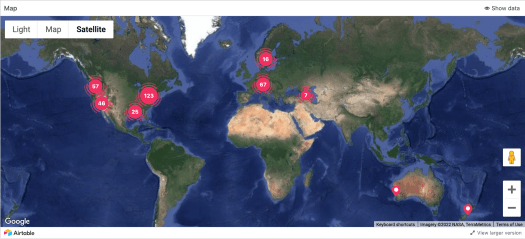
This is a comprehensive, up-to-date list of the world's current dictators and authoritarian regimes. In 2022, there are 57 dictatorships in the world. We define a dictator as the ruler of a land rated โ€œNot Freeโ€ by the Freedom House in their annual survey of freedom. See the interactive map and photos below or click to visit the current dictators category.

Of course, the dictators of the world will point to all the yellow areas of this map and claim, “There! There is the evil capitalists who are draining the world of resources and polluting our planet!”

They are not entirely wrong, expect they think in black and white, good and evil, right and wrong. They split the world into opposite halves. Then, they step inside the Good Bubble, created entirely inside their mind and spew out their pent-up boiling hate, vengeance, and destructive tendencies on everyone else. They never take responsibility for themselves. They are the consummate victim, and always the hero in their narcissistic story. And so, it is in this way that we (the human race) will split the planet into two unreconcilable halves and all die together in a seething puddle of hate.


Free to Choose: Mirror of Deeds: Terror Groups

One step behind dictators and authoritarian rulers of the world are terror groups such as Boko Haram, ISIS, and Taliban (which actually managed to retake control of Afghanistan bumping them back up to the dictator map above). The map below shows terror groups around the world and provides a list of largest terrorist groups worldwide.

These are groups of people who twist words and religions to bolster their brutal causes. They are mostly stateless centers of terror who are trying to grab some land and people who they can crush and ruin.

Free to Choose: Mirror of Deeds: 2021 Global Terrorism Index
Overall Terrorism Index Score: GTI is a composite measure made up of four indicators: incidents, fatalities, injuries and property damage. To measure the impact of terrorism, a five year weighted average is applied.

Free to Choose: Mirror of Deeds: Hate Groups

One step behind terror groups are hate groups. Rather than centering their brutal activities in one spot or country, hate groups operate like a distributed network that hock, sell, and propagate hate. It is easier than ever to breed hate with the advent of the Internet and people who live their lives online.

Hate groups traffick outrage and outlandish accusations designed to divide the world into Us and Them, into people you can trust and people you can’t trust. Hate groups are insidious and invade peoples minds like a drug. Once you become addicted to hate, it is an addiction that is harder to kick than heroin. It is a poison to your mind that is more destructive than Meth. Hate literally changes the neural pathways of your brain.

The following images are from Jigsaw, an incredible website that helps you visualize hate.

Free to Choose: Mirror of Deeds: Red Pilling: Signalling allegiance to a group or ideology often becomes an all-consuming project for extremists. Even once an extremist has been formally admitted into a group or online forum of extremists, formers described the need to prove themselves as โ€œdown for the causeโ€ or โ€œwhite enoughโ€ by committing more and more time and energy. This performance of dedication often escalates in a competitive fashion, resulting in hate speech and violence.
Free to Choose: Mirror of Deeds: Red Pilling: The rise of informal white supremacist communities online over the last 20 years has made it easier to find, join, and become radicalized into white supremacist groups. Whereas groups in the past might have recruited at white power rock shows or amenable bars, online radicalization no longer requires this investment of in-person time and physical vetting. Today a person can spend hours online moving through increasingly radical content and discussion forums. The immersive nature of these online forums and communities can create a โ€œnew normalโ€ that contradicts offline social norms28. This also means younger children and teens, who could not be recruited at bars or white power concerts in the past, can more easily join white supremacist groups at impressionable ages. One former interviewed had entered a white supremacist forum at age 13 and, drawn to the provocative memes and secretive chat forums, had adopted national socialist beliefs by 15. By 18, he was part of a neo-Nazi terrorist organization proscribed in the UK.
Free to Choose: Mirror of Deeds: Formal and informal extremist groups often coexist online, playing complementary roles
Free to Choose: Mirror of Deeds: White supremacy is a globally networked movement

Another excellent mapping project is the Hate-Map using real time data of hate events to create a map that shows hotspots and how hate is growing worldwide.

Free to Choose: Mirror of Deeds: Interactive Hate Map | You need to go to the site embedded in the Hate Map, but as you zoom into an area, the number of incidences increases in the the places that appear white in the map above this one.
The Hate Map is populated with data submitted both by our internal researchers, the public and our network of volunteers. This data largely stems from publicly available news-sources and consolidations of information from other public data-sets and records. Existing records are however often limited in scope and fail to give a comprehensive picture of the global activities of the far right ranging from spread of propaganda and low-level activities through major terrorist incidents.
All data in the Hate Map is verified and quality controlled by internal researchers who are experts on far right extremism and experienced in the field of open source intelligence (OSINT) building on public sources and providing verifiable documentation before it is made available in our public-facing database and dashboard. Our researchers take great care to verify sources where there might exist any doubt. Links to external sources are provided for all our database entries in order to ensure that the public further can verify any incident independently.
Our dataset is cross referenced against the work of other institutions and organizations mapping the far right in order to ensure as comprehensive a picture of the global situation of the far right as possible, in keeping with the highest academic standards.
The Hate Map is a living document and both recent and historic events are added and verified on a daily basis. -- The Hate-Map

Free to Choose: Mirror of Deeds: The Playbook

Regardless of if you are a dictator; an authoritarian ruler; a leader or member of a terror group; a leader or member of a hate group; a narcissistic boss, sibling, friend, or parent, you play from the same dirty handbook. That book repeats one mantra over and over, which is to inflict as much pain, terror, and suffering on your enemy (which is anyone who does not agree with you) while constantly claiming to be the victim. And if you can’t win that way, then you have the right to destroy everything.

This attitude, belief system, behavior is all a big cover up of who you really are. It is a smoke screen and distraction because deep, deep down inside yourself you feel inferior, impotent, dithering, confused, frighten, and like a limp Weiner. That’s why you run around the world hurting everyone else. If you can’t have it your way, then you want to be the first to destroy it!

Looking at these map, it is pretty clear we are not doing very well as species. No wonder we are not paying attention to Climate Change. Perhaps we won’t need to after all. The way things are going we will blow ourselves up before nature cleans us off the surface of the planet with climate disasters that are only getting bigger and more deadlier by the year… and this trend is only going bigger and badder not the other way.

Perhaps we all better stop, take a deep breathe, and listen to the Whale Songs again. The ones Vermont biologist Roger Payne captured and brought to us in the 1970s!

Free to Choose: Mirror of Deeds:
Songs Of The Humpback Whale – by Dr. Roger Payne
Gordon Snyder; 494 subscribers

Free to Choose: Mirror of Deeds: Yetzer Harah

I realized this thing Lin said in the second episode of Shantaram is part of the puzzle of the Yetzer Harah.

I first heard about the Yetzer Harah while listening to Alan Watts lectures who describes it like this:

So, in Hebrew theology incidentally. That there is a thing called the yetzer harah. And in the beginning of time when God created Adam he implanted in him the yetzer hara and the yetzer hara means that wayward spirit. He put something funny in man so that man would be a little odd and it was a result of the yetzer hara that Adam was tempted by Eve who was tempted by the serpent to eat that famous fruit. And, but the Hebrew believes that everything that God created is good. Including the Yetzer Hara. Because if it hadnโ€™t been for the yetzer hara, there would have nothing ever happened. Everybody would have obeyed God and God would have said well this is kind of a bore. 

Now that you see, you canโ€™t you canโ€™t just get up to someone and say disobey me, because if they do there are varying you. See thatโ€™s a double bind. Say to somebody disobey me but God is much more subtle than that. He didnโ€™t tell Adam to disobey he told him to obey. 

But suddenly he put this yetzer hara thing in like that so that, God would say well Iโ€™m not responsible. For this thingโ€™s going to happen on its own because what everybody wants is something to happen on its own. And everybody wants that. 

Because you see, this sensation of being you. This curious lonely center of awkward sensitivity, subject to the most peculiar feelings and pains and anxieties and all that sort of thing all that. Is an essential prerequisite for feeling something else. These two experiences go together. -- 2.4.9 Way Beyond Seeking Part 2; Alan Watts Organization

In short, the Yetzer Harah is why we do evil things, why we fear people we don’t know, why we wage wars, why we cheat each other… pretty much why we are living in the mess we made of the world today.

Shantaram tells the story of how Lin made a mess of his life (surely guided by his inner Yetzer Harah that tempted him into making a lot of bad choices that landed him in prison). Then, Lin makes a courageous choice, escapes from prison, and gets a second chance to live his life, which he is messing up again–gosh darn it!

I’m only on episode 2…so Lin is probably going to embark on different mistakes. And I bet he is going to grow from these mistakes because Lin demonstrates the capacity to reflect on his new situation and past mistakes, which pushing open the door of the prison cell inside your head, just a little bit, but if you look…there is vast and beautiful field of wisdom beyond your prison cell behind your wall of ignorance.

Is wisdom perhaps the reason God implanted the Yetzer Harah into man at the very beginning?

I suppose we will never know because clearly we are going to kill each other long before we can collectively learn how to embrace diversity and celebrate life in all its many facets and ways of being in the world.

Free to Choose: Mirror of Deeds: Images For Archetypal Animations

Feature Archetypal Animation

Cucuy: The Boogeyman
Free Evil Fiend Art Prints and Artworks
Alice In Wonderland Clip Alice Falls Into a Rabbit Hole 2010 HD
Shop Alice Falling Down The Rabbit Hole Designs in Fabric
White rabbit runs and falls into a hole

Music: Down the Rabbit Hole: Emma Wallace [1] Rabbit Hole    2:02


Second Archetypal Animation

I was searching for exactly what Lin said to himself when he woke up the first morning in his friends tent in the Bombay slum. I could not find it, but I found a lot of other great quotes from Gregory David Roberts who is the author of Shantarm. So, I have sprinkled these in between the credits of where I found the images for this animation.

Shantaram TV Review

โ€œCivilisation, after all, is defined by what we forbid, more than what we permit.โ€ 
โ€• Gregory David Roberts, Shantaram

โ€œFear dries a man’s mouth, and hate strangles him. That’s why hate has no great literature: real fear and real hate have no words.โ€ โ€• Gregory David Roberts, Shantaram

โ€œFor this is what we do. Put one foot forward and then the other. Lift our eyes to the snarl and smile of the world once more. Think. Act. feel. Add our little consequence to the tides of good and evil that flood and drain the world. Drag our shadowed crosses into the hope of another night. Push our brave hearts into the promise of a new day. With love; the passionate search for truth other than our own. With longing; the pure, ineffable yearning to be saved. For so long as fate keeps waiting, we live on.โ€ 
โ€• Gregory David Roberts, Shantaram

โ€œThe past reflects eternally between two mirrors -the bright mirror of words and deeds, and the dark one, full of things we didn’t do or say.โ€ 
โ€• Gregory David Roberts, Shantaram

Charlie Hunnam And Shubham Saraf Tell Us About How The Spirit Of Chaos (And One Drunken Night) Fueled โ€˜Shantaramโ€™

“While I was chained to a wall and being tortured, I realized, through the screaming of my mind, that even in that shackled, bloody helplessness, I was still free: free to hate the men who were torturing me, or to forgive them. It doesn’t sound like much, I know. But in the flinch and bite of the chain, when it’s all you’ve got, that freedom is a universe of possibility. And the choice you make between hating and forgiving, can become the story of your life.” ~ Gregory David Roberts

“The truth is that there are no good men, or bad men,’ he said. ‘It is the deeds that have goodness or badness in them. There are good deeds, and bad deeds. Men are just men – it is what they do, or refuse to do, that links them to good and evil. The truth is that an instant of real love, in the heart of anyone – the noblest man alive or the most wicked – has the whole purpose and process and meaning of life within the lotus-folds of its passion. The truth is that we are all, every one of us, every atom, every galaxy, and every particle of matter in the universe, moving toward God.” ~ Gregory David Roberts

“It’s forgiveness that makes us what we are. Without forgiveness, our species would’ve annihilated itself in endless retributions. Without forgiveness, there would be no history. Without that hope, there would be no art, for every work of art is in some way an act of forgiveness. Without that dream, there would be no love, for every act of love is in some way a promise to forgive. We live on because we can love, and we love because we can forgive.” ~ Gregory David Roberts

Charlie Hunnam Fell In Love With India While Working On ‘Shantaram’ But Also Fell Severely Ill!

“There’s a truth deeper than experience. It’s beyond what we see, or even what we feel. It’s an order of truth that separates the profound from the merely clever, and the reality from the perception. We’re helpless, usually, in the face of it; and the cost of knowing it, like the cost of knowing love, is sometimes greater than any heart would willingly pay. It doesn’t always help us to love the world, but it does prevent us from hating the world. And the only way to know that truth is to share it, from heart to heart, just as Prabhakar told it to me, just as I’m telling it to you now.” ~ Gregory David Roberts

“Love is the passionate search for a truth other than your own; and once you feel it, honestly and completely, love is forever.” ~ Gregory David Roberts

“Some feelings sink so deep into the heart that only loneliness can help you find them again. Some truths are so painful that only shame can help you live with them. Some things are so sad that only your soul can do the crying for them.” ~ Gregory David Roberts

Shantaram
Inde. Bombay ou Mumbai, il faut choisir son 

Music: Shantaram (Chapter Four)Various Artists [1] Aeternum    9:16 [2] Inner Fire – Yuriy from Russia Remix    9:15