A curated collection of content worth your time and attention—films, books, talks, art, and actions that illuminate the moment and feed your inner fire. These are beacons in the fog of collapse, helping us remember, reorient, and rise.
How Would A No Labels Presidential Candidate Change the Outcome in 2024?
This blog focus on the idea that the non-profit organization called No Labels plans to put a third party candidate into the 2024 Presidential Campaign. While I agree with Ryan Clancy’s idea of creating more choice for American voters, it is an extremely, short-sighted, ill-conceived, and premature idea to try to do this year.
While 60,000 voters think a third party candidate can win, so far no third party candidate has ever come close to getting a toe hold into the White House. There are so many more MAGA voters inspired by cooky myths, lies, and the very scary Seven Mountain Mandate men, of whom Marjorie Taylor Greene and Lauren Boebert are examples of women leaning heavily into “Let’s Do Medieval Again!“
The Stakes
This year, more than any year in American history, the stakes are higher than most people care to believe or admit or reckon with. Having Robert F. Kennedy Jr. and Cornel West already running on third party tickets is concerning. So now, we want more choice and add a No Labels ticket too?! Really, this year, when King Kong and his MAGA base is coming to rip down democracy and replace it with the Christian Alt Right Stary-Eyed, Let’s Have Kings Again, The Seven Mountains Mandate men?!
Who are The Seven Montains Mandate men and women? Think Handmaids Tale.
It is not: “Oh the guy I voted for didn’t do the one thing I really wanted him to do, so I’m not voting for him again.”
This is an ignorant, short-sighted, and extremely selfish opinion. Running a country of 331+ million people democratically is not done by waving magic wands and fixing this problem instantly, then this problem, then that problem, and so on and so forth…
Do you live in reality people who give this as a reason for not voting for Joe? MAGA voters are a whole different story. They are a battering ram. They want to destroy democracy and rebuild America as a Totalitarian Christian Nationalist Country. Do you, ordinary voters unhappy with Joe want to live in a Christian Nationalist State run by one of the stupidest men on the planet… the Orange Baby?
Bradley Onishi is a former Christian nationalist who's now a professor of religion and the author of Preparing for War, a critique of the movement and its impact on American democracy.
BRAD ONISHI: I think it has. Christian nationalism is having a moment. It's having a moment in ways that it's requiring those who adhere to its principles and ideologies to respond to it. Folks like Marjorie Taylor Greene and Lauren Boebert and others have talked about the ways that Christian nationalism not only informs their understanding of politics, but how they identify explicitly as Christian nationalists. And so we are at a point in American politics where Christian nationalism is something that many people are discussing.
GROSS: Are there many people in Congress who are affiliated with Christian nationalism?
ONISHI: I think it's fair to say that, yes. One of the things that's true about our Congress is that it is disproportionately Christian. Now, there are many different types of Christian people in our Congress from various denominations. However, if we look at the GOP and we look at the tenets of the party's policies and its approach to the upcoming elections, we find core Christian nationalist ideals in that platform. And we find many, many, many members of Congress from the GOP who support those principles. So from outgoing Speaker Kevin McCarthy to current speaker Mike Johnson, all the way to senators and other members of the House, there are many folks who I would describe as Christian nationalists in the United States Congress.
GROSS: What are some of the fundamental principles of Christian nationalism? Like, how would you define Christian nationalism?
ONISHI: I think in very simple terms, Christian nationalism is the idea that Christian people should be privileged in the United States in some way - economically, socially, politically - and that that influence and that privilege is a result of the country being founded by and for Christians. Christian nationalism is not the idea that others can't be here - that if you're a Muslim or an atheist, that you have to leave. It's also not the idea that only Christians can be part of the government. However, for most Christian nationalists, there is a core belief that the story of the United States is one where it has been elected by God to play an exceptional role in human history, and as being chosen by God, it's the duty of Christian people to carry out his will on Earth.
So Christian nationalists take an approach to their Christianity that says it should have an undue influence on our government, on our economics, on our culture, and that it is by dint of our history, the religious faith that is meant to be privileged in our public square. With that said, there are different kinds of Christian nationalists and different ways that people manifest their understanding of the term. But when it comes down to it, if we all sit down as Americans at a table and there are people from different backgrounds, different ethnicities, different faiths, and someone who is a Christian says, just by being at this table, I should have a special place, well, to me, that's Christian nationalism because you're saying that somehow this country is yours in a way that it is not for everyone else. And to me, therein lies the problem.

Go to Fresh Air to listen or read the rest of this interview. It is really, really important!
And this is really creepy:
GROSS: An extreme group of Christian nationalists is the New Apostolic Reformation, and they advocate the Seven Mountain Mandate, which is that Christian nationalists or Christians should lead government, family, religion, business, education, media, arts and entertainment, and that they - all of these sectors should reflect the kingdom of God. And I think I mentioned all seven there. So what does that mean to reflect the kingdom of God in family, religion, business, education, media, arts and entertainment, and the government?
ONISHI: The Seven Mountains mandate is a particular form of understanding human society that says that Christian people are not called to persuade their neighbors to practice the Christian faith, to demonstrate to their fellow Americans that the Christian faith is the faith of love and truth. The Seven Mountains Mandate is, as my colleague Matthew Taylor says, a mandate to colonize the Earth for God. The seven domains as you listed them - arts and leisure and the economy and the government, the family - are seen as mountains of conquest. The goal is not dialogue with neighbors who may be Muslim or atheist or Hindu. The goal is not to simply reflect the character of Christ on earth by way of living a life that upholds his glory and his teachings. The goal is to have absolute authority and power over every facet of human society.
And so we can see here what I take to be a very dangerous approach to practicing Christianity in the public square. It is not one that recognizes democracy or dialogue, pluralism as sacred values. The goal is power. The goal is conquest. And so when one hears about a politician or a leader or anyone in influence, especially as part of our government, who adheres to the Seven Mountains Mandate, that should set alarm bells off immediately.
Democracy Is Not: “Joe’s too old, Joe’s too square, Joe’s too this or that...” This is just as stupid, impatience, ignorant reason to not vote for a known and vetted winner: Joe Biden.
There was a time in the not so distant past when age was considered a plus and must for a ruler. Wisdom takes time to ripen and mature inside of people. And it does not come to everyone who ages… look at the overly large, orange, baby King Kong with his revved up mad as hell MAGA base.
Do you think they are worried about the Orange Giant being too old… his less than 4 years younger than Biden!! Anyone giving this as a reason not to vote for Joe is suffering from ageism and is pretty ignorant about how a government governing 331+ million people really works! It takes a lot of people to make it work… good people who are appointed to their positions in a timely fashion and have the expertise and experience to do their jobs. Trump had the most vacancies in top, critical positions of any former President. Some key positions were never appointed under the Orange Giant.
Democracy Is Not: “I’m mad a Joe for aiding Israel.” Modern nation-states are messy… alliances are messy… the world is messy and hard and cruel… that is why nations make alliances, and when Israel was attacked by HAMAS in one of the bloodiest, most gruesome slaughters of innocent people of this century, of course US comforts and supports Israel. There is so much going on behind the scenes that you and I never hear about. The death of any innocent person is intolerable. And Joe and his cabinet are doing their damn best to push for resolution, ceasefire, peace. But, tell me, anyone threatening not to vote for Joe because he can’t wave his wand and make this bloodshed stop… DO YOU REALLY THINK THE ORANGE GIANT (the man to put in place the Muslim Ban days after taking office)…. DO YOU REALLY THINK he is a better option?! I was mad at Obama for not doing more to stop the slaughter of Syrians being bombed by Russia as they aided their ugly ally Bashar al-Assad.
Take A Minute, Learn Something… Maybe Something New
Do Americans really understand democracy? Do Americans really cherish it? Do American comprehend what is at stake this year?
No Labels Debate
It is a choice. Listen to this debate and listen to Fresh Air if you are truly concerned about making an informed, intelligent choice.
The centrist group No Labels is planning to host a bipartisan nominating convention in 2024. This is leading some people to speculate that they may promote a third-party candidate that better reflects the perspective of middle-of-the-line voters who don’t favor President Biden’s re-election bid or Donald Trump receiving the Republican nomination.
Those who say it will help Trump argue the group doesn’t have enough influence to make lasting tangible change and worry that promoting a third-party unity ticket will give an unpopular candidate like Trump a lower threshold for votes that would’ve gone to Biden.
Those who disagree say voters who are discontented with both major parties but particularly opposed to Trump, might turn out in support of the third-party candidate, indirectly reducing Trump's chances.
With this context, we debate the question: “How Would A No Labels Presidential Candidate Change the Outcome in 2024?"
Rahna Epting argues that the No Labels Party does not have a path to win the presidency. Ryan Clancy argues a No Labels unity presidential ticket has a viable path to win the White House in 2024. Emmy award-winning journalist John Donvan moderates.
Open to Debate:How Would a No Labels Presidential Candidate Change the Outcome in 2024?
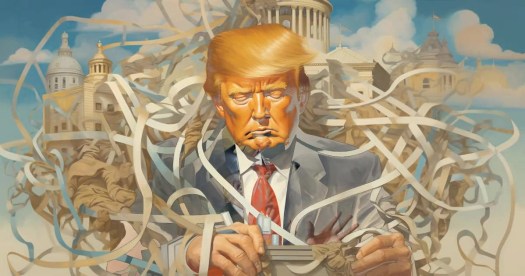
Feature Archetypal Animation
Music: Mickey Mouse Operation | Little People — [11] Fisticuffs At Dawn 1:02
How Corporations, Politicians & Billionaires Profit Off of the Infantilization of Mankind, September 3, 2023
This blog series is based on Joost Meerloo’s The Rape of the Mind and his warnings about modern mass persuasion, emotional conditioning, repetition, spectacle, and engineered dependency.
SUMMARY OF THE 2023 Super Hero, Terror?!
What Super Hero, Terror?! is about
In the summer of 2023, long before the phrase “information warfare” became dinner-table conversation, this blog asked a question most people weren’t ready to hear: what if the same psychological tactics used by totalitarian regimes — fear, manufactured confusion, the Big Lie, the myth of the all-powerful leader — were already operating inside our democracies, wrapped in entertainment and spectacle?
Drawing on psychiatrist Joost Meerloo’s prescient 1956 book The Rape of the Mind, Part 4 of the Marvelization of Man series traces how psychological warfare works: not through brute force, but by exhausting your capacity to think clearly. The unpredictable leader. The firehose of falsehood. The slogans of defeat whispered before a single battle begins. Meerloo documented these tactics in the aftermath of World War II. This post asked whether we were watching them repeat.
It also argued something subtler: that hollowed-out mythmaking — Marvel’s assembly-line superheroes, engineered for profit rather than meaning — leaves us psychologically undefended. We need strong archetypal stories to build the inner models that help us resist manipulation. When our myths go thin, so does our resistance.
“Logic can be met with logic, while illogic cannot — it confuses those who think straight.” — Joost Meerloo, The Rape of the Mind, 1956
Read it as a warning.
From warning to diagnosis: reading this post in 2026
When this piece was published in September 2023, it read as a warning shot. In May 2026, it reads as a field guide to what has already happened.
Meerloo described the “unpredictable madman” as a deliberate tactic — a calculated performance of chaos designed to keep opponents off balance, unable to mount a coherent response before the next lie lands. What this post identified as a political style has since become governing policy. The firehose of falsehood is no longer primarily a foreign adversary’s weapon. It runs domestically, at scale, from the top.
The institutions Meerloo identified as psychological anchors — a free press, independent courts, reliable civic language — have been systematically challenged and, in some cases, functionally dismantled. This is not coincidence. It is the playbook. You weaken the structures that help people tell truth from fiction, and then the fiction wins by default.
Meanwhile, the infantilization argument this post introduced has only deepened. AI-generated content floods every platform. Algorithmic feeds are engineered for emotional reaction, not reason. Political identity has been gamified. People are more entertained, more stimulated, and less equipped for critical thought than at any point in recent memory — which is precisely what a propaganda ecosystem requires of its audience.
Most urgently: Meerloo wrote that the real goal of totalitarian psychological warfare is to win before the fighting starts — to break the will to resist. The question this blog was asking in 2023 was: are we awake enough to see this happening? The question in 2026 is harder. We can see it. The question now is whether we still believe our response matters — and whether we act before we stop believing it does.
“Only the awakened imagination can counter the machinery of deception.”— Sapience: The Moment Is Now
That line is from Sapience: The Moment Is Now, a novel I spent twelve years writing, published in 2024. The book traces a 5,000-year arc of civilization — through the rise and fall of empires, the machinery of authoritarian control, the engineered collapse of collective wisdom — and arrives at the same conclusion this blog reaches: that what is being stolen from us, above all else, is our capacity to imagine something different.
The Super Hero, Terror blog asked why our myths were going hollow and what that cost us. Sapienceanswers that question through three characters living across three moments of planetary collapse — one in 2024, watching it begin; one in 2050–2109, living through the worst of it; one in 2147, trying to remember how it could have gone otherwise. Together, they trace exactly what Meerloo warned about: a civilization that was shown the tools of its own manipulation and still could not look away from the spectacle long enough to resist.
The blog diagnosed the disease. The book maps the terrain of what happens if we don’t treat it — and what becomes possible if we do. Both were written as warnings. Both are now something more urgent than that.
The moment, as it has always been, is now.
Original 2023 Introduction toSuper Hero, Terror?!
The Marvelization of Man series juxtaposes the marvelous world of Marvel and its universe of Super Heroes against the not so marvelous world of real life human beings. Sometimes the men and women who present themselves as Super Heroes swooping in to protect us turn out instead to be deceiving and manipulating us.
Way too often in our Modern Era the men and women presenting themselves as the Super Heroes saving civilization are hiding behind lies and madman tactics designed to intrigue, confuse and shock us into their mesmerizing realm of thought control.
Recapof The Marvelization of Man Series
My series begins with Marvel origin story of Morbius who as a “living vampire”, which is an archetypal character for real life narcissists. Morbius flopped even though it should have racked in the bucks as discussed in depth in Part 2 of The Marvelization of Man.
Part 3 of The Marvelization of Man dives into how our minds work and why when a conglomerate company like Disney absorbs the universes of Marvel, Star Wars, Predator, and so many others, the movies they spin out can fall into the trap of creating transactional characters who are made to fit into a highly formula movie that is calculated to do one thing: make lots of money.
This results in weak storytelling and weak Super Heroes. Lacking strong Super Hero stories can water down our inner ability to resist mass manipulation of the kind Joost speaks about in his book: The Rape of the Mind, published in 1956. Super Heroes are our modern versions of archetypal stories and when we tell weak archetypal stories, we lack strong models to base the development of our own inner archetypal stories impacting every aspect of our ordinary lives.
Part 4 of The Marvelization of Man is delving deeper into the subtle art of mind control. It is something our Modern world has excelled at doing and perfected regardless of whether you live in a totalitarian system of government where overt mind control is used by nation-state like Russia, China, or Saudi Arabia OR if you live in a free-wheeling, capitalistic nation-state like the United States, Britain, Australia, or pretty much any nation aligning themselves economically and politically with the Western values and civilization.
The Rape of the Mind
Joost Meerloo describes Chapter 5 of his book Rape of the Mind in this way:
The purpose of the second part of this book is to show various aspects of political and non-political strategy used to change the feelings and thoughts of the masses, starting with simple advertising and propaganda, then surveying psychological warfare and actual cold war, and going on to examine the means used for internal streamlining of man's thoughts and behaviour. Part Two ends with an intricate examination of how one of the tools of emotional fascination and attack -- the weapon of fear -- is used and what reactions it arouses in men.
                   -- page 65 | The Rape of the Mind
I will highlight parts of Chapter 5 discussing Psychological Warfare as a Weapon of Terror (Page 69 — The Rape of the Mind) and provide current models of how this continues to take place today.
Psychological Warfare as a Weapon of Terror
Rape of the Mind,Chapter 5: The Cold War Against the Mind.
Every human communication can be either a report of straight facts or an attempt to suggest things and situations as they do not exist. Such distortion and perversion of facts strike at the core of human communication. The verbal battle against man's concept of truth and against his mind seems to be ceaseless. For example, if I can instill in eventual future enemies fear and terror and the suggestion of impending defeat, even before they are willing to fight, my battle is already half won.
            -- Page 69 - 70 | The Rape of the Mind
The strategy of man to use a frightening mask and a loud voice to utter lies in order to manipulate friend and foe is as old as mankind. Primitive people used terror-provoking masks, magic fascination, or self-deceit as much as we use loudly spoken words to convince others or ourselves. They use their magic paints and we our ideologies. Truly, we live in an age of ads, propaganda, and publicity. But only under dictatorial and totalitarian regimes have such human habit formations mushroomed into systematic psychological assault on mankind.
            -- Page 69 - 70 | The Rape of the Mind
Super Hero, Terror?! Trump — Shaman-Magician, Primitive Boogeyman | Music: Succession: Season 1 (HBO Original Series Soundtrack) — Nicholas Britell
The weapons the dictator uses against his own people, he may use against the outside world as well. For example, the false confessions that divert the minds of dictator's subjects from their own real problems have still another effect: they are meant (and sometimes they succeed in their aim) to terrorize the world's public. By strengthening the myth of the dictator's omnipotence, such confessions weaken man's will to resist him. If a period of peace can be used to soften up a future enemy, the totalitarian armies may be able in time of war to win a cheap and easy victory. Totalitarian psychological warfare is directed largely toward this end. It is an effort to propagandize and hypnotize the world into submission.
            -- Page 69 - 70 | The Rape of the Mind
Consider Russia:
Russian President Vladimir Putin speaks with journalists after a live broadcast nationwide call-in, Moscow, April 14, 2016
We characterize the contemporary Russian model for propaganda as “the firehose of falsehood” because of two of its distinctive features: high numbers of channels and messages and a shameless willingness to disseminate partial truths or outright fictions. In the words of one observer, “[N]ew Russian propaganda entertains, confuses and overwhelms the audience.”2
Contemporary Russian propaganda has at least two other distinctive features. It is also rapid, continuous, and repetitive, and it lacks commitment to consistency.
Russia’s years-long information war was instrumental in informing Putin’s decision to invade Ukraine. This effort has failed to build support for Russia among Russian-speaking Ukrainians, especially in Donbas.
A key example is the myth of “Novorossiya”. The term, which means “New Russia”, is meant to conjure up feelings of a restored Russian empire and righting the historical “wrong” of assigning Russian lands under Ukrainian jurisdiction.
Since 2014, Putin, the Kremlin’s propaganda strategists, and insurgents in the “People’s Republics” of Donetsk and Luhansk repeatedly referred to “Novorossiya” as one of the justifications for Russia’s invasion.
In reality, there never was a Novorossiya. As an ideological project, it has failed to take hold in the minds of those living on its supposed territories in eastern and southern Ukraine, and was abandoned by Russia and the authorities of the “People’s Republics” of Donetsk and Luhansk as soon as it became politically inconvenient.
As far back as the early nineteenth century, Napoleon organized his Bureau de l'Opinion Publique in order to influence the thinking of the French people. But it fell to the Germans to develop the manipulation of public opinion into a huge, well organized machine. Their psychological warfare became aggressive strategy in peacetime, the so-called war between wars. It was as a result of the Nazi attack on European morale and the Nazi war of nerves against their neighbours that the other nations of the world began to organize their own psychological forces, but it was only in the second half of the war that they were able to achieve some measure of success. The Germans had a long head start.
         -- Page 69 - 70 | The Rape of the Mind
Hitler's psychological artillery was composed primarily of the weapon of fear. He had, for example, a network of fifth columnists whose main job was to sow rumours and suspicions among the citizens of the countries against which he eventually planned to fight. The people were upset not only by the spy system itself, but by the very rumour of spies. These fifth columnists spread slogans of defeat and political confusion: "Why should France die for England?" Fear began to direct people's actions. Instead of facing the real threat of German invasion, instead of preparing for it, all of Europe shuddered at spy stories, discussed irrelevant problems, argued endlessly about scapegoats and minorities. Thus Hitler used the rampant, vague fears to becloud the real issues, and by attacking his enemies' will to fight, weakened them.
         -- Page 69 - 70 | The Rape of the Mind
Super Hero, Terror?! Manipulation Man | Music: Books of Blood: The Coming of Tan by Jedi Mind Tricks [Album: The Psycho-social, Chemical, Biological, And Electro-magnetic Manipulation Of Human Consiousness]
Not content with this strategic attack on the will to defend oneself, Hitler tried to paralyze Europe with the threat of terror, not only the threat of bombing, destruction, and occupation, but also the psychological threat implicit in his own boast of ruthlessness. The fear of an implacable foe makes man more willing to submit even before he has begun to fight. Hitler's criminal acts at home -- the concentration camps, the gas chambers, the mass murders, the atmosphere of terror throughout Germany - were as useful in the service of his fear-instilling propaganda machinery as they were a part of his delusions.
        -- Page 69 - 70 | The Rape of the Mind
There is another important weapon the totalitarians use in their campaign to frighten the world into submission. This is the weapon of psychological shock. Hitler kept his enemies in a state of constant confusion and diplomatic upheaval. They never knew what this unpredictable madman was going to do next. Hitler was never logical, because he knew that that was what he was expected to be. Logic can be met with logic, while illogic cannot - it confuses those who think straight. The Big Lie and monotonously repeated nonsense have more emotional appeal in a cold war than logic and reason. While the enemy is still searching for a reasonable counter-argument to the first lie, the totalitarians can assault him with another.
          -- Page 69 - 70 | The Rape of the Mind
What this essay identified in 2023 has not diminished. It has accelerated.
The machinery of psychological warfare no longer operates only through state propaganda ministries, television broadcasts, newspapers, or carefully staged political spectacles. By 2026, it has become embedded in algorithmic feeds, attention markets, viral video loops, targeted persuasion systems, and synthetic media environments that operate continuously. Fear no longer arrives in discrete political messages. It now circulates as a permanent atmosphere.
That matters because Joost Meerloo was describing something deeper than propaganda alone. He was describing how confusion, repetition, shock, emotional overload, and distortion gradually weaken the mind’s capacity to distinguish reality from performance. That process has become industrialized. The contemporary information environment rewards velocity over reflection, emotional arousal over understanding, symbolic identity over structural analysis, and outrage over orientation. The result is not merely misinformation. It is psychological destabilization.
The old totalitarian insight remains brutally modern: if you can keep populations frightened, disoriented, exhausted, and continuously reacting, you weaken their ability to think clearly about actual causes, actual power, and actual danger. While citizens chase spectacle, the deeper architecture of political, economic, technological, and institutional power becomes harder to see.
This is where the “super hero” dimension of this essay becomes more important now than when it was first written. Heroic spectacle trains the imagination toward simplified moral theater—heroes, villains, saviors, enemies, dramatic confrontations, and emotional resolution. But real civic life rarely works that way. Real democracy demands attention, patience, complexity, memory, and collective responsibility. A population trained to seek theatrical emotional certainty becomes more vulnerable to those who know how to weaponize fear, grievance, myth, and spectacle.
In 2026, the danger is not simply that people believe false things. The deeper danger is that many people now live inside engineered emotional environments where fear, shock, tribal identity, symbolic conflict, and perpetual crisis continuously shape perception itself. This is precisely the terrain Meerloo warned about: the battlefield of the mind.
How Corporations, Politicians & Billionaires Profit Off of the Infantilization of Mankind
August 23, 2023
Summary: “Public-Opinion Engineers” — Part 3 of The Marvelization of Man (August 2023)
This blog is Part 3 of the Marvelization of Man series, and it pivots from entertainment culture into the mechanics of covert thought control in free-market capitalist societies, drawing heavily from Joost Meerloo’s 1956 book The Rape of the Mind. sapience2112
The central argument is that we face two flavors of the same poison: overt, brutal thought control practiced by totalitarian regimes (covered in Meerloo’s first half), and the subtler, profit-driven manipulation practiced by what Meerloo calls the “Public-Opinion Engineers” — the political consultants, advertisers, and media architects who shape what we believe, what we buy, and who we vote for. The blog warns that when elaborately engineered propaganda campaigns can sell any idea or candidate to the public, the danger is that whoever can pay the most can temporarily become the one who influences people to act against their own real interests. sapience2112
A substantial section is devoted to the importance of healthy archetypes — the deep psychological templates that superheroes embody — as a form of mental immunity. The blog argues that healthy archetypes empower people to choose wisely and resist manipulation, while unhealthy, one-sided archetypes can hijack the mind without the person even knowing it. Christopher Nolan’s comments about Batman as “modern-day mythology” are used to illustrate how superhero stories serve this protective psychological function. The problem is that Marvel characters are increasingly becoming one-dimensional and cartoonish as commercial priorities override storytelling, watering them down so they feel less real and less inspiring — which, in the blog’s framework, is actively harmful, stripping the culture of the archetypal nutrition people need to resist manipulation. sapience2112Sapience2112
Meerloo’s 1956 observations about motivation research, infantile impulse-triggering, manufactured dissatisfaction, and the engineering of artificial needs are presented as eerily applicable to 2023 — and the blog argues that a society of “Automen and Autowomen” conditioned into passive consumption is the ideal population for narcissistic power-seekers to exploit. sapience2112
The narcissist archetype runs as a throughline: from corporate CEOs to political figures, the blog argues that modern capitalism has become an incubator for narcissistic personalities who then employ Public-Opinion Engineers to do their bidding.
Original 2023 Blog: Part 3: Public-Opinion Engineers
Part 1: The Marvelization of Man pokes fun at the entertainment universes (very much a plural) that are owned by Disney. However, I am glad Mark Parker (Disney Chairman) and Bob Iger (Disney CEO) are such a gargantuan company that they can go toe-to-toe with grumpy Governor Ron DeSantis. He is polling at 19% as the man in the 2024 Republican Presidential campaign who is trying to be Trumper than Trump.
Part 2: The Marvelization of Man dives into The Narcissist. This is what Morbius’ character embodies for he is a ‘Living Vampire’. But Morbius is a nice vampire (aka he is an evolved Narcissist). This evolution is necessary because by the 1970s narcissism has proliferated to unprecedented levels in America and any culture embracing a free-market economy based on capitalism.
For the most part, free-market economies embracing capitalism flourish in Western Civilization, and it is here where we find the underbelly of the beast of thought control: The Public-Opinion Engineers, which this blog will explore. This is what Joost Merloo writes about in the second half of his 1956 book The Rape of the Mind.
The first half of his book is dedicated to the mirror image of a free-market capitalist based society. This mirror image is totalitarian capitalism where there is is an economic system in which a capitalist market economy exists alongside an authoritarian government. A more extreme version of this mirror image is simply totalitarian communism (or simply totalitarian rule) where overt thought control is employed to get society to produce the riches that the upper 1% depend upon to enjoy their super luxurious life styles.
The totalitarian style of thought control is what Joost Merloo writes about in the first part of his book. The free-market capitalist style of thought control is what Joost writes about in the second part of his book.
This series: The Marvelization of Man delves into covert forms of thought control. I specifically draw from Joost Merloo who describes covert thought control techniques in the second part of his book: The Rape of the Mind.
One of the only ways to build up resistance to mind conditioning and other forms of thought control is to understand more about how your mind works. One of the essential components of a healthy mind are active fully realized archetypes. A conscious person’s mind simply does not work without them.
However, just like our bodies, we need to pay attention and take care of the systems running and regulating our mind. A person who eats junk food, does not exercise, does not sleep enough, abuses drugs and alcohol is going to run down and ultimately destroy their body faster than a person who does the opposite thing.
The same is true of the mind. If we don’t understand, pay attention to, and exercise our mind, we are going to fall prey to the predators of our society. And they exist in democratic, fake democratic, communist, and totally totalitarian systems. And The Narcissistic personality plays an oversized role in all our modern economic systems. This is why I think Morbius is an important Marvel character and why I focused on The Narcissist in Part 2: The Marvelization of Man.
It is during the 1970s, which is when Morbius was first created, that The Narcissist really proliferates American society. They were certainly multiplying by the buck loads in the 1960s, but the 1970s, the bucket of narcissism runneth over.
Morbius realizes his mistake in hunting for a cure to his crippling disease and he doesn’t want to drink human blood to survive. Fortunately, he invented synthetic blood, which is tiding him over, but it’s not as good as human blood and eventually, it will not sustain him.
He thinks ending his life will solve the problem, but his best childhood friend with the same disease gets his vampire serum, and so now there are two of them: one nice, the other one not nice.
Morbius is forced to hunt down his friend using his vampire super powers, but it’s not easy because his mean friend has them too. This is where we get to the critical idea that it just might take a monster to kill a monster. In other words, it takes a good vampire to kill a bad vampire.
Applying this to the archetype that the vampire represents, it just might take a recovering Narcissist to dethrone or take down a very sick Narcissist. Think Bob Iger (Disney CEO) [the narcissists trying to be a good narcissists] and grumpy Governor Ron DeSantis [the narcissists trying to be meaner, mightier, and uglier than the Trump Narc who is the biggest, baddest Narc clobbering anyone in the Republican Party who goes against him].
Public-Opinion Engineers: Match of the Narcs | Corporate Disney Narc vs Political DeSantis Narc
Narcissism Runs Rampant in American Culture& Public-Opinion Engineers Help Spread IT
Before leaving this idea of how narcissism dominates the social, political, and economic systems of American Culture (as well as most of Western Culture, which does not leave the rest of the world off the hook, they simply have overt narcissism running rampant while American and Western Cultures are cultivating covert narcissism), I want to highlight Andy Dunn and his story of success at the price of his mental health.
Andy Dunn, co-founded of the men’s apparel company Bonobos in 2007, agrees with me about American corporate culture being one that embraces and celebrate narcissism. In his TedTalk about Starting a company, dealing with bipolar disorder and struggling to manage both, he describes how our modern capitalist market-based economy basically makes being a Narcissist a prerequisite to start a company or be a CEO as well as other mental health disorders or illnesses.
Lessons from Losing My Mind | Andy Dunn | TED
Super Hero Stories Are Important
Also, before Joost’s chapter on the Opinion Engineers, I want to highlight why super hero characters in comic books, novels, and movies are vital to our mental wellbeing.
The stories we tell each other and to ourselves do much more than entertain us. They condition our minds to operate in certain ways.
Christopher Nolan and Batman
I heard Christopher Nolan on Fresh Air talk with Terry Gross about his new movie Oppenheimer. They also talked about “Dunkirk,” “Tenet,” the “Batman” trilogy, “Inception,” “Insomnia” and “Memento.” What he said about Batman (a different super hero universe but important nonetheless) is relevant to the points I am attempting to communicate about archetypes and how our minds work.
He said:
NOLAN: Well, I think, like a lot of kids, you know, I would read comics. And they were a great sort of launchpad for your imagination. You know, the way in which your brain processes the frames of a comic book, not unlike the way a filmmaker processes storyboards, you know, that have been drawn for a sequence or something - you're kind of - you're using your brain to flesh out from the work of the sort of artists and writers. And I became more interested in the character of Batman in that great era of sort of graphic novels - you know, the work of people like Frank Miller in particular. So they meant mythology, I suppose. They meant modern-day mythology, and they meant larger-than-life sort of operatic figures.
So when I took on the character of Batman in the trilogy we made, in the "Dark Knight" trilogy, you know, it was really all about an operatic approach to storytelling. So it's heightened reality, and that character really allows you to do that. And what I loved about Batman - of all the characters, the reason I wanted to deal with Batman is for me, he was the most human and relatable of superheroes because he doesn't really have any superpowers unless you count his extraordinary wealth. You know, that's the thing he brings to bear. But he's basically a guy who does a lot of pushups. And...
Nolan thinks comic book super heroes are important! They help us workout our minds and grow new abilities such as imagination, creativity, and film-making-storytelling. Nolan believes comic book super heroes fill a place in our mind where meaning is made and purpose is born.
This is an important place Nolan speaks of. It is that invisible place deep inside every human being where larger-than-life, operatic characters live. These are the archetypes. Think of them more like pools and reservoirs of energy. Each pool or reservoir provides the energy and mental models needed to understand and met specific situations, moments, and challenges in our lives.
These moments and challenges are universal to all people. The archetypes might take different shapes and wear different costumes depending on culture and time, but they represent the same energy of human beings grappling with situations and life experiences that are uniquely human.
Archetypes transcend place and time. Archetypes hold the collective experiences, challenges, and cognitive changes we have made to instincts going back, back, back to the very first conscious Homo sapiens (of which we are one species of six and we are the last surviving species, if we can survive the consequences of consciousness).
Archetypes are the mirror image of instincts. They energize and inspire us to fulfill and handle the life situations and challenges confronting us every day. Archetypes are arches because they contain the energy of instincts changed by consciousness that channeled action in a way better than what nature would have allowed through instinctual responses. And, they contain all the energy of instincts changed by consciousness that channeled action in a way that turned out worse than nature would have allowed through instincts.
Think of archetypes like memories for the mind to use instantaneously to respond to things happening inside and outside of the body.
When we cultivate and exercise our mind, in the way Nolan describes, we grow the capacity to solve our problems and handle our life situations in new and novel ways that might work out better than the ways we were told or taught.
Healthy Archetypes
Healthy archetypes see both sides of themselves. Healthy archetypes know there is a good way to respond or do something and there is a bad way. Healthy archetypes empower us to choose wisely. Healthy archetypes give us a feeling of power and control, but also peace and serenity because healthy archetypes know when to not use power to control others or their environment, which is most of the time. Healthy archetypes, even in the most challenging and adverse conditions, help us do the hardest things. So this is no small stuff super hero and other strong movies do for us.
Public-Opinion Engineers: Arches of Consciousness
Super Heroes (aka Archetypes) also help us grow mental immunity to thought control efforts and mind control conditioning that you will soon see through Joosts work surrounds us every moment of every day. We are constantly submitted to the social pressures of the Public-Opinion Engineers as well as a host of other mind control tactics.
Unhealthy Archetypes
The reverse is also true of archetypes. Unhealthy archetypes have lost sight of one side of themselves. Unhealthy archetypes are one sided and inflexible. Unhealthy archetypes can hijack our minds and make us respond to circumstances in our life in lopsided, rigid, and inflexible ways. Unhealthy archetypes are stealth and sneaky. Unhealthy archetypes are lopsided and want to remain lopsided. Unhealthy archetypes can take over your life and rule you and you won’t even know it because unhealthy archetypes work night and day to keep your conscious mind in the dark or in a very little box.
I saw 3,000 Years of Longing recently that does a pretty good job showing you what unhealthy archetypes can do to you.
In this movie the main character Alithea Binnie is a British narratology scholar who occasionally hallucinatesdemonic beings. Despite being a story researcher, she is an incredibly rational person.
The movie begins with her saying: “My name is Alithea. My story is true. You’re more likely to believe me if I tell you it’s a fairy tale.” She is flying to a conference in Istanbul about storytelling and even though she is telling the audience that we have science to tell us how everything works and we really don’t need stories any more, the following happens:
Alithea is one of the speakers at the conference, where she says that stories about mythical gods have been a part of human history for ages. (In the background on the conference stage is a collage portrait of comic book superheroes, to illustrate her point.) During her speech, Alithea sees in the audience a vision of ghost-like elderly man wearing all white in an ancient royal outfit, including a crown.
--
Review: ‘Three Thousand Years of Longing,’ starring Idris Elba and Tilda Swinton -- August 28, 2022 by Carla Hay
No matter what she does to try to make the White Demon go away, he appears closer and closer until she passes out with fear.
And she hasn’t even met the Djinn yet! This story-movie hints at another thing mythic stories do for us. They help us digest and deal with anxiety and stress of daily living. In fact, they provide an outlet for it as well as for other strong feelings that are hard get rid of or express in modern society such as anger, disappointment, despair, longing, fear, frustration, anguish, disgust… the icky stuff that’s not polite to show or discuss in civil society but the stuff we all feel and experience in life.
Perhaps mythic movies actually give us an outlet for this pent up energy, help us balance our psyche, which helps us feel less anxiety, less frustration, and a greater sense of meaning and purpose.
Archetype Are Echoes
Archetypes are echoes, they are the memory of every alteration ever made by consciousness through space and time. When confronted with a similar situation, archetypes jump into action riding up alongside instinctual responses and giving us instantaneously knowledge of ways to alter our response consciously.
However, when we don’t exercise our mind with curiosity, learning, and imagination, archetypes fall into our unconsciousness and we may pick a bad response due to our failure to remain fully conscious of all our options.
Myths and stories are filled with archetypal characters that convey information about all our options in converting the energy of archetypes into action. Heroes, super heroes, tricksters, wise old men, wise old women, and villians of every story portray what happens when people see both sides of their archetype, when people become unconscious of their archetype, and when people lose sight of one side of their archetype being called into action and act in a lopsided way.
The characters of myths and stories are essentially showing us how the energy running through us all the time can improve our lives or make it worse. When we find ourselves in similar situations our mythic heroes and villians are living out their story arch inside us.
Myths and stories help us recognize, develop, and mature these strong energies that as feelings, emotions, and other mental forces that can knock us sideways if we don’t pay attention or take care.
Myths and stories help us recognize ourselves and give us examples of how to integrate these unconscious aspects of ourselves. All good myths and stories provide templates, examples of bad ways of dealing with these energies (the villians) and good ways of channelling and dealing with these energies (the heroes).
Archetypes are mirror images of instincts but they have been changed by conscious choices. Archetypes provide human beings with images of the spectrum of consequences for how primal instinctual energies are changed by conscious choices. And as you have probably guessed by now, some choices are destructive and produce destructive outcomes, other choices are creative or compassionate and produce generative outcomes.
This sort of knowledge is power. It is a power our ancestors understood very well.
Archetypes echo the vibrant reflections of our innate, instinctual behaviors.
Public-Opinion Engineers: Archetypes
Perhaps if we modern humans understood the power of archetypes, we could better navigate our outer spaces (the place where you and I can meet) and inner spaces (the place where you talk to yourself…we call it thinking).
Perhaps if we really understood archetypes, we could play them like a lute… or perhaps they play us, but we might know when they are playing us and be better prepared for the consequences.
Joost Merloo, Rape of the Mind and the Role of Public-Opinion Engineers
This is the stuff A.M. Merloo, M.D., writes about in his book the Rape of the Mind. This nebulous space we call mind. A space we take for granted that we all just naturally do, but do we really know what we are doing inside our heads or have we been conditioned to think we know what we are doing, but the thoughts, ideas, and behaviors have been planted their by the Public-Opinion Engineers! They are the professionals who herd us like cows and get us to believe, act, and buy the things they want us to think, do, and buy… their stuff.
In the first half of his book, Merloo goes into great detail about how autocrats, tyrants, dictators, despots, and fascists control people’s minds. These are brutal people who employ brutal tactics. These are people and regimes that have an overarching need to control other people and imposing their way of thinking on them… much like the narcissist. They use overt, cruel tactics of thought control.
The second half of his book deals with the subtle uses of thought control. This is the part I am covering here. Subtle thought control is a tool that serves the banker, the baker, and candlestick maker. Basically, if you run a business, you need to get inside the minds of possible customers. But some businesses are much more nefarious about this.
Subtle thought control is a given element of modern economics, especially capitalistic economics that have practically become an incubator for narcissists.
A.M. Merloo wrote his book in 1956 but it sure sounds like 2023. I introduce Merloo in this blog.
The conviction is steadily growing in our country that an elaborate propaganda campaign for either a political idea or a deep-freeze(r) can be successful in selling the public any idea or object one wants them to buy, any political figure one wants them to elect. Recently, some of our election campaigns have been masterminded by the so-called public-opinion engineers, who have used all the techniques of modern mass communication and all the contemporary knowledge of the human mind to persuade Americans to vote for the candidate who is paying the public-relation men's salaries. The danger of such high-pressure advertising is that the man or the party who can pay the most can become, temporarily at least, the one who can influence the people to buy or to vote for what may not be in their real interest. -- Page 67 -- The Rape of the Mind, A. M. Meerloo, M.D.
This first paragraph cannot be emphasized enough. I’m not even going to try. Rather, I’ll try to articulate it with an image.
Public-Opinion Engineers:The Price of Mediocre Is So Cheap!! “The Price for Believing Mediocre Men… Is Being Ruled By the Monsters of Mediocrity: VOTE for ME! BECAUSE……Only ICAN MakeAmericaGreatAgain!!! BUY ME! You NEED Me to Freeze YourMeat & YourMind! The World According to Trump and Putin…… and ALL Their Evil, Mindless Minons Mine! Mine! I OWN everything with MY MONEY!!I OWN YOU!! I OWN theWORLD! I OWN EVERYTHING!!!” Music: City Dreams (interlude) 2:17, by: The Midnight, album: MonstersThe Price of Mediocre Is So Cheap!!
The specialists in the art of persuasion and the moulding of public sentiment may try to knead man's mental dough with all the tools of communication available to them: pamphlets, speeches, posters, billboards, radio programs, and T.V. shows. They may water down the spontaneity and creativity of thoughts and ideas into sterile and streamlined clichés that direct our thoughts even although we still have the illusion of being original and individual.
The effects of persuasion wear down our resistance to it (such as watering down the stories we tell with Super Sweet Super Heroes). Persuasion also turns us into automatic humans, pretty much robots who do what the Big Guy wants them to do. The Big Guy is usually the Biggest Narc in control of the group who has succumb to the persuasion put out by that Narc’s Public-Opinion Engineers. Here are two examples:
Watered Down Archetypes
Public-Opinion Engineers: Watered Down Archetypes
Marvel is essentially watering down their super heroes (or sweeting them up too much) by making them transactional characters. That is to say that purpose of the Marvel character is to sell a pre-packaged storyline that follows a movie arch that has already made billions, not to tell a good story. As movies and entertainment become more mainstream, more collective, the archetypal characters we see are super watered down, not super heroes. The more we see every character following the same pre-packaged theme, the faster they turn into sterile clichés, rather than ambassadors of powerful inner forces influencing us every moment of every day.
As modern man loses recognition and contact with his inner archetypes, he essential cedes his own conscious awareness to going with the flow of the slow, steady drizzle of mediocrity demanded by Modern life. Doing what you are told slowly becomes the gold standard of being a man, even if it means becoming the standardized mediocre bloke everyone has told him he is from the day he was born.
What we call the will of the people, or the will of the masses, we only get to know after such collective action is put on the move, after the will of the people has been expressed either at the polls or in fury and rebellion. This indicates again how important it is who directs the tools and machines of public opinion.
Julia Angwin brings up the example of the man who broke into Nancy Pelosi’s home and attacked her husband with a hammer. As the police were taking him away, he proclaimed that he didn’t want to do this but he had to because the dangerous liberal democrats and seizing so much control. He saw himself as a warrior in an existential crises that demanded violence… yes, violence! We should be alarmed and jump out of our arm chairs knowing someone thinks their own fellow citizens are eating babies and want to kill them, so they will kill the liberal democrats first!
She asks people, “Do we want to live in the Stasi where people are informing on each other?”
Julia Angwin
Everyone says “No definitely not!” But, she warns if we don’t watch our current slide as a nation that is exactly where we are going to end up.
Julia Angwin
The Public-Opinion Engineers — Continued
Trust is the most essential ingredient for a civil society. When trust breaks down, polarization reigns in society. Where polarization and lack of trust in each other reigns, individuals become very vulnerable to the work of the Public-Opinion Engineers.
In the wake of such advertising and engineering of consent, the citizen's trust in his leaders may become shaken and the populace may gradually grow more and more accustomed to official deceit. Finally, when people no longer have confidence in any program, any position, and when they are unable to form intelligent judgments any more, they can be more easily influenced by any demagogue or would-be dictator, whose strength appeals to their confusion and their growing sense of dissatisfaction. Perhaps the worst aspect of this slick merchandising of ideas is that too often even those who buy the experts, and even the opinion experts themselves, are unaware of what they are doing. They too are swayed by the current catchword "management of public opinion," and they cannot judge any more the tools they have hired. The end never justifies the means; enough steps on this road can lead us gradually to Totalitaria. -- The Rape of the Mind, p. 67
Even in Joost’s time in the 1950s, the adverse and negative effects of Public-Opinion Engineers was very apparent.
At this very moment in our country, an elaborate research into motivation is going on, whose object is to find out why and what the buyer likes to buy. What makes him tick? The aim is to bypass the resistance barriers of the buying public. It is part of our paradoxical cultural philosophy to stimulate human needs and to stimulate the wants of the people. Commercialized psychological understanding wants to sell to the public, to the potential buyer, many more products than he really wants to buy. In order to do this, rather infantile impulses have to be awakened, such as sibling rivalry and neighbour envy, the need to have more and more sweets, the glamour of colors, and the need for more and more luxuries.
Even then, the very people we were told to go to for help with our mental health were not always helping to liberate us from the tentacleof the Public-Opinion Engineers.
The commercial psychologist teaches the seller how to avoid unpleasant associations in his advertising, how to stimulate, unobtrusively, sex associations, how to make everything look simple and happy and successful and secure! He teaches the shops how to boost the buyer's ego, how to flatter the customer.
Once the Public-Opinion Engineers make it inside our minds, we grow dangerously close to becoming the Automan. This is the most ideal mental state for an ordinary citizen in a society ruled by narcissists to exist in.
The marketing engineers have discovered that our public wants the suggestion of strength and virility in their product. A car must have more horse-power in order to balance feelings of inner weakness in the owner. A car must represent one's social status and reputation, because without such a flag man feels empty. Advertising agencies dream of "universitas advertensis," the world of glittering sham ideas, the glorification of "menus vult decipi," the intensification of snob appeal, the expression of vulgar conspicuousness, and all this in order to push more sales into the greedy mouths of buying babies. In our world of advertising, artificial needs are invented by sedulous sellers and buyers. Here lies the threat of building up a sham world that can have a dangerous influence on our world of ideas.
Public-Opinion Engineers: I AM the AUTOMAN by James’s Equation 5:53,I Am Robot And Proud, album: The Catch & Spring Summer Autumn Winter: AI Generated Images from Midjourney as Found on Genolve
A society increasingly populated by Automen and Autowomen is a hard and sharp society. Lots of people suffer in such a society, including the Automen but they are taught to blame their misfortunes on others and never to take responsibility for their own choices.
This situation emphasizes the neurotic greed of the public, the need to indulge in private fancies at the cost of an awareness of real values. The public becomes conditioned to meretricious values. Of course, a free public gradually finds its defences against slogans, but dishonesty and mistrust slip through the barriers of our consciousness and leave behind a gnawing feeling of dissatisfaction. After all, advertising symbolizes the art of making people dissatisfied with what they have. In the meantime it is evident man sustains a continual sneak attack on his better judgment.
Joost is right, the Modern Age is like a tsunami of Public-Opinion Engineers paid by Narcissists who are working hard to wear us down into an army of Automen and Autowomen carefully conditioned to power the economy that provides the luxurious lifestyles the people at the very top of our pyramid structured systems enjoy.
In our epoch of too many noises and many frustrations, many "free" minds have given up the struggle for decency and individuality. They surrender to the "Zeitgeist," often without being aware of it. Public opinion moulds our critical thoughts every day. Unknowingly, we may become opinionated robots. The slow coercion of hypocrisy, of traditions in our culture that have a levelling effect -- these things change us. We crave excitement, hair-raising stories, sensation. We search for situations that create superficial fear to cover up inner anxieties. We like to escape into the irrational because we dislike the challenge of self-study and self-thinking. Our leisure time is occupied increasingly by automatized activities in which we take no part: listening to piped-in words and viewing television screens. We hurry along with cars and go to bed with a sleeping pill. This pattern of living in turn may open the way for renewed sneak attacks on our mind. Our boredom may welcome any seductive suggestion.
The Rape of the Mind explores the Psychology of Thought Control, Menticide, and Brainwashing. Published in 1956 and written by Joost A. M. Meerloo, M.D., Instructor in Psychiatry, Columbia University Lecturer in Social Psychology, New School for Social Research, Former Chief, Psychological Department, Netherlands Forces.
How Things Have Progressed Since August 2023
The blog’s warnings look considerably less theoretical from where we sit in May 2026. Several things the blog was tracking as warning signs have accelerated:
The 2024 U.S. election cycle demonstrated public-opinion engineering at a scale and precision Meerloo couldn’t have imagined — AI-generated content, micro-targeted social media, and algorithmic amplification of emotionally charged messaging reached saturation levels. The “Automan” dynamic the blog described — citizens conditioned to consume rather than think — mapped directly onto the information environment of that election.
My more recent posts from 2025 and 2026 reflect this acceleration — titles like “Absolute Power Corrupts Absolutely: From Caligula to Trump,” “Stephen Miller: The Architect of Fear,” “Prediction 2026: Catastrophic Authoritarian Overreach,” and “Monuments Against Time: Nero, Hitler, Trump” suggest the series has moved from warning to documenting an unfolding crisis. Sapience2112
The Marvel universe continued its commercial decline — audience fatigue with formulaic, franchise-first storytelling validated the “watered-down archetypes” argument from a purely entertainment standpoint, while simultaneously the culture’s hunger for genuine mythic stories found other outlets (and in some cases, was exploited by very dark storytellers on the right who understood archetypal power better than the studios did).
Meerloo’s core insight — that the erosion of trust creates a population vulnerable to demagogues — played out with almost textbook precision. His warning that when people can no longer form intelligent judgments, they become more easily influenced by any would-be dictator whose apparent strength appeals to their confusion reads now less like analysis and more like a prediction that came true.
The Northman really resonated with me. And I know, I’m one year behind its debut. I am often behind the wave of popular culture tending to wait for a time that feels right to me to engage in the drama or story being presented–be it through movie, book, or song.
Often when I do this, the timing coalesces with my own creative work and the act of watching a drama or reading a story feds my inner world. I think creative works no matter what time, place, or culture have always served to feed our inner beings and to strengthen the invisible realms we all inhabit because we are sentient, self-aware living beings.
Circle of Sacred Creation
When we watch, read, or listen to any act of creation, we complete the circle of the sacred act of creating. This sacred circle of creating is something humans do that empowers us to master and control the world in ways no other living beings have done on Earth.
Throughout most of human history this sacred circle of creativity was revered and highly valued for every group of humans struggling to survive understood the transformative power of symbols. They understood how symbols can awaken and transform human consciousness. They knew the power of collective human endeavor, and they could feel how collective cultural symbols galvanized collective will.
However, this process of creative completion has been dreadfully downgraded in our Modern Age. We have cheapen it by slapping monetary values onto creative workd determined by arbitrary values such as how much money a movie made on its opening weekend.
This is true of books and songs too, while paintings and sculptures still get a pass tending to gain monetary value over time rather than lose it. However, collective judgements are made on these works too. Judgements that determine which works of art get displayed in museums or galleries as worthy of the public’s attention. Judgements that are often heavily laced with biases such as race, social status, gender identity, religious identity, or any other label we want to throw on people.
Monetary value of creative works tends to act like a rating system or popularity contest. It is a sign of our time. A time when hard-working, ordinary men and women are stressed, over worked, under paid, in constant fear of losing their jobs, and 10,000 other things all modern people must pay attention to survive in a modern civilized society. So it is no wonder people need distractions to silence a restless inner feeling that something is terribly amiss, awry, unsatisfactory, adrift, and completely out of order in our lives.
Since we don’t have time to wonder why we feel this way, we try to distract ourselves from this unpleasant feeling or any unpleasant feeling we may have in the course of living our overly sped up lives in our overly complicated societies.
In search of the next fix, the next distraction, most modern people don’t have the time or energy to complete the creative circle by digesting what they have experienced. The creative thing is reduced to its most superficial qualities and forgotten as the hungry collective searches for the next big blockbuster thing.
The Northman: Synchronistic Perfection
So, I missed the crashing wave of The Northman that debuted in 2022. It is a Nordic tale about Prince Amleth who witnesses his father’s murder by his uncle Fjölnir who lusts for the throne and his mother. It sounds like Hamlet or even the Lion King, but this story is much older than both. This story is the cradle from with Hamlet and the Lion King emerged.
Young Prince Amleth narrowly escapes his own death and is forced to flee his Icelandic homeland. The story fast-forwards 20 years to a grown Amleth who is a warrior of a Viking Raiding party making its way up a river to raid a Rus settlement. These are other Vikings who settled in the area that we now call Russia. In fact, Russia comes from Rus.
But the timing for me watching it just shy of the United State’s 4th of July holiday weekend, is a matter of synchronistic perfection. This July 4th weekend marks 5 years since I had a chance to save my father, who was also a Northman.
I had an intense feeling around this time 5 years ago that I should hop on a plane and go see dad. I did not because my husband had just left to go deal with his narcissistic mom playing her narcissistic games with her children. Our daughter had just graduated from high school and I didn’t want to leave her alone her last summer home before going to college.
By this time 5 years ago, I had submitted two huge government proposals for a small religious-based non-profit that had previously not had the where-with-all to write or submit government proposals. In less than one year, I had submitted 3 big government proposals and countless other foundation and local government proposals for them. I had not taken any time off since being hired and had accumulated 89 hours of unpaid time I had worked above and beyond the measly 40 hours per week I was paid.
The only catch is my father wouldn’t make it to September 2018 because he would have a massive heart attack later in July. First responders would revive him after 15 minutes of resuscitation efforts and he would be flown to the Mayo Clinic where he would survive 10 more days before dying.
The day after his heart attack, I was by his side and would not leave it until he died. Indeed, I had to make the call to remove lifesaving support and I would be with him when he died. And he had almost made a full recovery, only to not make it.
I won’t retell the tale here. I fully account this terrible time here:
I would be fired by the CEO of this religious organized where I worked for being with my father when he died. This moment marks a downward spiral I barely survived.
Sláine
When dad died, I was working on the backstory for one of the 7 Warrior-Priestesses that are part of an epic novel I have been writing since 2012.
My story is not published yet, but this did not stop me from working my story’s timeline forward and backwards. Sláine is a young orphan girl raised by nuns living in Ireland during the mid-800s—a time when the Vikings were plundering and raiding much of Europe and beyond alongside the growing strength and influence of the Catholic church.
In fact, I as reading my new work to dad when he died. I had a vision earlier that morning that I should read to him my story and tell him that it was a sled pulling him across to the other side where his mother and brother and other loved ones were waiting for him.
I told him that he could leave any time and that I would read for as long as he needed. I didn’t think he would die that day. But he did. He departed just after I finished the chapter about Easter.
I had been doing tons of research on life in the 800s C.E., especially Nordic life. So seeing The Northman’s time stamp of A.D. 895 definitely caught my attention and it felt eerily similar to what I had been dreaming into my own story of Sláine and what happened to her when Viking raiders came to her convent in the early 800s.
Since I am rushing to watch as many DVDs as Netflix can send me before they stop sending DVDs in the mail, I happen to watch the cut scenes and interviews with Robert Eggers (writer-director), Alexander Skarsgård (actor who plays the grown Amleth, and others involved in the making of The Northman who included historians and museum specialists.
I was struck by how much time and care they took to recreate the known details of Nordic life and culture during this time. The Northman is as much a historical accounting of European history as it is a creative act of entertainment. It does not reduce Nordic raiders to savage brutes but rather gives critical cultural context to why they did the things they did and how it fit into their collective culture beliefs and worldview.
Indeed, if you are paying attention, the people and civilizations depicted from this time are incredibly violent. It is a time of Viking history dominated by male violence, greed, and revenge. No wonder Viking warriors wished to be killed in battle because if they did not die there, they were sure to be picked off by one of their own like what happened to Amleth’s father.
Mashables writes about The Northmen:
"...the friction between man and beast, and the beast within...how you're trying to hold onto your civility and your humanity but the animal comes out,” says Skarsgård. "Some of them it just explodes out of the body, and that reminded me a lot of that transformation, that scene in which Amleth sheds his humanity and becomes Bjǫrnúlfr (or 'bear-wolf'). The beast comes out and he doesn't try to fight it but actually lets it out, which was quite a trip."
Of course, this level of unleashing the beast comes with some uncomfortable modern associations, and The Northman is, in a sense, an examination of Viking men (among weirdly pristine women), and masculinity. Price has written at length on Viking masculinity, noting in an article(opens in a new tab), "Beyond the stereotype, there is a cold truth to Viking male violence. At the height of the 9th-century raids, Viking armies shattered the political structures of western Europe: the loss in blood and treasure was immense, thousands were violated and enslaved. There were parallels at home, too, not just in the form of civil warfare between rival petty-kingdoms, but also in domestic violence...Today there are those who tend to glorify the Vikings in their male, militaristic incarnation, but this is a mistake; they were no heroes, at all."
"The thing is that they do terrible things and they are seen to do terrible things, and that's important," Price tells Mashable of The Northman. "Robert and I talked about this a lot. I personally really don't want anybody to come out of that scene and want to be a Viking."

    -- Robert Eggers film. In an age of Viking myth overload, the film doubles down on the details. By Shannon Connellan for Mashable on April 20, 2022
This is such an important point that cannot be emphasized enough. But the problem today is that we DO want to BE like them.
The Heinous Crime Modernity Refuses to Admit
In our rush to become a civilized, modern world, humanity has committed the most heinous act of violence of them all. It is more heinous than Vikings Berzerkers ever committed in their altered states of animal consciousness.
The Northman: Image from: Mashables | How accurate is ‘The Northman’ to Viking history? Well, it’s a Robert Eggers film. In an age of Viking myth overload, the film doubles down on the details. Alexander Skarsgård stars as Amleth. Credit: Aidan Monaghan
Western Civilization is particularly guilty of this crime, but all modern civilizations suffer from this transgression. It is a point of view that has steadily invaded and infected pretty much every human being trying to survive in the modern world.
Alan Watts says it best:
And indeed, there is a point of view which occurs in certain forms of paranoia, where people don’t seem to be real. They are mechanisms, and you can think that out quite intensely with a good deal of intelligence. After all, if you start from a good old Darwinian or Freudian basis, and see that man is a material machine, and that the consciousness of man is simply a very involved and complicated form of chemistry, and that’s what it is, you see? Well, then these awful mechanical things, these Frankensteins that everybody is, they come around and they say, “Well, I’m alive. I’m a human being. I have a heart, I love, I hate, I have problems, I feel.” And you feel like saying, “Come off it! You’re just a monster, and you put on this civilized act because, really, you’re just a set of teeth on the end of a tube, and got a ganglion behind those teeth which you call your brain or your alleged mind.” -- WEB AS MUTUALITY | Out of Your Mind Series | Library of Consciousness
And this thing is really, basically, there for two purposes: one, to be cunning enough to get something to eat, to put down the tube, and the other—you know what—Mr. Freud’s libido. And everything else, you see, can be construed as an elaborate, subtle way of pretending that that’s not really what you want to do. But you do, but you put on a great show. Now some people, according to this view, get mixed up. They so repress that what they really want to do is to eat and to screw, that they get involved in higher things that are the masks for these activities, and think that that’s the real purpose of life. And then they become what’s called neurotic, because they get involved in being pure camouflage. So that’s what’s called escaping from the facts: not looking at life, not looking at reality correctly. -- WEB AS MUTUALITY | Out of Your Mind Series | Library of Consciousness
This Modern point of view permeates the Modern Mind and provides cover for plausible deniability of who we really are as human beings.
We are the creators of Heaven and Hell. We choose what each and every day that we live and breathe what we are going to bring into this world or not allow to grow. And we, the Good People of Earth, have developed the capacity and power to annihilate ourselves and all life on Earth.
We are the Devil and we are the Almighty God himself, but we pretend and play at being Poor Little Old Me!
This way of being in the world has been long in the making. It is the rippling effect of thinking too much, of ripping the world into opposites and colliding into our self-made polarized ideas and beliefs over and over and over again.
The Universe as a dumb thing that must be dominated and controlled (the mindset destroying Earth Now) is a counter reaction from the overbearing influence of religiosity, which really took root and grew into a Titanic force in the civilizations of the Fertile Crescent and EuroAsia that have been jostling for survival and supremacy for more than 5,000 years.
In all this jostle, civilizations found religions provided a powerful galvanizing glue that held together the power and authority of a king or an emperor. A ruler could imbue legitimacy to his rule not only through laws and armies, but through the Gods themselves. This was a powerful way to bind together burgeoning cultures and civilizations that were growing larger and larger.
The problem all rulers face as their kingdoms grew bigger and bigger was how to keep everyone on the same page. Every intelligent ruler understood that if the people of his or her kingdom began to crack and fracture into opposing fractions, his/her power and authority would eventually fall victim to the fracturing and fragmentation of the civilization, unless unity could be restored.
But with the advent of highly successfully civilizations, it was getting harder and harder to get everyone to hold the mold and stay on the same page as group. Rulers use many devices to hold the mold of their societies and civilizations, but by far one of the most effective is Collective Beliefs, especially spiritual and religious beliefs.
But, in the early days of civilizations there were so many Gods and Goddess one could pay homage to, and if a ruler selected one to honor above another, he/she would inevitably alienate an important group of people needed to keep the unanimity of the kingdom or civilization and alienation can rapidly lead to loosing control of one’s power, authority, and supremacy.
I write about this in great detail and depth in Book 1 of Sapience Series (look for it 4/24/24), but long story short, it was really convenient for the ancient rulers of pre-Christian civilizations to winnow down the Gods to just ONE. The first ruler to do this is Akhenaten who got rid of all the other ancient Egyptian Gods and Goddesses claiming that Aten is the one and only God, all others are blasphemous, and that he was the one and only chosen son of Aten, represented by the solar disc of the sun.
This was a powerful claim that pissed a lot of people off way back then. When Akhenaten and his beautiful queen Nefertiti died, probably due to plague, the people and the priests abandoned his brand new city built by children appropriated by his kingdom and did everything possible to wipe his memory from Egypts memory.
But the one God would return again and again through the Zoroastrianism, Judaism, Christianity, and Islam. These are the biggest ones with Judaism, Christianity, and Islam dominating the modern world. But there are others including Baha’i Faith, Rastafari Movement, Sikhism, Vodou, Eckankar, and Tenrikyo.
One God unifies all the people of a kingdom or an empire under one king or empire under one celestial and holy authority and this is a powerful thing.
In the story I write, I explore the collision and confluence of polytheistic and monotheistic beliefs in great detail, and when I get to Sláine, I explore the collision between the violent Viking Berzerkers and passive Catholic Priests. It is a colossal clash of opposites that will send shock waves through the centuries.
Indeed, we are still reverberating from this collision, perhaps most especially today.
The Northman: Christianity Eventually Subdues the Viking Beast
The Catholic priests do suffer for centuries. They are killed, enslaved, and their riches taken by the Vikings for several centuries, but eventually Christianity tames and subdues the Viking beast.
This period of time of Nordic history is beautifully written about by Sigrid Undset in her three part series entitled Kristin Lavransdatter: The Bridal Wreath, The Mistress of Husaby, and The Cross.
This course will focus on the novel "Kristin Lavransdatter", in three volumes 1920-1922, by the Norwegian Catholic writer Sigrid Undset. We will read the novel with reference to Undset's life and other work. "Kristin" is one of the greatest Catholic novels yet written, and it's popularity reignited after its second translation into English by Tiina Nunnally whose edition we will be reading. It's strongly recommended students read as much of the novel ahead of time as they can. The trilogy has nine parts, three per volume, that we will be treating in eight classroom settings. The Nunnally translation is available both in paperback and Kindle.
In pursuit of my interest in all things relating to the history of Northern Europe, and on my wife’s strong recommendation, I read Kristin Lavransdatter, a trilogy of books written by the Norwegian author and Nobel laureate, Sigrid Undset. Comprised of The Bridal Wreath, The Mistress of Husaby, and The Cross, Kristin Lavransdatter is an unusual work of literature. It looks back on the medieval period without the romanticism of many fantasy authors while also avoiding the stark ugliness which characterize many modern “realistic” portrayals of the Middle Ages. In other words, while being a firmly modern writer, she comfortably and capably depicts the time period as it was in accurate detail without feeling the need to push an agenda on the medievals in her portrayal.
If you have not read these stories, I highly recommend them. They honestly portray the positive and negative consequences of this transformation of Nordic culture from mysterious, mythical, pagan beliefs into modern Christian sensibilities and beliefs.
Now my father was a Lutheran minister as was his father and my other grandfather and many of my uncles. Both sides of my family are devout Christian Norwegians. And both sides have done many things that have brought comfort to others who are suffering.
But there is a price for all this goodness. And the price is cutting oneself in half. To be a good Christian, I would be taught early on that I must identify everything bad in me and suppress it. Even better is deny the existence of the beast inside me… the Devil… the very fiend that ancient Vikings clearly knew lived inside of them and called upon to conduct their violent conquests.
And this is a very dangerous thing to do… because if you aren’t the Devil or the dangerous beast… then someone else has to be it because the world is both Good and Bad. Alan Watts calls this duplicity in man’s mind out too.
“Superior virtue is not conscious of itself as virtue, therefore it is virtue. Inferior virtue is conscious of itself as virtue, therefore it is not virtue, it is hooked on being virtuous.”
Alan Watts – The Road to Hell is Paved with Good Intentions
“Inferior virtue can’t let go of virtue, thus not virtue.” — Alan Watts
Watts often says that wars conducted for purely selfish reasons are merciful wars because the raiders want to enjoy the goods of the people they are invading. They want to take their treasures and enjoy their women, and because of this they will not destroy everything.
But wars conducted in the Name of God, or even worse, wars waged by men who claim to be chosen by God and therefore they are waging a righteous war, or even more worse than this, men who believe themselves to a God and they are bringing in a superior, better world, these kind of wars are the most brutal, most merciless, most destructive wars ever conducted by mankind.
When you hear someone invoking the Name of God to legitimize an idea, a cause, a belief, a political party… you should run!
The Northman: And Modern Parallels
These people are not doing this thing or touting that belief in the Name of God! They are doing this for their own personal Power and Glory!!! They are doing it to get inside your mind! And once inside, the will control you like a hungry Monster!
There have been many monsters like this since the dawning of our gleaming, golden modern age! Monstrous, modern men who have engage in the the most gruesome, heinous Virtue Wars.
All of them have conducted in the name of some God–be it the Holy God Almighty or the God of Ideas (man’s petty, polarizing ideas that they believe will bring glory to the nation, which is really double speak for Power and Glory to themselves). Virtue wars are the bloodiest, most violent, most merciless, most catastrophic wars ever conceived and conducted by mankind.
Each generation of men seems to breed a more hideous monster, and there have been many: Adolf Hitler (Germany 1934-1945), Joseph Stalin (USSR 1924-1953, Idi Amin (Uganda 1971-19790, Pol Pot (Cambodia 1975-1979), Muammar Gaddafi (Libya 1969-2011), Saddam Hussein (Iraq 1979-2003), Benito Mussolini (Italy 1926-1943), and the list goes on and on… to reign terror, destruction, and death on scales never before achieved by one man or one brutal bunch of people.
In some ways, the Vikings were simply more honest about their violence. Today, we glorify their violence while pretending to be Modern, civilized, virtuous beings who know how to make the world a better place.
In fact, they are the only ones who know and they will kill you if you don’t believe them!
This is the world we live in now.
My Dad Was A Northman Too
My dad was a Northman too. He was a civilized one…a man of the cloth…but he had suffered early in life…and he doubted his faith greatly throughout his life, especially as he bore witness to the monstrous things man was doing to his fellow man.
He knew he could not correct the malfunctioning mentally leading to our great destruction as a species, but he did what he could with what he had wherever he was. And he remembered his roots. He knew he was capable of good deeds and bad deeds. Because of this he did not shame and blame others. And because of this, he could truly be with people and comfort them at their times of greatest need and suffering.
Preface to Calculating Hate from the Perspective of 2026
In 2023, when I first wrote Calculating Hate: It’s In Their Eyes, I was trying to understand something visible but difficult to name. It was there in the coldness of political speech, in the ease with which some people stripped others of dignity, and in the frightening normality of public cruelty. In 2026, that question has only become more urgent.
Hate rarely begins as open violence. It begins as calculation.
Throughout history, ruthless rulers have understood this. They study grievance. They locate fear. They identify old wounds, old humiliations, old tribal loyalties, and then they turn them into political fuel. They do not create hatred from nothing. They cultivate what already exists—resentment, insecurity, fear of change, fear of loss—and then give it permission, language, and targets.
That was part of Donald Trump’s political genius and danger. To win again in 2024, he did not need to persuade the whole country. He needed to deepen fracture, intensify fear, and turn alienation into loyalty. He tapped into what I call Trump’s Ignis Fatuus—the false light that appears to guide but instead leads people deeper into the swamp. It promises restoration, greatness, belonging, strength, and protection. But it feeds on anger, grievance, humiliation, and division. It burns brightest when people feel disoriented and afraid.
The old architecture of American racial power still matters. The murder of Emmett Till remains one of the clearest examples. His white accusers and killers lived inside a social order that protected them. Their whiteness itself was sufficient entry into the circle of impunity.
That circle has changed.
Today, whiteness alone is no longer enough. The elite circle has narrowed and hardened. Increasingly, entry requires ideological loyalty, political obedience, wealth, and willingness to look away. Under Trumpism, the test is not merely racial identity. It is whether one accepts the degradation of others as necessary, normal, or profitable. It is whether one will ignore the humanity of immigrants, political opponents, the poor, the vulnerable, and even democratic institutions themselves.
Trump did something historically significant: he divided white America against itself.
He did not simply intensify racial division between white and nonwhite Americans. He turned citizenship into a loyalty test. He separated those willing to submit to grievance politics from those unwilling to surrender democratic norms. That fracture matters. It reveals that authoritarian movements are not merely about race. They are about hierarchy, obedience, and the concentration of power.
And once a political movement learns how to criminalize one group, it rarely stops there.
History shows the sequence clearly. First come immigrants. Then dissidents. Then journalists. Then educators. Then political opponents. Once the machinery of dehumanization is normalized, the category of “enemy” expands.
That is why the current moment feels so dangerous. What many now call the Epstein class is not merely scandal or spectacle. It reveals something darker about elite moral decay. The playgrounds of the ultra-rich—private islands, private compounds, private networks of access and immunity—expose a culture where ordinary human beings become objects, instruments, entertainment, and disposable bodies.
And this is not reducible to one party.
That is the harder truth.
The rot runs through both major political camps, through finance, media, celebrity, corporate power, and oligarchic privilege. The defining credential is not ideology. It is access. It is wealth. It is insulation from consequence. It is the belief that rules exist for other people.
Jeffrey Epstein understood this with predatory precision. He built environments where wealth, boredom, appetite, immunity, and moral vacancy converged. He understood that extreme privilege often produces not wisdom but numbness. And numbness, left unchecked, can become cruelty.
That same psychological and moral architecture sits at the center of my book, Sapience: The Moment Is Now.
In that world, humanity pushes past the climate cliff. Nation-states fracture. Corporate states rise. Power concentrates in the hands of super-rich CEOs and their loyal enforcers—the Uppers—people rewarded not for conscience but for obedience.
At first glance, their worlds look dazzling.
But beneath the spectacle lies something deadened.
Their playgrounds are not places of joy. They are theaters of psychic collapse—constructed by people consumed by boredom, domination, self-hatred, estrangement from life, and the inability to feel what ordinary human beings still can: empathy, grief, wonder, love, responsibility.
That is what makes hate so dangerous.
It does not merely destroy its victims.
It hollows out the souls of those who wield it.
And that may be the deepest warning of 2026.
America is not only confronting political extremism. It is confronting a spiritual and psychological crisis—a struggle over whether human beings will continue to recognize one another as human.
The eyes still tell the story.
The question is whether enough of us are willing to look.
Introduction to Calculating Hate form 2023
On April 25, 2023, Carolyn Bryant Donham died in Westlake, Louisiana. She was 88 years old.
Sixty-eight years earlier, as a 21 year old girl, she accused the black teenager Emmett Tilll of whistling at her, grabbing her hand, and asking for a date. All of this except maybe the whistle (which could have been someone else, even someone white) was a lie, but her husband Roy and his half-brother J.W. Milam took it upon themselves to mete out justice, Jim Crow justice, justice laced with hate and loathing.
With Carolyn in the car, Roy and Milam broke into Emmett’s uncle’s house, kidnapped him, then beat, shot, and lynched Emmett beyond recognition. They threw his broken body into the Tallahatchie River where it would not be found for days.
The year was 1955. Because of the bravery of Emmett Till’s mother who insisted on an open casket funeral, the lynching of Emmett Till in Mississippi ignited the spark for the Civil Rights Movement, which would crash across America trying to washout hate.
But hate is a mighty sticky thing. It clings to craggy rocks inside the mind that are full of grievances, grumbles, and grudges. White people cling to hate in order to feel important,in command, and confident about their place in the world. Having seizing power centuries earlier, White people have created tremendous systems of inequality and injustice. And now, White people cling to these corrupted systems for dear life!
They do so because they don’t know if they really can stand on their own two feet. They really don’t know if they can make it in the world where everyone has equal rights, equal opportunities, and true equity. White people are afraid of their own incompetence, ineptitude, and inadequacy. I am White. I know.
I also know hiding behind a wall of seething hate makes people feel powerful for a minute, but that feeling is fleeting. And hate is a very heavy thing. Hate drags people down into Pits of Ignorance. These are very deep, very dark, and very nightmarish place inside every human being, except we are too scared to look.
Calculating Hate: Notes for Book
But that’s the cure! Looking!! That is the only way to vanquish the haunting ghost of hate. Looking and confronting your own Pit of Hate, is the only way not to be controlled by hate. A person has to face it, to own it, and eat it. It is part of being a conscious being.
If you are human, you are processing all sorts of awful feelings and emotions that are in direct competition for your conscious attention. The only way not to get sucked in to one hole or another is to keep both opposites, both sides of yourself, within your gaze of conscious awareness.
Justice is a very important element in digesting consciousness and growing a stronger psychological-spiritual body over time.
Calculating Hate: This undated photo shows Emmett Louis Till, who was kidnapped, tortured and killed in the Mississippi Delta in August 1955 after witnesses claimed he whistled at a white woman working in a store. ( File / AP Photo ) | Photo from The Take Away, May 1, 2023
No, there won’t. They last person involved in his murder has died.
This is the woman responsible for telling the lie that got Emmett Till killed.
I only learned about Carolyn Bryant Donham’s death yesterday (about a week after she died). I was wrestling with a section in my book about hate. I heard about her death on the Take Away while taking a break trying to do a refresh of my muddled mind.
Dr. Melissa Harris-Perry was speaking with with Timothy B. Tyson who is the author of The Blood of Emmett Till and senior research scholar at Duke University. She was also speaking with Keith Beauchamp who is an award-winning filmmaker behind the documentary “The Untold Story of Emmett Till” and producer of the movie “Till” about what Bryant’s death means in the quest for justice in Emmett Till’s murder.
Side note: I am so disappointed with NPR for cancelling this show. We are living through times of unprecedented violence, ignorance, and hate. To survive such times, we need diverse voices. Dr. Melissa Harris-Perry through this show provides such a voice. It is a significant lost on the landscape of sanity, truth, and recovery from the fatal infection of hate.
Calculating Hate: This 1955 file photo shows Carolyn Bryant Donham, the white woman who accused Black teenager Emmett Till of making improper advances before he was lynched. (Gene Herrick, File/AP Photo) | Photo from The Take Away, May 1, 2023
Calculating Hate:The Take Away — Emmett Till
Melissa Harris-Perry recounts the events of that fateful day in 1955.
On August 28th, 1955, two adult white men, Roy Bryant and JW Milam, kidnapped 14-year-old Emmett Till at gunpoint from his uncle's home in Money, Mississippi. It was the middle of the night. Bryant and Milam beat and shot Emmett. They used barbed wire to tie a cotton jean fan to his neck, and they threw him into the river. When Mamie Till-Mobley received her son's remains, the child was disfigured beyond recognition.
She made a choice so vulnerable and courageous; it altered the course of history. At her insistence, for five days, Emmett's mutilated body lay in an open casket. More than 50,000 people visited the Southside Chicago Church where he lay and millions more saw the shocking photos of the brutalized Boy in Jet Magazine. All bore witness to the stomach-churning realities of Bryant and Milam's racist violence.
"When people saw what had happened to my son, men stood up who had never stood up before. People became vocal who had never vocalized before. Emmett's death was the opening of the Civil Rights Movement. He was the sacrificial lamb of the movement." -- Mamie Till-Mobley
Melissa Harris-Perry: Her steel-spined courage launched a movement for justice, but Mamie Till-Mobley never received even a modicum of accountability for the murder of her son. In 1955, an all-white Mississippi jury refused to convict the killers, and in 1956, Look Magazine paid the men $4,000 to print their confession to the murder. Throughout it all, there was a third co-conspirator, Carolyn Bryant now Carolyn Bryant Donham. It was Mrs. Bryant who told her husband and brother-in-law that Emmett Till whistled at her. It was Mrs. Bryant who told the 1955 Mississippi jury that Emmett physically accosted and sexually propositioned her.
It was Mrs. Bryant, who during the trial, brought her own young sons to the courthouse, dressed in their Sunday best. It's Mrs. Carolyn Bryant captured in a Black and white photo who stands with her head thrown back in laughter, embracing her husband Roy at the end of that farce of a trial. It's a photo that still haunts my dreams and my waking. Late last week, Carolyn Bryant now Carolyn Bryant Donham died at the age of 88 while in hospice care. Joining me now is Tim Tyson, senior research scholar at the Center for Documentary Studies at Duke University and author of The Blood of Emmett Till. Tim, welcome to The Takeaway.
You can read or listen to the entire interview here.
Calculating Hate:My Take Away of The Take Away
I zeroed in on a point in their conversation about how jovial and happy the defendants were when a white jury found Roy and Milam Not Guilty.
Several months after their acquittal, the two men with the help of their defense attorney sold their story to Look Magazine where they admit their guilt. They get even more recognition and celebration by vast swaths of the White Community bathing in racism and hate.
I had to find a picture of these jubilant hate-filled white people. I did. It is very jarring. They are so young, so jubilant, so ignorant (and happy of it). What is even more jarring is that Carol’s sister-in-law, Juanita, looked a lot like me when I was that age.
With that recognition, I immediately realized that if had I grown up in a community infused with hate and racism, I could have easily been that girl smiling so brightly in the courtroom knowing they had all just gotten away with murder.
This recognition of how easily I could have been her is frightening. It elicits a deep and profound feeling of disgust and self-loathing inside myself. I want to condemn her and them, but I know I need to be honest about my own ignorance and hate.
So how do I do that?
The first step is recognizing that hate lives inside of me. It lies in wait like a sleeping dog ready to jump up and bite anything that threatens me, rejects me, injures me, makes me feel bad about myself, threatens my family, threatens my livelihood, threatens my beliefs.
Hate lives inside all of us. If you are a human being who thinks, you are creating hate. It is a natural byproduct of thinking, just like pooping and peeing are natural byproducts of eating. We all produce it just by being human and thinking.
Thinking is division. Thinking is cutting the world up into smaller and smaller pieces to understand it, predicate it, and make it feel safer for us to exist. But when you split the world into pieces in an effort to control it, you always get opposites. We name these opposites Good and Bad, or you might know them as Us and Other (the Evil Other).
So, I recognized myself in the picture of Carolyn and her sister-in-law laughing in court. And then, I found this picture of Carolyn. This picture captures her hate. I see it in the rigid tilt of her head, the stiffness of her shoulders, the hardness of her face, and mostly, I see it in her coldpinpoint, hard eyes.
Calculating Hate: Woman whose accusation led to the lynching of Emmett Till has died at 88, coroner says | Image from CNN report on Carol’s death — You see the hate in her eyes clearly in this photo
When a person is calculating hate, their eyes narrow like slits. The pupils grow smaller and hard like bowling balls. Their glare hardens like ice picks. They are calculating how to kill you.
This the glare I see in this picture. It glare people recognize all over the world. When you see this glare, you should run!
Another source about Carolyn and the murder of Emmet Till is accounted by American Experience: Getting Away With Murder.
It turns out that Roy, Carolyn, J. W. Milam, and Juanita were poor, really poor!
American Experience recounts:
Carolyn Bryant, the daughter of a plantation manager and a nurse, hailed from Indianola, Mississippi, the nucleus of the segregationist and supremacist white Citizens' Councils. A high school dropout, she won two beauty contests and married Roy Bryant, an ex-soldier.
The couple ran a small grocery, Bryant's Grocery & Meat Market, that sold provisions to black sharecroppers and their children. The store was located at one end of the main street in the tiny town of Money, the heart of the cotton-growing Mississippi Delta. They had two sons and lived in two small rooms in the back of the store.
To earn extra cash, Roy worked as a trucker with his half-brother J. W. Milam, an imposing man of six-feet-two inches, weighing 235 pounds. Milam prided himself on knowing how to "handle" blacks. He had served in World War II and received combat medals.
On the evening of August 24, 1955, Emmett Till went with his cousins and some friends to Bryant's Grocery for refreshments after picking cotton in the hot sun. The boys went into the store one or two at a time to buy soda pop or bubble gum. Emmett walked in and bought two cents' worth of bubble gum. Though exactly what happened next is unconfirmed. She stormed out of the store. The kids outside said she was going to get a pistol. Frightened, Emmett and his group left. -- American Experience
Their collective act of violent hate made them popular! In fact, it made them celebrities for a minute.
Calculating Hate:Carolyn Bryant, Chicago Defender | Photo from American Experience — Getting Away with Murder — The hate is not there yet, in her head, it is a latent potential waiting to jump out…
Some reporters talked about Roy and Carolyn's "handsome looks" and J. W.'s tall stature and big cigars. They even alluded to Carolyn as "Roy Bryant's most attractive wife" and a "crossroads Marilyn Monroe." -- American Experience: Getting Away With Murder.
She is pretty in this photo. The hate is not in her eyes. She looks soft and like a doll, which how women had to look back then. Even though women had won the right to vote several decades earlier, misogyny still ruled and ran rampant just like racism. Carolyn knew being pretty was her only asset.
During the trial, the families arrived with their sons dressed in their Sunday best, Roy and J.W. in starched white shirts while their wives donned cotton dresses. Many whites in the surrounding counties showed up to watch the show. They brought their children, picnic baskets and ice cream cones. Meanwhile, African American spectators were relegated to the back and looked on in fear.
Carolyn testified under oath, but outside the presence of the jury, that Emmett said "ugly remarks" to her before whistling. -- American Experience: Getting Away With Murder.
Making up her lie about Emmett Till lifted Carolyn above her station in life, which was a pretty poor station with very few prospects, despite being pretty.
She hadn’t even graduated from high school. Her biggest accomplishments up til this time was winning two beauty contests and marrying Roy, then popping out two babies all before turning 21.
But suddenly, she was popular! Really popular! Hate had made her Great! She was getting noticed and being showered with so much love by others harboring and clinging on to hate, which was most White people in the South just like her.
Now, fast-forward to May 3, 2023. Have we changed very much since this horrible crime?
Calculating Hate: Archetypal Animation from January 2022 blog | When Do We Get To Use Violence? They hate is clearly in Bannon’s eyes as well as loathing…
Calculating Hate:Hate Is Popular
Calculating Hate: Young protestors during the Birmingham Campaign in Birmingham, Alabama, May 1963. The movement, which called for the integration of African Americans, was organized by Martin Luther King Jr. and Fred Shuttlesworth amongst others. (Photo by Frank Rockstroh/Michael Ochs Archives/Getty Images) | From 1A; May 2, 2023
Emmett Till’s death ignited the Civil Rights Movement. And a little less than 10 years after his brutal murder, it would be written into law through the civil rights act of 1964.
But not before a lot of pain and suffering occurred as recalled in this interview on 1A.
“Hate was popular,” Jeff Drew tells Jen White in an interview about The Birmingham movement, 60 years later produced by 1A. “What we were trying to do and continue to try to do is bring awareness that everyone is important. Every human being is important.”
On May 2, 1963, hundreds of school-age kids in Birmingham, Alabama, woke up with a plan.
Through coded messages broadcast by local radio DJs, they were given the signal to leave the classroom and meet at the park for a peaceful protest against segregation in the city.
“My mother said, ‘I’m sending you to school, don’t get in any trouble’,” said Janice Kelsey, who was a 16-year-old high school student in Birmingham at the time. “I was going to school. I just wasn’t going to stay.”
Jeff Drew also participated in the Children’s March. His parents were involved in the Birmingham movement for civil rights and hosted Dr. Martin Luther King Jr. in their home.
“You cannot imagine the joy of being on one of those buses on your way to jail,” said Drew. “We were nearly dying to participate.”
Janice Kelsey and Jeff Drew joined us at the Carver Theater in Birmingham last month for a community conversation on the fight for civil rights then and now. Their actions as students in the spring of 1963 brought national attention—and a new momentum—to the civil rights movement, support for which had been waning as more adults were jailed and reluctant to be arrested.
Civil rights leaders, including James Bevel, recruited young people to participate in a peaceful demonstration on May 2, 1963 in what became known as the Children’s Crusade. Hundreds of kids were arrested by police for parading without a permit. Images of police dogs and firehoses being used on students in the city highlighted the injustices in Birmingham and prompted President John F. Kennedy to express support for federal civil rights legislation.
On our trip to Birmingham, we also spoke to the next generation of activists. Ashley M. Jones is a Birmingham native and the Poet Laureate of Alabama. At 32 years old, Jones is the state’s youngest-ever poet laureate and the first person of color to hold the position. Birmingham Mayor Randall Woodfin also joined us to talk about how the city’s past informs his role today.
This conversation was recorded in April as part of our Remaking America collaboration with six public radio stations around the country, including WBHM. Remaking America is funded in part by the Corporation for Public Broadcasting.
And, 59 years after the Civil Rights Act, White Americans are still rolling in raging pools of hate. Hate is still immensely popular, so popular, people are making tons of money selling it to all the grumpy people holding onto grudges and hurts and who need to take a daily swim in their pool of hate to feel better about themselves!
We have lots of new celebrities helping to spread and celebrate hate. Here are three who have recently been in the news. But there are tons more! We are literally being drown them.
Calculating Hate: The Donald, The Rupert, The Tuckered-out Carlson — Drawing by me
America has a huge problem with hate. We love it so much we want to tear our country in two again. The Civil War really did not end on April 9, 1865. It lives inside the minds of people who are swimming in their private pools of hate.
But, we don’t have to worry… collective hate is running rampant all over the world.
Hate remains really popular everywhere!
Calculating Hate:Collective Hate
So, let’s tackle Collective Hate.
Calculating Hate: Hitler, Putin, Ruthless Rulers… Epstein Class
We all know what it is. Collective Hate is when one group of people dreams about crushing another group of people because it makes them feel powerful (for a minute, this kind of power is fleeting too).
When a group of people full of hate actually act on their hate-filled fantasies, they act like fanatical freaks. That’s because they are… because they have drained the humanity from their being, leaving nothing but a husk that looks human but acts like raging monster crushing, killing, stealing everything from the people they hate.
Collective hate is visceral. It is so toxic it drives the people infected by it mad. Mad humans infected by hate will do the most vicious, brutal, savage things like Roy and Milam did to Emmett Till. Mad, hate-filled humans act in barbaric, fiendish, heinous, hideous ways. It’s an epidemic on Earth right now.
Let’s delve into how hate wraps around a person’s heart and mind to steadily squeeze the humanity out of them.
Calculating Hate:Carolyn Bryant’s Story (or More Aptly Her Great Disappointment)
Now, there is no way I can possibly know what Carolyn was thinking or feeling that terrible day, but let’s suppose, she was feeling a little bit sorry for herself and unhappy about her life. She was a beautiful woman. She knew she was a beautiful woman.
If only things had gone a little bit different 90 years earlier, which is when the Civil War ended (April 9, 1865), she would probably, no: most certainly, she would be living a completely different life right now! (Hate always happens in the Now)
Why instead of being the daughter of a plantation manager and a nurse from Indianola, Mississippi, Carolyn Bryant might instead be a beautiful, beguiling Southern belle like Miss Scarlett O’Hara! But, if only for one tiny, little glitch, that snatched her wonderful, beautiful life away like Gone With the Wind!
Of course the wind that blew her dream life away was that the Confederate lost the Civil War.
Scarlett O’Hara’s best lines (Gone with the Wind)
Because of this glitch, she was condemned to run a small grocery, Bryant’s Grocery & Meat Market, selling provisions to black sharecroppers and their children. She took turns with her sister-in-law, Juanita, watching their children and tending the store while their husband’s drove trucks to make extra money because they were all very poor.
The store was located at one end of the main street in the tiny town of Money, the heart of the cotton-growing Mississippi Delta. And also right next to Indianola, Mississippi, which was the nucleus of the segregationist and supremacist white Citizens' Councils.

Carolyn was a high school dropout, she won two beauty contests and married Roy Bryant, an ex-soldier. They had two sons and lived in two small rooms in the back of the store.
                          -- American Experience: Getting Away With Murder
This was not the life she was supposed to live. She was sure of that! And this made her mad, and more than a little bit grumpy as well as resentful.
These feelings are the perfect ingredients for hate to take root and grow. Combine her personal grievances with the steady drum beat of the Southern Segregationist and White Supremacists constantly spreading their toxic thinking far and wide and polluting the collective swimming pool of human connections that everyone needs to survive, Carolyn Bryant was the perfect instrument of hate.
She bought into the thinking that White people are suppose to give the orders and be in control. She bought into the feeling of being deeply wronged that White people couldn’t stack the social decks in their favor they way they used to do. She bought into the fantasy of yearning for and bringing back the old way of life in the deep South.
Carolyn Bryant was the perfect poster girl for Southern Hate.
Calculating Hate:Crash Course on Cognitive Dissonance
Segregationist and White Supremacists use cracks between reality and people’s dreams/fantasies to break social bonds. One of the things they work hard to increase in the hearts and minds of hurting humans is cognitive dissonance.
In the field of psychology, cognitive dissonance is the perception of contradictory information and the mental toll of it. Relevant items of information include a person's actions, feelings, ideas, beliefs, values, and things in the environment. Cognitive dissonance is typically experienced as psychological stress when persons participate in an action that goes against one or more of those things.[1] According to this theory, when two actions or ideas are not psychologically consistent with each other, people do all in their power to change them until they become consistent.[1][2] The discomfort is triggered by the person's belief clashing with new information perceived, wherein the individual tries to find a way to resolve the contradiction to reduce their discomfort.[1][2][3]
Coping with the nuances of contradictory ideas or experiences is mentally stressful. It requires energy and effort to sit with those seemingly opposite things that all seem true. Festinger argued that some people would inevitably resolve the dissonance by blindly believing whatever they wanted to believe.[4] -- Wikipedia: Cognitive dissonance
Cognitive Dissonance in Politics
Cognitive dissonance theory might suggest that since votes are an expression of preference or beliefs, even the act of voting might cause someone to defend the actions of the candidate for whom they voted,[72][self-published source?] and if the decision was close then the effects of cognitive dissonance should be greater.
This effect was studied over the 6 presidential elections of the United States between 1972 and 1996,[73] and it was found that the opinion differential between the candidates changed more before and after the election than the opinion differential of non-voters. In addition, elections where the voter had a favorable attitude toward both candidates, making the choice more difficult, had the opinion differential of the candidates change more dramatically than those who only had a favorable opinion of one candidate. What wasn't studied were the cognitive dissonance effects in cases where the person had unfavorable attitudes toward both candidates. The 2016 U.S. election held historically high unfavorable ratings for both candidates.[74]
After the 2020 election, which Joe Biden won, supporters of former President Donald Trumpquestioned the results, citing voter fraud. This continued even after such claims were dismissed by numerous state and federal judges, election officials, governors, and government agencies as false.[75] This was described as an example of Trump supporters suffering cognitive dissonance.[76]
Cognitive Dissonance in Self-perception Theory
In Self-perception: An alternative interpretation of cognitive dissonance phenomena (1967), the social psychologist Daryl Bem proposed the self-perception theory whereby people do not think much about their attitudes, even when engaged in a conflict with another person. The Theory of Self-perception proposes that people develop attitudes by observing their own behaviour, and concludes that their attitudes caused the behaviour observed by self-perception; especially true when internal cues either are ambiguous or weak. Therefore, the person is in the same position as an observer who must rely upon external cues to infer their inner state of mind. Self-perception theory proposes that people adopt attitudes without access to their states of mood and cognition.[81]
As such, the experimental subjects of the Festinger and Carlsmith study (Cognitive Consequences of Forced Compliance, 1959) inferred their mental attitudes from their own behaviour. When the subject-participants were asked: "Did you find the task interesting?", the participants decided that they must have found the task interesting, because that is what they told the questioner. Their replies suggested that the participants who were paid twenty dollars had an external incentive to adopt that positive attitude, and likely perceived the twenty dollars as the reason for saying the task was interesting, rather than saying the task actually was interesting.[82][81]
The theory of self-perception (Bem) and the theory of cognitive dissonance (Festinger) make identical predictions, but only the theory of cognitive dissonance predicts the presence of unpleasant arousal, of psychological distress, which were verified in laboratory experiments.[83][84]
In The Theory of Cognitive Dissonance: A Current Perspective[85] (Aronson, Berkowitz, 1969), Elliot Aronson linked cognitive dissonance to the self-concept: That mental stress arises when the conflicts among cognitions threatens the person's positive self-image. This reinterpretation of the original Festinger and Carlsmith study, using the induced-compliance paradigm, proposed that the dissonance was between the cognitions "I am an honest person." and "I lied about finding the task interesting."[85]
The study Cognitive Dissonance: Private Ratiocination or Public Spectacle?[86] (Tedeschi, Schlenker, etc. 1971) reported that maintaining cognitive consistency, rather than protecting a private self-concept, is how a person protects their public self-image.[86]Moreover, the results reported in the study I'm No Longer Torn After Choice: How Explicit Choices Implicitly Shape Preferences of Odors (2010) contradict such an explanation, by showing the occurrence of revaluation of material items, after the person chose and decided, even after having forgotten the choice.[87]
There’s a lot more to cognitive dissonance, but I digress and I am sure you see how this is a very handy tool in sowing fields and polluting rivers full of hate.
Now let’s get back to hate mongers and how they used cognitive dissonance to grow huge toxic waste pits of fetid, stinking hate. That is because hate is a natural malodorous waste product of thinking. A normal healthy human being is supposed to poop it out, not eat it. But that is what hate mongers know how to do. They know how to make people eat their own shit.
Calculating Hate: Here’s How Hitler Did It — Hitler’s Ignis Fatuus
Let’s define Ignis Fatuus so you know what I’m talking about:
Ignis Fatuus is a mid 16th century word. It originate from modern Latin speakers amd literally means ‘foolish fire’ (because of its erratic movement). It has evolved to mean: something deceptive or deluding.

This definition and images come from Oxford Languages Dictionary.  I kind of like Foolish Fire!  And I think men like Hitler, Stalin, Pol Pot, Putin (some of the biggest killers) like it too!  It's like possessing the power of Dark Magic, knowing how to get people to believe Foolish Pipe Dreams... stuff men like Hitler can say, knowing he will never, ever deliver on the promises he is making to the masses.  They are illusions, delusions, nightmares cloaked by glitter and sickening charm.
So back to Hitler’s ignis fatuus. He was part of a great body of people who just suffered a huge lost. This big lost was due partly to a style of self-inflated vanity, stubbornness, snobbishness, and stupidity corrupting the German hierarchy, which led to a massive miscalculation that lost the war.
All Quiet on the Western Front | Official Teaser | Netflix
The war Germany lost was WWI. And they were punished by the victors, and rightly so, but like Carolyn Bryant and lots of White people who used to make lots of money using slave labor, some of the German people were sore losers.
Among these sore losers was Hitler.
Let me be very clear, not everyone who experiences trauma or crisis ends up becoming a sore loser. In fact, the vast majority of people do not, many even grow stronger and get even better at accepting and assimilating reality.
But there is also a percentage who don’t grow or can’t grow. This is who I am talking about here, Germans who could not accept and assimilate that they were wrong, they lost, they needed to change.
Among this group of sore losers is Hitler: a roguish, impish, and deceitfully deluded man as well as brash and brazen. He captivates just enough sore losers to gain some traction. One he got a little power, he leveraged it to get more.
Then, many more Germans flocked to him like some new, exciting lover. Not all, of course, many Germans were afraid and for good reason.
Hitler understood all this, and manipulate everyone to leverage even more power. One way he galvanized public support was creating a good foil/a scape goat. Hitler attacked the Jews and mongrels. He was going to make the world pure again.
This fantasy was the cornerstone of his convoluted ignis fatuss and the disaffected Germans fell for it–hook, line, and sinker.
Adolf Hitler came to power with the goal of establishing a new racial order in Europe dominated by the German “master race. -- United State Holocaust Memorial Museum -- 9/20/19
Adolf Hitler and the Nazis believed that the world was divided into distinct races. According to the Nazis, each race had its own traits. These ... -- Nazi Racism | Holocaust Encyclopedia -- 12/15/22
Hitler’s Plans for the World if He Won
Adolf Hitler Speech in 1935
Calculating Hate:Stalin’s Ignis Fatuus
Stalin’s ignis fatuus is similar, but he rode to power on the back of Lenin and the Russian Revolution, a wave that was sweeping across the world. It was a backlash to rapid industrialization and the ridiculous amount of power and wealth landing up in the hands of a very few; the rich, evil capitalists! See a pattern here?
Stalin carefully calculated his chances to take control of this great wave. When his chance came, he took it with tremendous ruthlessness–killing every rival in his party without mercy.
His passion for control mutated him into one of the world’s biggest control freaks. Russia still suffers to this very day from the devastation Stalin wrought. He is the very reason why Putin now controls Russia. Putin is imitating Stalin to a tee. Putin is pushing his foolish vision of a Great Russia once again on his poor, demoralized, broken, diminished people. They are so because Stalin killed so freaken many enlightened, differently thinking Russians.
Stalin's “revolution from above” sought to build socialism by means of forced collectivization and industrialization, programs that entailed tremendous human ... -- Library of Congress
Starting in the late 1920s, Joseph Stalin launched a series of five-year plans intended to transform the Soviet Union from a peasant society into an industrial ... -- History Channel
Terrifying Story Of Joseph Stalin’s Rise to Power
A Day in The Life of a Dictator: Joseph Stalin
"Once he decided to attain absolute power, he would never relinquish it," observes Alexandre Allilouiev, nephew of Joseph Stalin. "He was a monster." In order to achieve his goals, Stalin set about re-imaging the vast empire in his own image, which included the extermination of all those who dared oppose or refused to adhere to his ideology. The film follows the activities of Stalin on November 24, 1938 - a crucial day that set in motion the end of his Great Purge. -- A Day in the Life of a Dictator: Joseph Stalin
He believes he's been chosen by providence to create the ideal socialist, communists society. To do this, he must destroy everything to recreate it. He puts into action a scientific, systematic plan to purge unwanted peoples of Russia. - A Day in the Life of a Dictator: Joseph Stalin
Calculating Hate:Pol Pot’s Ignis Fatuus
Another brutal killer who cloaked his ugly shit under the same auspices of the Russian Revolution, the backlash to a rapidly changing, globalized world. Lots of people longed to go back to the old ways, the old life, the idealized past. And, this is what Pol Pot sold bundled up with with a lot of hate.
The Khmer Rouge, organized by Pol Pot in the Cambodian jungle in the 1960s, advocated a radical Communist revolution that would wipe out Western influences in Cambodia and set up a solely agrarian society. -- History Channel -- Jan 7
Pol Pot wished to create a state focused on their rural idyll, with all citizens pledging loyalty in a way which prohibited all ... -- Holocaust Memorial Day Trust
Pol Pot's objective was to construct a classless, communal and self-sufficient Kampuchea, unspoiled by foreign influences, intellectualism and ... -- Alpha History -- 9/12/20
In 1960, a small group of Cambodians, led by Saloth Sar (later known as Pol Pot) and Nuon Chea, secretly formed the Communist Party of Kampuchea. -- United State Holocaust Memorial Museum
The party's aim was to establish a classless communist state based on a rural agrarian economy and a complete rejection of the free market and ... -- Al Jazeera -- 2/3/12
World’s Most Murderous Dictator Pol Pot
Calculating Hate:Mao Zedong’s Ignis Fatuus
Moa Zedong also rode the Red Wave. He also sold an idealized, backwards looking China who would vanquish all the evil Capitalists and live happily ever after! Xi Jinping is riding on the back of Mao now.
Mao and his communist supporters had been fighting against what they claimed was a corrupt and decadent Nationalist government in China since the 1920s. Despite massive U.S. support for the Nationalist regime, Mao’s forces were victorious in 1949 and drove the Nationalist government onto the island of Taiwan. In September, with cannons firing salutes and ceremonial flags waving, Mao announced the victory of communism in China and vowed to establish the constitutional and governmental framework to protect the “people’s revolution.” -- Mao Zedong outlines the new Chinese government
Cultural Revolution: Mao believed that this would ultimately create a new society where there was no gap between urban and rural, laborers and intellectuals. What are some of the ... -- University of Washington
Communism, Capitalism, and Democracy in China: Mao wanted to eliminate capitalism and its emphasis on property rights, profits, and free-market competition. He followed the ideas of Karl Marx, who envisioned ... -- Constitutional Rights Foundation
Moa Zedong was willing to kill to make his dream a reality. He was willing to kill lots of people, and he did.
Why Mao Zedong Was The Most Brutal Tyrant
Calculating Hate:Putin’s Ignis Fatuus
Let’s play a different game with Putin! Let’s pretend he had an ideal childhood and experienced lots of love growing up and was surrounded by peace-loving, Earth-loving Russians. Perhaps the descendants of people Stalin was trying to kill but missed. This Putin is a happy, pot-smoking hippy!
Young Putin | 1967 Peace Rally on the Red Square
Yes! Before Putin was a KGB agent and mass murder, he was a happy, happy hippy!
What nice eyes this young, happy, hippy Putin has!
If only we could have this Putin back!
But sadly yes, this is a deepfake. It is made with AI. I saw an interview with the man who is making AI deep fakes, but he’s hiding, so I can’t share it.
Calculating Hate:Collective Hate
Collective Hate rises from inside each and every individual. It is the collective accounting of grievances and wrongsevery civilizations harbors, especially if they have been around for a long time. All civilizations go up and go down; the stock market goes up and down; all people’s lives go up and down; all living beings experience ups and downs… that is called being alive.
Hate attempts to grab hold of only one side of the wave. Haters only want to exist on the up part of the wave (the up and up, we’re going up, we’re on the rise).
But in order to do this, reality must be split into Good and Evil. Hate mongers step into the Good Fairy Bubble and spew the Evil they have cut off from themselves on everyone else.
They know the ordinary man and women are afraid of their own shadows. Of course they know this because most modern societies and civilizations teach people to be afraid of their own shadows!
Hate-filled fear mongers tap into this pervasive fear and anxiety that plagues pretty much ever human living in a civilization. They tell people how unfair the world is treating them. They get them really good and frighten about all the things coming to ‘get them like the boogeyman‘, and then tell them that the Evil Others did this to them. Then they tell them that they better fight like Hell to keep their lives the way they want it and get their fair share.
Really, what hate-filled fear mongers are really doing is getting people to eat their own shit. If there are people who don’t do as they are told, and if the hate-filled fear monger has power, the disobedient people are killed.
“Do as you are told or else!” — the hate-filled fear monger cries
This is a tale as old as time, which for human beings living in civilizations is about 5,000 years that when all this hate and fear and more hate and more fear really started to grow. You’ll have to read my book on why this is so.
But in the meantime, do we really want to live a world ruled by Shitty Ideas and Foolish Fires?!
I found this song entirely by accident. I love putting together ugly images with beautiful music. And this one matched better than I could ever have intended!
Lyrics by Musixmatch
You always do this stuff We’ll never be enough You were floating in the life We were floating in the life It’s in your eyes [Hate lives in the eyes]
You think that’s not fun, the day is done With no other feelings Just why are your eyes not shining in lights? [Hate shuts down life… the shining lights of life] There’s more than one meaning Just get what you want, but again you got numb, [Greed feds Hate] It’s because of freaking illusion [Hate grows in Foolish Fantasies, delusions, and illusions] That life is not fiction, the sense in the description of love, [Life is wiggly… it goes up and down… fiction tries to make life all up all the time… that’s a lie] It’s an awful conclusion [No one likes to admit they have to poop and pee, but it is true — the origins of Shame another great catalyst of Hate]
You could always turn it back [Yes, turning back is always such a great idea! Look where we are as a world in the year 2023! It’s so Great!! Let’s do more turning backwards!] Get another heart attack [Let’s see… there is the Putin heart attack, Xi Jinping heart attack, Trump heart attack… should I go on?!!!] We roll! We’ll find ourselves in love
Oh fuck… [Yep… we are pretty much fucked as a species due to our propensity to engage in Foolish Fantasies]
Preface from 2026for Being in a World Where Ukraine Is Free
In 2023, when I first wrote this reflection, I still believed the world understood what was at stake in Ukraine.
I believed that after the twentieth century—with its mass graves, shattered democracies, concentration camps, engineered famines, and the terrible human cost of authoritarian power—we had learned enough to recognize the warning signs before the fire spread.
I was wrong.
By 2026, the war in Ukraine has become more than a war over territory. It has become a test of democratic memory, moral courage, and political imagination. And too often the world has failed that test.
The tragedy is not simply that authoritarianism returned. The deeper tragedy is how ordinary its return felt.
People still went to work. Markets opened. Families argued over dinner. Politicians performed certainty. News cycles churned. Social media raged. Many treated the destruction of a free people as background noise—something terrible, yes, but somehow distant, abstract, survivable.
History often arrives like that.
Not as thunder.
As normalization.
That is one of the reasons I keep thinking about Dickinson and Emily Dickinson.
In one of the most moving moments of the series, Emily is surrounded by fracture. Her aunt has died. The country has already been bleeding through two years of civil war. Her family is coming apart. Her brother is drinking. Her father nearly dies after a family conflict that tears the household in half. Her church burns. Her beloved pushes her away. Death hangs everywhere—personal, political, spiritual.
And yet amid all of it, she sees a bird.
Or imagines one.
The series never fully resolves whether the bird is “real.” Most people around her do not see what she sees. But that is precisely the point. Her imagination is not denial. It is perception. It is the stubborn human capacity to recognize possibility while surrounded by evidence of collapse.
That vision became her poem, “Hope is the thing with feathers.”
That poem matters even more now.
Because 2026 feels uncomfortably familiar.
The world again stands in a season where many people insist things cannot really become what they are already becoming.
The reelection of Donald Trump did not merely alter American politics. It sent shockwaves through alliances, institutions, democratic norms, and the fragile moral architecture that helped restrain authoritarian power after World War II. When America weakens its commitments, the consequences do not stop at its borders. Ukraine pays. Europe pays. Democracies everywhere pay. The cost is measured in fear, fracture, disinformation, abandonment, and lives.
That is why Ukraine matters.
Ukraine is not merely defending land.
Ukraine is defending the proposition that truth still matters, that free people still possess agency, that brute force and imperial fantasy do not have the final word in history.
In 2023, I imagined a world without Vladimir Putin.
In 2026, I understand that the deeper question is larger than one man.
It is whether the world can free itself from the political psychology that keeps producing Putins, Trumps, oligarchs, cults of grievance, and systems built on fear, spectacle, and obedience.
That is the real struggle.
And that is where Emily’s bird returns.
Hope is not naïveté.
Hope is not passivity.
Hope is not pretending the church is not burning.
Hope is seeing the fire clearly and refusing to surrender the future to it.
A world where Ukraine is free would not simply be a world without Putin.
It would be a world where people stop mistaking cruelty for strength, propaganda for truth, domination for order, and fear for patriotism.
It would be a world that remembers what democracy is for.
It would be a world that learns, at last, how not to build another Trump.
Introduction to Being In A World Where Ukraine Is Free | 2023
Resistance requires bold acts of creativity. Without creativity, we lack the ability to imagine a better world.
This blog focuses on creative acts of resistance and resilience regarding Russia’s invasion of Ukraine. These five Bs are just but a few of the billions of ways we can resist violence and hatred wherever and whenever it pops up in our world. Without resistance, destructive people like Putin will turn our world into a Hellish place.
Food, art, dance, and storytelling (in any form) have always been creative tools of resistance and resilience for oppressed people living anywhere in world during any age or time. There are many ways to resist creatively, as many as there are human beings alive on the planet right now.
Wherever you are, know you are not alone, and you can resist creatively. The world is slowly catching up to the realization that we cannot leave any human being behind to be devoured by beasts like Putin or other fiendish, fascists monsters.
Each human being, be they rich or poor, famous or obscure, is critical to the social currency and fabric of human life on Earth. Not one person is dispensable or disposable, no matter how much the haters want us to think this is so.
Being in a World Where Ukraine Is Free: Art by Monika Aichele | The New York Times | What Makes Some People More Resilient Than Others The very earliest days of our lives, and our closest relationships, can offer clues about how we cope with adversity. By Eilene Zimmerman, Published June 18, 2020
I.Bake for Ukraine
There are so many ways everyone around the world can help the people of Ukraine overcome Putin’s War. Bake for Ukraine. If you sell your creations, donate some of the money raise to individuals as chef José Andrés and his organization World Central Kitchen who are providing food to people trying to survive in places devastated by the same beast that held Europe in its grip in the wars that became global: WWI and WWII.
There is no ignoring this beast lives inside of Putin, his stooges, and his flying monkeys. We must stare it down right here, right now. We need to do what ever we can to help every Ukrainian wherever they are and in whatever way we can. We must merge our collective will into a force greater than the beast inside of Putin. If we fail, it will only grow stronger and swallow more of the world dissolving it into its acid of hate.
This is a beast desperate for its intoxicating food, which is destruction and death. So bake, shout, write your congressmen and women. Tell them to do more for Ukraine and all people suffering from brutality or indifference wherever they live in the world. If we do not deal with this now (if we do not stare down the beast wherever it pops up in our world), we will pay the collective price for ignorance (that is ignoring what we can do now to help others rather than just helping ourselves).
A.Bake for Ukraine — Acts of Creativity Are Acts of Resistance
Being in a World Where Ukraine Is Free: Bake for Ukraine | Acts of Creativity Are Acts of Resistance
This is a video I made of us (really Elena) creatively baking Putin out of our world.
Music: Sally Cooper by Foubert [as featured under Neutral Music on iPhone]
One way leads towards greater freedom and self-determination for people and countries. It is not any easy path for it roots out corruption in imposes consequences on the people who steal from others, who lie, who double-deal, who smear and slander others, who take what others need to live, including their lives.
The other way leads to less freedom and no self-determination for people and countries. It is an easier path because you just have to follow the crowd and keep your mouth shut, even if that means your business is taken from you to line the pockets of some rich billionaire or your child is beaten up for spraying painting an act of resistance against a fascist government or showing too much hair under a veil. This is the way towards dictatorial rule of a few people who want to control everything.
Everybody on the planet is choosing right now. What will you choose?
B.Bake, Bake, Bake for Ukraine and to Free Oppressed People Everywhere
Elena baked all these gorgeous cakes! Drawing on her rich and beautiful Ukrainian culture and heritage, she is mixing and baking a better way to be and live in our precious, fragile world.
Bake, Bake, Bake for Ukraine | Cakes from October to FebruaryBeing in a World Where Ukraine Is Free: Bake, Bake, Bake for Ukraine | Cakes from October to February
This is another video I made of us (really Elena) creatively baking Putin out of our world.
Music: Space Space [I made this song using GarageBand!?!]
When people are eating together, they are not fighting each other.
We all choose our path in life. Do you choose love and kindness, sharing food and fun times with other people.
Eating together also requires physically being in the same space, something increasingly rare in our fast-moving, high-tech world. Do you choose hate and rage using your keyboard to troll and disparage others sowing seeds of fear and loathing through dark myths, lies, and misinformation… a evil form of creativity, closely associated with Dark Empathy and Narcissism.
C.World Central Kitchen
Food brings people together. Food nourishes people. Food is an act of love!
When people are eating together, they are not fighting.
Cook, bake, and create for the people of Ukraine and all people who are living under tyranny or trying to escape it. When we cook and bake for people, we are not ignoring them or turning them away from our borders after desperate journeys of survival and escape from injustice and violence.
Being in a World Where Ukraine Is Free: World Central Kitchenfounder vows to keep helping Ukrainians in need
II. Banksy & Other Street Artists for Ukraine
Being in a World Where Ukraine Is Free: Music: Ukraine Is | ROXOLANA [1] Очима 3:18
A. Who Is Banksy?
My good friend from Germany sent me a video about Banksy’s art in Ukraine. I did not know who Banksy is and had to look him up. Then, I was shocked I didn’t know about him.
Being in a World Where Ukraine Is Free: An artwork by Banksy showing Napoleon rearing his horse, wrapped in a red cloak in Paris, France. EPA
Banksy might be one of the most famous names in the world of art, but for the person behind the tag, it’s a different story.
The street artist, whose thought-provoking works have appeared in almost every corner of the globe, could stroll past you in the street, and you would be none the wiser.
Banksy has managed to maintain anonymity despite years of making global headlines, thanks to a combination of careful planning and a trusted inner circle.
But, if you look hard enough, there are a few details out there about the elusive artist.
B.Banksy in Ukraine
Being in a World Where Ukraine Is Free: Ukraine | banksyfilm | Click here to watch on YouTube
So, then I searched for more of his street art in Ukraine and it is absolutely thought-provoking and inspiring!
The world's most famous street artist Banksy has unveiled his latest piece of work, this time choosing a very special location to showcase his signature graffiti style: war-torn Ukraine.
Banksy posted a photo of the mural - a girl gymnast performing a handstand on a small pile of concrete rubble - on Instagram late on Friday.
His work is a creative act of resistance against the brutal, evil will of Putin and his fiendish cronies. President Volodymyr Zelenskyy says if the Free World remains united like a fist, Ukraine will win this war started by Russia.
C. Other Artists Supporting Ukraine Through Creative Acts of Resistance
As I scrolled through Banksy’s work, I also saw other beautiful and inspiring murals, graffiti, and creative acts of unity and resistance. Art is a powerful form of symbols, and symbols have long united human beings in accomplishing difficult and dangerous collective action.
Now is no different than 10,000 from now or 10,000 years ago. We need each other to do difficult, dangerous things. And untied, as President Zelenskyy says, we will smote the evil flame Putin light on his bomb of greed and hunger to control and crush anyone who does not worship him.
III. Ballet for Ukraine
Ballet has always been used to symbolize and defy great powers of death and destruction and to inspire hope. Here are just two examples of how ballet is defying Putin’s hate.
A. Ballet dancers from across Ukraine bring ‘Giselle’ to the Kennedy Center
Being in a World Where Ukraine Is Free: NPR | United Ukrainian Ballet Company members Liza Gogidze and Oleksii Kniazkov in Giselle, choreographed by Alexei Ratmansky. Altin Kaftira/The United Ukrainian Ballet
Some 60 Ukrainian dancers are scheduled to arrive in Washington, D.C., this weekend from The Hague. They'll perform Giselle, with choreography by Alexei Ratmansky, at at the Kennedy Center.
The dancers are refugees who fled Ukraine after the Russian invasion. With help from local officials and dance professionals, they formed the United Ukrainian Ballet Company. The artistic director is Igone de Jongh, a former prima ballerina with the Dutch National Ballet.
The stories of how these dancers fled Ukraine by train, bus, car and by foot are harrowing. Vladyslava Ihnatenko was dancing with the Odesa Opera House when the Russians invaded. She decided to leave when she could hear explosions from her apartment. -- NPR, 1/28/23
Being in a World Where Ukraine Is Free: NPR: United Ukrainian Ballet dancer Vladyslava Ihnatenko was dancing with the Odesa Opera when the Russian invasion began. Yevgeniy Repiashenko
B. Ballet for Refugee Kids in the Czech Republic
I learned about this beautiful program taking place in Prague, Czech Republic that helping Ukrainian refugee children find joy during a time of incredible stress and dislocation. I learned about this magnificent program from a friend who is in a writing group that we both belong. The story of how this program came into being is just as wonderful.
In the summer of 1995, Greater Europe Mission’s president, Ted Nobel, visited GEM workers Greg and Debby Nichols in Odesa, Ukraine. As they walked along the beach, Debby told him about her crazy thoughts and dreams of organizing an evangelistic concert at the Philharmonic Hall of Odesa. President Nobel said, “But what if those are not ‘crazy thoughts’ but rather the still small voice of the Lord prompting you to move ahead with this dream?” Those words still ring in Debby’s ears today. That was the beginning of three yearly outreaches reaching thousands of Odesans.
Fast forward to 2022. The Nichols now live in Prague, Czech Republic where part of their work has been with refugees over the past six years. When the Ukrainian war began in February 2022, the Nichols jumped in with both feet to minister to their hurting friends. After many years of practicing listening to the still small voice, they are quicker to discern. And yet, it still surprises them when God invites them into ministries that only he could think up.
As they personally provided help to over 50 refugees who journeyed out of Ukraine, the Nichols sought to bring Christ’s healing in varied ways to the bodies, minds and souls of the displaced Ukrainians. Out of this sprang the idea to create a ministry Center in Prague from which to better operate. As Greater Europe Mission sought to maximize its efforts toward the Ukraine crisis, GEM focused resources on two main areas of refugee ministry –Bucharest, Romania and Prague, Czech Republic.
You can learn more about ballet for refugee kids in the Czech Republic and Greater Europe Mission’s work here.
Special note, I just received an article from my friends that Prague unveiled a powerful new mural on anniversary of the Russian invasion.
I think it is also important to point out that Czechoslovakia was invaded by Hitler for the same reasons and in the same manner as Putin invaded Ukraine. A very good friend of mine who is German told me his father who lived through Hitler’s tyranny of German said that Putin gave the very same speech justifying why Russia was invading Ukraine that Hitler gave before invading Czechoslovakia.
Hitler invaded Czechoslovakia before Poland. The world did nothing. Hitler kept going.
Our next-door neighbor is Peter Stein and he has written a truly compelling book about being a boy in German occupied Czechoslovakia. His father was Jewish and sent to a concentration camp. His mother was Catholic and forced to work in a German factory for long hours throughout the war.
Amazon: Peter J. Stein was a witness to history, a keeper of Holocaust memories and teller of its stories. He grew up the child of a Catholic mother and a Jewish father who was forced into slave labor and later disappeared. Nazi-occupied Prague was full of German soldiers everywhere and Peter’s loved ones vanished in mystery and secret. As a 12-year-old immigrant in America, he searched for a new identity that left his past behind. But as Faulkner tells us, the past is never past. When, as a college professor, a group of students sought his help to challenge a Holocaust teacher, Stein’s memories of his childhood resurfaced. A Boy’s Journey makes the past present and carries it into our future so that we do not forget.
C.BALLET BENEFIT RAISES FUNDS TO HELP UKRAINE’S CHILDREN
Throughout history, dance — ballet in particular — has played a vital role during times of war and exile. Ballet and other forms of art were used to both symbolize and defy great powers during World War II and other times of conflict. Today, as we near the one-year mark of escalated war in Ukraine, dancers from Ukraine and around the world are fighting back.
In August 2022, the National Ballet of Ukraine performed at Steinmetz Hall in Orlando, Florida. Presented by the Ginsburg Family Foundation, the Ukraine Ballet Benefit invited audiences to experience Ukraine’s culture through its national artists while raising funds to support those whose lives have been upended by the war. The performance, with the Orlando Philharmonic Orchestra, was professionally filmed by the Parable Foundation in partnership with Full Sail University, and the resulting feature film is now available for free streaming. -- Unicef USA, Ukraine, Ballet Benefit to Help Ukraine's Children, January 25, 2023
Coming Soon, the historic performance by the National Ballet of Ukraine from the Taras Shevchenko National Opera House, live from the Dr. Phillips Center for the Performing Arts in Orlando, Florida. Accompanied by the Orlando Philharmonic Orchestra, this monumental performance brings together Ukraine and the America united for the hope of Ukrainian independence and sharing the light of hope to the world through the art and power of ballet. Presented by the Ginsburg Family Foundation, this performance was filmed and produced by the Parable Foundation, in partnership with Full Sail University. All proceeds raised are donated directly to Olena Zelenska Foundation, Razom, and UNICEF to provide humanitarian aid relief to Ukrainians impacted by Russian military invasion. -- Promo - Ukraine Ballet Benefit
Ballet and dance are most definitely brilliant, powerful ways to resist fascism and unite the Free World in collective resistance to smote the evil flame Putin ignited when he invaded Ukraine in 2014. Dance is a brilliant flame to counteract any evil flame ignited by a budding evil fascists or hater in the world.
Let’s dance our world back into harmony and peace so all can live without fear and terror.
IV. Blook & Blog for Ukraine
Where would we be without writing and words? Probably, we’d still living in caves, I suppose. The first volleys of every modern war (even medieval wars) begin with words of hatred and dehumanization of the target to the aggressors seeks to diminish, control, or destroy. It has always been this way. The war begins inside the mind.
So too does the resistance and resilience. Words and stories and video blogs (aka blooks) help reconnect us to what is most essential about ourselves and each other. Words inspire us to be better humans and to act in ways to create a better world. During times of war, words will destroy the swords and bombs because they live in the hearts and minds of people.
A.Blooking
I first learned about Olena from Anderson Cooper when he interviewed her in the first horror-filled and savage days after February 24, 2022.
Blogging is another powerful way to show what Putin is doing to real people, right now. And another powerful way to galvanize the world’s collective will against fascism and hate of any kind. As I explored in my last blog, fascism and hate is not confined to Putin and his cronies. It inflicts China, Iran, Saudi Arabia, the Philippines, the United States of American.
Fascism, hate, and ignorance lives inside of all of us. But, we do not need to be slaves to it. It only takes a little conscious awareness to illuminate the fullness of who you are and the choices that lay before you each day. It only takes a little self-awareness to choose loving kindness instead of hate and dictatorial impulses to control and degrade other human beings. No one on this planet is dispensable or disposable. No one!
Beliefs form our life boats upon the sea of being that we must all navigate throughout our lives. Here are two powerful individuals sharing how people survive against all odds to overcome the impossible and to thrive once again.
Esther Perel: The routines, rituals and boundaries we need in stressful times | TED
This is a deeply moving and compelling podcast. It illuminates just how devastating Putin’s insane war has on every dimension of being human. War…wherever it happens, however it happens, however big or small it is…it tears apart the nature and fabric of life and everything life needs to survive.
Anyone who desires war and can’t wait for the shooting and killing to start is a deranged human being. This is something my brother-in-law actually said to his son just before the events of January 6, 2021 unfolded. My brother-in-law is a deranged human being devoid of empathy, filled with hate, and obsessed with himself.
Perhaps our modern world has done this to vulnerable human beings in the world making them feel unmoored, frightened, and insecure. Like animals, a hurting human can lash out and hurt other humans. But, there is something more ominous and menacing going on in the world today. A thing that is boiling over into the rise of hate groups around the world. A thing that puffed up Putin into a blimp of terrific terror who is pummelling the world with his particular brand of hate and horror.
I think Esther Perel is a wondrous voice of healing, hope, and regeneration beginning inside ourself and spreading throughout every relationship we have in every moment of our crazy, draining modern lives.
Esther Perel: The Power of Relational Intelligence |
This is another talk by Esther Perel that dives in deep into how relational intelligence guides us towards well-being, success, and a better, healthy, more nourishing life. We need to nourish ourselves so we can nourish each other. We need this sort of nourishment, this sort of insight and self-knowledge desperately now before we blow ourselves up with hateful wars or destroy our planet with woeful ignorance and lack of the collective action to save our planet from our self-destructive actions based on competition, greater profits over the greater good, and self-annihilating focus on things, power, and control.
Love always finds a way. When it doesn’t, the world will end.
B. The Will to Win
Clarissa Ward has been reporting in Ukraine since Putin’s dramatic escalation of his ugly, brutal war on February 24, 2022. Nearing the one year mark since this horrible day one year ago, Clarissa returned to some of the places where she reported to reconnect with people and places during the earlier days of this invasion. And she connects with survivors of Putin’s indiscriminate killings.
It is a compelling testament to the resilience of the Ukrainian people and how love is overcoming hate each and every day of Putin’s hate. It is the Will to Win!
The People Fueling Ukraine’s ‘Will to Win’ | It’s been one year since Russia invaded Ukraine, setting off the bloodiest land war in Europe since World War II. Since then, the bravery and ingenuity of the Ukrainian people has been on full display while its military has defied the odds and inflicted staggering losses on the Russian army. In today’s episode, we hear some of their stories and look at what comes next as the conflict drags on.
Whatever your joy is, whatever you like to do when you can really relax and sink deeply into yourself, do it now in one magnificent, massive act of creative resistance that will utterly, totally blow Putin’s flame of evil and hell out.
Archetypal Animations
Both Archetypal Animations Draw from These Creative Sources
Six months on since Russia invaded Ukraine on Feb. 24, artists around the world have created poignant murals to support Ukraine. Here’s how artists have depicted the war across continents: (Go to their gallery to see the images) -- CNBC | The art of war: Artists around the world leave their mark in support of Ukraine
Street artists worldwide are paying tributes to Ukraine amid Putin’s invasion and showing their support for Ukraine. The invasion on 24th February 2022 has been widely condemned internationally as an act of aggression and has triggered Europe’s largest refugee crisis since World War II.
French street artist Seth Globepainter painted a little girl in Paris three days after the war began that symbolizes the Ukrainian people’s courage and determination to face the Russian invasion. Seth Globepainter visited Ukraine in 2017 when he painted a mural of a little girl for the Back to School Project at the Popasna school, located close to the frontline of the Donbas war, curated by Oleg Sosnov, Unicef Ukraine and Sky art foundation. The artist states that the school children he met in 2017 were the inspiration for his mural “Onwards Ukraine”. -- GraffitiStreet | Street Artists Paint in Solidarity with Ukraine, Worldwide 2022
A new mural featuring a young girl taking shelter under a Ukrainian flag with popular figures from children's entertainment can now be seen on Mojmírova street in Prague 4, a few blocks from Náměstí Bratří Synků.
ChemiS, the artist behind the work, told journalists on Friday that the mural is an an expression of his stance against the war in Ukraine, and an appeal for continued support of Ukrainians affected by the war.
Image From: Let’s talk about Ukraine | It’s more than just the economy. | Make Me Smart MarketPlace
When I wrote this in 2023, I still believed history’s warnings might be enough.
I believed the words Never Again still carried moral weight. I believed the memory of fascism, world war, mass death, and the destruction of democratic societies remained close enough to human consciousness to guide us away from the abyss.
From the vantage point of 2026, that belief feels painfully naive.
Ukraine did not merely become a test of military endurance. It became a test of democratic memory. And across much of the world—especially in the United States—we failed that test. Not always through open betrayal. Often through fatigue, distraction, complacency, and the slow normalization of cruelty. We watched cities burn, civilians die, children disappear into the machinery of war, and gradually many people learned to look away.
At the same time, American politics revealed something even more unsettling. The nation that once helped defeat Nazism drifted toward open alignment with authoritarian power. During the second Trump era, what once would have been unthinkable became public fact: growing sympathy for Vladimir Putin, contempt for democratic alliances, attacks on institutions of law, escalating political intimidation, and the widening belief among oligarchic elites that wealth places them beyond moral accountability. The deeper revelations surrounding the Epstein world only sharpened that reality. It exposed not merely individual corruption but a culture of entitlement—a ruling class convinced that power exempts it from the rules imposed on everyone else.
This is where the old political maps fail us.
For years many people imagined politics as a straight line from left to right. But the deeper truth is closer to the U-shaped theory. At the extremes, supposedly opposing forces often begin to resemble one another. Authoritarian left and authoritarian right can converge in their contempt for pluralism, their appetite for purity tests, their hatred of independent thought, and their willingness to use fear, spectacle, and scapegoats to mobilize the wounded and disoriented. What appears to be opposition can become mirror image.
And that convergence did not remain abstract. It entered kitchens, holidays, friendships, marriages, neighborhoods, and families. Across these years, people lost one another. Conversations became impossible. Shared reality fractured. Bonds built over decades cracked under the pressure of propaganda, algorithmic rage, humiliation, and permanent emotional mobilization. One of the deepest wounds of this period was not merely political division but the breaking of trust itself.
Yet history also moved in ways few predicted.
One of the most startling examples was Marjorie Taylor Greene. Once among Trump’s most fervent defenders, she emerged as one of his loudest antagonists. Whether motivated by conviction, political calculation, factional conflict, or self-preservation, the reversal itself matters. It reminds us that movements built on grievance, spectacle, and personal loyalty eventually begin consuming themselves.
Carl Jung called this enantiodromia—the tendency of things to turn into their opposite when driven too far in one direction. We are seeing that now. Excess breeds reversal. Fanatic certainty generates fracture. Systems built on lies eventually collapse under the weight of their own contradictions. But enantiodromia is not salvation. It is destabilization. Collapse can produce renewal—or something far darker.
And then there is Elon Musk.
Before 2024, many still saw him as an eccentric futurist, a symbol of technological ambition. By 2026, something more dangerous had become visible: the fusion of enormous private wealth, ideological radicalization, platform control, political manipulation, and contempt for democratic restraint. History has shown repeatedly that when concentrated capital merges with authoritarian appetite, democracy becomes fragile.
So why are human beings so vulnerable to this?
Because human beings are not primarily rational creatures. We are myth-making, fear-driven, belonging-seeking creatures. Under pressure, many people do not move toward truth. They move toward identity, tribe, certainty, and the emotional relief of being told who is to blame. Collective ignorance serves power because it makes populations governable through confusion. It turns citizens into spectators, neighbors into enemies, and suffering into background noise.
That is why remembrance matters.
“Never Again” was never meant to be a slogan of historical self-congratulation. It was meant to be a discipline of attention.
Ukraine exposed what happens when that discipline fails.
The road remains crooked. But history is not finished. The future still depends on whether enough people recover the courage to see clearly, think independently, defend one another, and refuse the old seductions of fear, spectacle, obedience, and forgetting.
2023 Introduction | Ukraine: Never Again the World Once Said
For over 5,000 years, civilizations have repeatedly succumb to the desire to have more than they deserve and to dominate their neighbors. Instead of civilizing our species, civilizations have rather made us crazier and more violent than our most primitive ancestor.
Case in point: One year ago, Putin ruthlessly escalated his invasion of Ukraine. It is an invasion that began in 2014 when he ordered his Russian army to go into Ukraine and annex Crimea. With Putin’s dramatic intensification to bring the people of Ukraine back under the heel of his will, the illusion that all Putin wanted was Crimea was irrevocably broken into 10 million shiny shards of hate, ruthlessness, and horror. With his revulsive choice to bomb Ukraine into compliance, the idea that we live in a civilized world was also shattered. And, even more horrifying, we have not learned a thing about letting a monster like Putin have his way.
Ukraine | TheUn-Civilizing Effect of Civilization on Man’s Psyche
Instead of civilizing man, civilization has provided man the means to destroy itself. Civilization is a tool that allowed groups of humans to channel this little ability our primitive ancestors figured out to focus consciousness into a stream of attention and think.
This ability combined with the invention of civilizations has allowed human beings to do unbelievable things and to create amazingthings that never existed in the world before.
But there is a price for focusing consciousness into such narrow streams, and then creating powerful tools of destruction using our minds. A bloodthirsty ruthlessness has steadily been growing in the untended gardens called minds and men (and women) are increasingly getting lost in shallow, superficial thoughts that they confuse with reality. Engrossed in the jungle of thoughts, it is easy to see how people naturally gravitate towards thoughts of how to achieve more power, glory, and self-gratification.
Once lost inside the superficial jungle of one’s own mind, the snake of ruthless lies in wait. Once bitten, men and women will do anything to gain more power and status over others.
Some of Earth’s most hideous monsters are disguised as ordinary human beings. Expect for one crucial thing–they have become infatuated with themselves and their own self-importance and rather than using all their extraordinary gifts of consciousness for good and the betterment of all mankind, they use it to better themselves.
Individuals who possess an exaggerated sense of their own self-importance are cultivating a narcissistic mind. Individuals who possess a ridiculous need to have more than they need or deserve are growing a coveting heart. Such people believe their own lies (they are nurturing ignorance), and they will stop at nothing to get money, power, or whatever they desire (they are growing a malevolent soul full of venom, hate and malice).
Such people are extremely sick with a serious disorder called narcissism. But, civilization is sick too because we the people of Earth keep allowing such individuals to rise to the pinnacles of power within our systems of governance where they can terrorize others with licentious abandonment.
I wrote about the consequences for our collective failure to deal with narcissist who grab hold of power in a previous blog titled: Memory Wars: How Society Fails to Deal with Sin. The civilized world has a whole lot of sin to go around the world dozens and dozens and dozens of times. No modern civilization on this planet at this time is free of sin and the failure to deal with it.
Part of this failure to deal with our collective sin as a civilized species is that we, the people of Earth, are infatuated with narcissists. We worship them as heroes, great men, strong leaders… that is until they go too far… then we are shocked, shocked, that they turned out to be a monster!
Ukraine | There Are Many Types and Flavors of Narcissists… But All Ruthless Rulers Are Malignant Narcissists
9 of the Most Famous Narcissist in HistoryAlexander the Great -- exhibited all the characteristics of a raging narcissist. He believed that you were either with him or against him and he took his faithful soldiers on endless battles, much to their expense, solely for his own glory and personal conquests. He showed no emotion for the bloodshed of his generals or soldiers but believed in his grandiose visions.
Henry VIII -- was considered to be both charismatic and handsome, but he was also one of the cruelest and most egotistical leaders in our history. Famed for having six wives, two of which he had beheaded. He was known to show narcissistic traits such as a lack of empathy and being overly concerned with his appearance.
Napoleon Bonaparte -- The term ‘Napoleon Complex’ comes from Napoleon Bonaparte’s behaviour, which was to act in an overly aggressive manner to make up for feelings of inferiority and low self-esteem. Napoleon was considered a tyrant by everyone that knew him, who had grandiose thoughts and believed he was special. In fact, in his book entitled ‘Thoughts’, he wrote: “It was precisely that evening in Lodi that I came to believe in myself as an unusual person and became consumed with the ambition to do the great things that until then had been but a fantasy.”Adolph Hitler -- is undoubtedly one of the cruellest leaders of the 20th century, led a campaign that saw the death of millions of innocent people. His actions also incited one of the largest wars in our generation, all due to his unwavering beliefs that he, and all other white Germans, were a superior race to everyone else.
His actions are typical of a self-obsessed narcissist in that he showed no empathy for the suffering of others, he spread his false propaganda about superiority in order to further his campaign and he demanded total acquiesce.
Narcissistic people are charming, charismatic, and magnetic people. They are people (women or men) who can read you (your soul) like normal people read books. They study and gather information about you sensing your vulnerabilities, dreams, fears, and rage.
Narcissists create glittery narratives about themselves using the intel they’ve gathered about you. They promise to provide you with the sun, the moon, and the stars, if only you sign on the dotted linegiving them full access to your soul.
Using their glittery narratives, well-crafted to make you think and do exactly what they want you to do, they use the illusion of whatever it is you want to see in them to manipulate you. Once hooked, you become something they consume for entertainment or they use as a deviant character in their narcissistic nightmare.
Ruthless men and women rely on natural born instincts to gather information and calculate how to manipulate others for maximum devilment and self-gratification. We all have these instincts, narcissists are simply willing to use them to hunt people.
These are dangerous people. They have become hollowed out by their bottomless selfishness and self-absorption. And they can become masters at whipping up crowds into mindless, hostile dummies who are willing to murder, maime, and destroy anyone or anything that doesn’t walk, talk, and quack like them (in other words, they hunt down and kill anyone who does not align with the narcissists).
Ukraine | “I’m the Greatest Duck-Miester on the Planet! OFF WITH YOUR Head!” | Music: Barbra Streisand – Duck Sauce | Barbra Streisand (Original Mix)
Hitler’s rise to power is a perfect example of what an unchecked malignant narcissists can do. Part of his rise to power included creating a compelling myth that aligned to the wishes, fears, and desires of the German people of his time. He manufactured a hostile myth of white power that epitomizes how hideous and heinous a malignant narcissists can charm a civilized people into becoming mindless monsters.
THROUGHLINE explores Hitler’s myth creation and how he used it to justify the most abominable genocide ever committed in modern times. It is a myth still resonating in the hearts and minds of people around the world to this very day. It is this myth Putin is drawing upon to justify his dramatic escalation of his invasion of Ukraine one year ago.
ARABLOUEI: On November 9, 1938, Nazi party paramilitary forces executed a coordinated, planned attack on Jewish businesses and synagogues across Germany and Austria. At least 91 people were killed, and thousands of Jewish men were arrested and sent to concentration camps. Many historians believe that this event, Kristallnacht, began one of the most deadly phases of the Holocaust that killed 6 million Jews and other people deemed racially inferior to pure Aryans by the Nazi party. That same year, Heinrich Himmler, one of Adolf Hitler's top commanders, sent a team of Nazi scientists on a mission.
PURANDARE: Himmler sets up a unit within the SS. The name of this unit is the Bureau of Ancestral Heritage. And what is its job? Its job is to find out the origins of the Aryan race. In 1938, he sends a team of five members of this unit to Tibet.
ABDELFATAH: Tibet. But why? The answer to that question makes this story even weirder.
PURANDARE: One of the theories is that there was this island called Atlantis somewhere between England and Portugal, and the Aryans lived there.
ABDELFATAH: Himmler thought the Aryans might be from the lost city of Atlantis.
PURANDARE: And one fine day, a divine thunderbolt hit the island. The island sunk. And the people of the island fled elsewhere. They swam to safety. And they looked for a more secure place to live in. These were the real Nordics, according to the racial theorists. And eventually, they moved to the Himalayas, specifically to Tibet. Why? Because, well, Atlantis had sunk, so you want to go to a place where you don't get a sinking feeling. One way of doing it is to get into the mountains, and the Himalayas are really tall mountains. And Tibet in particular is known as the roof of the world, so you'll be safest there.
ABDELFATAH: Himmler was searching for evidence of these Atlantis Aryans, and it was all part of a larger Nazi project to legitimize their racist views through, quote-unquote, "science."
PURANDARE: Himmler was hoping to come up with the exact definition of the Aryan race, the defining features that distinguish them from the rest of humanity, so that it would be so much more easier to identify those who are, allegedly, racially inferior. That was the whole idea. -- The Whiteness Myth, THROUGHLINE, 2/9/23
Ukraine | Another Insane Myth Used to Manipulated the Masses
This sounds about as insane as QAnon’s political myth story claiming former President Trump is facing down the shadowy cabals of Democratic pedophiles!
Ukraine | Signs referring to the QAnon conspiracy theory — with a Q — appeared at rallies for President Donald J. Trump.Credit…Al Drago for The New York Times | What Is QAnon, the Viral Pro-Trump Conspiracy Theory? — Kevin Roose, 9/3/21
Ukraine | It Could Not Be Clearer What We Are Dealing With… Again
Putin told his people one year ago that he needed to dramatically escalate his invasion of Ukraine to De-Nazify it. But who is really the monster in this equation?
Ukraine | “You Want It Darker? We Kill the Flame!” — Leonard Cohen | Leonard Cohen is telling us exactly what WE need to do in this moment of Ruthless Barbarity, the darkness Putin has plunged the world into once again, WE KILL THE FLAME... We (the Good People of Earth who honor life and respect freedom) WE kill the flame of EVIL Putin lit in 2014 and dramatically escalated last year! We don’t have a tomorrow to do this if we want OUR World Back.
Selfishness is not just something the super rich, celebrities, and ruthless rulers suffer from, all of us need to look in the mirror that we call the human soul and take a good long stare. As you look, ask yourself, are you being complicit in going along with a monster’s narrative and diabolical goals? And, if you are captivated and under the spell of a narcissist, it is your responsibility to wake up, now!
Ukraine | Putin is Not De-Nazifying Ukraine
Putin invaded Ukraine because Ukrainians were waking up. They were rooting out corruption and dysfunctional narratives imposed on them, first by Imperial Russia, then the Soviet Union, and now Putin’s deep desire to return to Imperial Russia, again.
Ukrainians were doing the hard work of getting rid of corruption imposed on them by Russia that filled every system with deceit, duplicity, and double-dealings. Corrupt ion is how Putin rewards his Flying Monkeys, mainly oligarchs in Ukraine. All good narcissists cultivate Flying Monkeys to do their dirty work–be they oligarchs, presidents, or stinking rich capitalists.
Ukraine | “Look Mom! I’m A Monkey for Putin!” | Music: Wizard of the Hood (Collector’s Edition) | Violent J — Shiny Diamonds | Putin should be careful as Xi Jinping may very well turn Putin into his Flying Monkey!
This is why Ukraine was invaded. This and this alone. They were doing the hard work of flushing Putin and his shit hole corruption down the toilet bowel of history.
And we should do the same, right here in the Good Old USA. Yet, so many Americans seem intoxicated with authoritarianism and all the corruption that goes with it. These Americans seem to hero worship Putin and all the power and authority he has accumulated since ascending to the highest throne in his fatherland or motherland of Russia.
These Americans make distributing rumblings about how the United States should NOT continue to support Ukraine in its fight defend itself from a monster, which is Putin. At first, I thought line of thinking was just coming from Tucker Carlson, a nighttime host on Fox Entertainment and well-trained Russian Stooge, along with some other entertainment specialists such as Marjorie Taylor Greene.
Apparently, they all feel sorry for Putin’s shit ass army and are trying to help him regain the upper hand as Supreme Demon on the planet. I suppose they hope if they rub his back, he’ll rub their back when the time comes.
But his US stooges are failing him just like his army is failing. So instead of fighting a real war, Putin simply kills innocent civilians, kidnaps children (6,000) and sends them to Russian indoctrination camps, and arrests its own citizens who dares to speak out against his war.
But then one of my friends shocked me with this same shit ass idea!
He is a flaming ass liberal… who are supposed to be against anything the Putin USA entertainment team is rooting for!
“What the hell is going on?!!” I thought to myself.
It discusses the horseshoe theory of politics proposed by French philosopher Jean-Pierre Faye.
He believed that the political ideological spectrum—traditionally construed as a linear progression from some form of socialism or democratic collectivism through a bourgeois-liberal center and on to some form of totalitarianism or fascism—was not a straight line between ever-more-distant political positions but rather something like a horseshoe, with the extremes bending almost magnetically into conjunction with each other.
Based on his observation of the alignment of fascist and communist parties in early 1930s German domestic politics and then on the Nazi-Soviet alignment in the international sphere, perhaps best embodied by the Molotov-Ribbentrop Pact, he believed that the political extremes have much more in common than a traditional interpretation of the political spectrum might suggest.
But low and behold, here you see it happening right here in the US, right now, over the war in Ukraine. There is a bizarre and truly hideous union happening between the Far Right (including Tucker Carlson, Rep. Marjorie T. Greene, Sen. Josh Hawley and other MAGA supporting Republicans) and Far Left (including Senator Bernie Sanders and Representative Ilhan Omar, Cori Bush, Alexandria Ocasio-Cortez, Rashida Tlaib, and company).
And oh yeah…arrogant, ignorant rich guys are joining in too. You know that man… who owns too many companies… what’s his name again? He owns Tesla… SolarCity… SpaceX (which owns Starlink)… Neuralink (yes, brain chips to combat bad AIs)… The Boring Company (yeah, it’s pretty boring, they actually drill tunnels)… Wyoming Steel… and OH YEAH, Twitter.
The arrogant asshole who just cut Starlink off from Ukrainians, limiting their ability to navigate drones and make targeted strikes on the ruthless, aggression of Russia’s Imperial ambitions. He said he did it to prevent WWI, as if he ever could!
Ukraine | “My little good boy” Putin says to Elon | Music: Good Boy by GD X TAEYANG
Ukraine | Strange Bedfellows Align
I found this article disturbing but helpful in understanding something I had not been aware of until my “friend” enlightened me.
Why America’s Far Right and Far Left Have Aligned Against Helping Ukraine –– The discourse surrounding Russia’s war on Ukraine has created strange bedfellows was published on July 4, 2002 and written by By Jan Dutkiewicz, a policy fellow at the Brooks McCormick Jr. Animal Law and Policy Program at Harvard Law School, and Dominik Stecuła, an assistant professor of political science at Colorado State University.
Since Russia attacked Ukraine, unprovoked, on Feb. 24, the discourse surrounding the war that has emerged in the United States has created strange bedfellows. Although the majority of the American public, led by U.S. President Joe Biden, have thrown their support behind Ukraine, many on the left and right alike have rushed to defend Russian President Vladimir Putin’s regime or, at the very least, have urged the United States not to intervene in Ukraine’s defense.
Tucker Carlson, the face of Fox News and host of the most popular show on cable news in the United States, has been spouting pro-Kremlin talking points for months (and is frequently rebroadcasted on Russian state television). Other right-wing figures regularly spew out anti-Ukrainian disinformation and rail against sending heavy weapons to the country.
Meanwhile, the luminary of the American intellectual left, Noam Chomsky, has invoked former U.S. President Donald Trump as a model of level-headed geopolitical statesmanship for his opposition to arming Ukraine. Left-wing sources—such as Jacobin, New Left Review, and Democracy Now!—have hewed to a party line that blames NATO expansion for Russia’s invasion and opposes military aid to Ukraine.
Online, armies of left- and right-wing accounts find fault with Ukraine’s politics, policies, and president. In Congress, seven of the most fervent conservative Trump supporters voted alongside progressive champions Reps. Ilhan Omar and Cori Bush against banning Russian fossil fuels; even more surprisingly, Omar and Bush are joined by so-called squad members Reps. Alexandria Ocasio-Cortez and Rashida Tlaib as well as the far-right fringe of the Republican Party in opposing the U.S. government seizing Russian oligarchs’ assets.
All of these developments highlight a bizarre alliance between the two ends of the political spectrum. The question is: Why?
Ukraine | Letter to A Misguided Friend
I sent this article with a note to my “friend”. This is what I said to him.
I have found the holes in your wish-thought that Ukraine should stop fighting and ceded territory to Russia.
This article provides some insight into part of your thinking problem. I see your favorite philosopher and economist on the far Left (Noam) is in on this wish-thought.
Sadly, he is falling victim to the very thing he so eloquently and valiantly fights against using his brilliant mind and words.
Words are weapons my dear friend. War is seldom fought solely with guns and bullets and bombs. War begins first inside the hearts and minds of men who want things to run in a certain way. The more you want things to run in a certain way, the more you seek explanations for why the world isn't working out that way.
Oddly, Trump's MAGA Republicans and Bernie's Radical Communist Liberals (I say this tongue-in-cheek) are aligning on the same side about what should be done (or rather not done) with Ukraine. All of it, and I mean man's ability to think itself, is a flimsy outline of reality. The more you grasp at it the more reality slips between the fingers of your mind.
This article explains why your thought-wish about what Ukraine should do is wrong.
I understand your feelings. These are not wrong. Feelings tell us when something is off kilter, when something is out of alignment, when something is dangerous!
I wish there was no war in the world too.
But wishing and seeing what is really happening to real people in real time are two completely different things. No amount of wishful ideas that have not dived nearly deep enough inside the human psyche can accurately articulate reality or make a thought-wish
Reviving a Yalta Conference mindset, but from the left, these ostensible progressives refuse Ukrainians agency, oppose U.S. armed involvement, and yet believe that the United States has the power and right to parcel out Ukrainian land in exchange for peace in Ukraine. In the heart of this perverse leftist anti-imperialism lies the un-imperial impulse to wield imperial power but only, ostensibly, in the name of peace—no matter the will of the locals. -- Why America’s Far Right and Far Left Have Aligned Against Helping Ukraine; The discourse surrounding Russia’s war on Ukraine has created strange bedfellows.
Ukraine | Righteous Rage
Rather than act like a grown up and have a discussion with me, this “friend” taunted and teased me about his opinions about Ukraine knowing how worked up I would get whenever he brought it up or the subject came up. He thought it was fun.
This “friend” is no longer my friend. I have decided he is a narcissists himself. In a nutshell, I exploded. In searching to understand myself, I encountered this meme about INFJs and Anger. I am an INFJ and this is exactly what happened, and for damn good reason.
From Quora INFJ Group
He’s a baby man who made the mistake of telling me (after coming to crash at our house without telling us far in advance that he needed to do this) that he did not support the US continuing to help Ukraine and wanted US to make Russia and Ukraine settle, being perfectly fine with letting Russia take territory and anything else Putin wants to take.
I could go on and list all the babyish qualities he clings to as a 70 year old man, but then I would fall ever closer into the category of a very angry (indeed raging) INFJ.
Let’s just say I tolerated him for 9 days and nights and my husband’s running away from the responsibilities taking care of this Baby Man under the auspices of helping our friends who are Ukrainian refugees. Yes, I feel very deeply the injustice of what Russia is inflicting on Ukraine. And, I feel this is not a time for the world to blink and look away.
We are right now (the entire world) staring down the glut of monster. We have seen this monster before… many times…Stalin, Lenin, Hitler… it goes back thousands and thousands of years.
Ukraine | Putin (and all Ruthless Rulers before him) embody the Beast of Greed, Selfishness, & Fascism... We feed the beast with our Time & Attention… The Beast is Driving Us All to the End of the World… We all know this! If we choose to be UNCONSCIOUS about this REALITY, then we feel it as FEAR, ANXIETY, DREAD. The only people HAPPY about the Direction Dictatorial Rulers are taking the WORLD are Narcissists… the same EVIL Creatures that Putin IS!
And yet, here we are again, and there are some of us (many of us) on this precious planet pretending it’s not there and let’s just get back to being play boys and business as usual…
This is how we lose the planet… because this is the same attitude preventing global action on climate change.
And, then we little, stupid INFJs have to make such a big deal about these injustices… that’s what my friend did… then I exploded. I scared myself!
All personalities (all people who have not been hollowed out by narcissism or turned into Flying Monkeys for a narcissists) are capable or Righteous Rage. If we can’t tap into it now, God help us all.
Ukraine | What Kind of World Do You Want to Live In?
So, I got rid of my “friend”. I’m not sure I can put Senator Bernie Sanders and Representative Ilhan Omar, Cori Bush, Alexandria Ocasio-Cortez, are Rashida Tlaib into the narcissists box as my baby friend is, but the United States of America can surely walk and chew gum at the same time.
I think these individuals are falling victim to the narcissists’ game. Narcissists want us to believe there isn’t enough to go around.
They want us to think there isn’t enough money to deal with balancing the national budget and to help Ukraine fight the war. They want us to believe there isn’t enough money to feed all the hungry people in the US and help Ukraine fight the war. They want us to fear there isn’t enough money to fight racism and gun violence in the US and help Ukraine fight the war.
It does seem this way because every time Mitch McConnells or that guy who is Speaker of the House gets control of their body of congress, they are busy making policies and crafting legislations designed to stuff more money into their own pockets and the pockets of the rich friends (aka — Flying Monkeys).
Not having enough money is exactly what narcissists who are in power want you to think!
If you think this, they have won!
There is plenty of money to stop all wars and fed the entire world, if we wanted to do such a thing. We just need to dig is out of the claws of narcissistic billionaire like Elon Musk and Rage Entertainers such as Trump, Tucker Carlson, Alex Jones, and Steve Bannon.
Ukraine | The Narcissists Game
Narcissists all over the world play this stupid game. They play it with people’s lives. Lives and people are merely things to be used to get whatever the narcissist wants. And if the narcissist doesn’t get it, they go into rage mode.
That is really all they are good at doing… Raging like Toddlers or little ducks whenever they don’t get what they want.
What Is Narcissistic Rage?
Bouts of rage when not given the attention they feel deserve.
Screaming and yelling.
Angry or explosive outbursts.
Intense anger.
Sudden fits of anger.
Becoming verbally or physically aggressive.
Inability to control the rage.
Intentionally trying to inflict pain (emotional or physical) on others.
Do you want a toddler running your house?
We have to stop standing around wringing our hands, twiddling our thumbs, and wondering what to do whenever we hit global inflection point such as Ukraine, Syria, Afghanistan, climate change. We know what needs to be done.
We need to do it!
Black Panther Sirens + [Slowed + Reverb] + (Best Part Loop)
Rather than succumbing to the mesmerizing, hypnotic Call of the Sirens inside your mind–fear, confusion, trepidation–the things narcissists purposefully trigger with their double-speak and mythic narratives. It is all part of the illusion to fool you into complacency and into playing the narcissists game.
We all hear their songs: “There isn’t enough money. We’re going to start WWIII. This isn’t our war! It’s not our concern. Go away people in need.”
But the best way to do away with them, is to turn around and a face them straight in the eye. Under the scrutiny of a unified soul, heart, and mind, such hypnotic songs will fall silent and the hard work of routing out corruption can continue, everywhere, all at once!
Perhaps we are at the end of the story of how civilizations function in the world, but perhaps, this is just where we are supposed to be, so we can get down to writing a better story of Earth.
Ukraine | “At the End of the World on the Very Last Day” | Music:At the End — A mix for the end of the world (part. 1) The National Parks | Final Archetypal Animation for The Half-Finished Heaven by Tomas Tranströme, which was my Winter Solstice blog for December 21, 2021 — This poem is actually a very fitting poem for this blog and subject matter dealt with throughout. We do need the world to end as we know it now. We need it to end, so we (the Good People of Earth) can starting working on and bring in a new story of Earth with new characters who are not hollowed out by narcissism, greed, and half-baked plans. There are after all, far more good people of Earth than evil people. That’s another game the narcissists play on us… they pretend there are more of them and they are bigger and badder than the rest of us… but that is just another big fat lie. They are scaredy cats. They are far more scared of us than we are of them. Ukraine is showing us that Good People of Earth! Listen andLearnandLive a Better, More Peaceful Life!After getting rid of the Monsters — there is no peace while they stomp all over our beautiful planet!Ukraine | These Are the Creeps Who Want the US to stop helping Ukraine rid the World of a Monster. They are Narcissists, just like the Putin Monster.
These are just a few of the Greedy, Dumb, and Selfish Fools, a bunch of shallow narcissists, who want the US to let Putin crush Ukraine. They want theWORLD to live in eternal darkness,just like Putin wants. They need darkness to maneuver and manipulate people. They need to maneuver and manipulate so they can have more than anyone else,more than they deserve. They steal from the helpless, the weak, the sick, the poor so they can have MORE, MORE, MORE of everything in the World, which of course inside their tiny selfish minds, was made for them to devour!
But they are a very small minority of the world, consisting ofless than 5% of the entire population of Earth. This is what my friend from Ukraine told me (about these fools who are a very small minority), and I believe her. Indeed, I feel the truth in what she says. She is INFJ just like me.
The U Shaped Theory explained above is really our Super Polarized World right now. The Creeps on Either End of the Sphere all want the same thing (that is why they are aligning on the issue of Ukraine). They want deep down for the World to Walk, Talk, and Quack like they do. In short, they want the World to Look the Way They Want it to… which is the very particular way they have figured it ought to look and act (due to their particular brilliance) and calculated it should be arranged (based on their superior values). What they are failing to see is that they are acting like a dictator who is dictating to others how the World should be.
Now, there are latitudes to Polarization, so many people with passionate causes fall in varying degrees closer and closer to the middle, which is where most of the World lives… the Middle Way, a very ancient Taoist idea that we should all reacquaint ourselves with NOW. To live in the Middle, a person must not only think, but feel. Not only understand outer reality, but one’s inner reality. A person who lives in the Middle must be willing and able to Trust, Cooperate, Listen, Empathize, Share. This is how MOST People live, even today… BUT the Narcissists would have us believe otherwise, and they do incredible things (like invade other countries) to get us to believe the world is a Cruel, Dangerous, Hideous place…. but it is only that way because they are making it so!
Note about Mitch McConnell: He does not promote the idea that US should stop helping Ukraine. He has publicly said to his Republican Entertainment Specialists that they should wake up. But he does belong in the Polarized South because he has not spoken up against thelies, deceits, double-talk, and efforts of Trump and his Flying Monkeys to overthrow the 2020 election. YES, Trump is a Flying Monkey of Putin, and Flying Monkeys tend to be Narcissists or people who are well on their way to becoming Narcissists. Most little narcissists have their own little group of monkeys who entertain and help them bring about their EVIL plans.
The Beast of Fascism is RIGHT here in America with 30% of US population itching for the next Civil War… stupid, ignorant fools that they are convinced by the lies and deceptions of creatures like Trump, Green, Holly, Carlson, and many others!
Alan Watts said often (and it is an ancient saying): “The Path to HELL is Paved by the Stones of Good Intentions… All the Do Gooders in the World trying to make the world they way they want it to be… never able to deal with it the way it really is.”
If you missed my blog last year, you can read Ukraine Letters, here.
What do we do when we see injustice, cruelty, inhumanity? What emotion would compel us to stand up and fight for what is right? What if not righteous anger?
My response:
You are absolutely RIGHT!
And I realized that Leonard Cohen in the last album he recorded before his death told us exactly how to use Righteous Anger in moments like these.
The entire world learned back in 1945 what needs to be done in moments like these.
Sadly, too many people have forgotten the lessons learned by our fathers and mothers and grandfathers and grandmothers (many of whom did not survive these ancient times; I say ancient tongue and cheek, given the speed at which our technology propels and forces most of us to live our lives in the world today).
Ukraine is showing us (the Free World) what to do if we want to stay free.
WE KILL THE FLAME... this is what Cohen sings in his song You Want It Darker...
I use this song in one of the Archetypal Animations shared above. The one with Putin sitting on a train staring at his reflection, which is Hitler. (Sorry whoever owns Cohen's collection. I see the copyright claim on YouTube, but I did use a free sample available on Spotify. Supposedly, these samples are made available to market Cohen's legendary work?!)
Putin lite the Flame of Evil. Do you know what Evil is?
Evil is Live spelled backwards. It is anti-Live. He is a force that destroys the environment necessary to support life... that is evil. Nature can be evil, consider the earthquake in Turkey and Syria. Tens of thousands of lives have been lost by a destructive event of nature, which destroyed the conditions necessary for life.
Now days, we don't hold Nature responsible for Her actions... death is a natural part of life and when we are born into the world, there is no guarantees we will live a long life. Ever since we became conscious as a species, we have known this and it terrifies us.
However, when a person (who knows what is necessary to sustain life) takes away the environment and self-agency every living being needs to survive... now, we get to a conscious choice that has been made. We have called such choices and such actions EVIL for as long as man has been civilized.
Putin is consciously raining death, terror, and destruction daily on the beautiful people of Ukraine. He wants the World to Be a Darker Place. That's what Creatures like him need to feel powerful and in control.
So WE KILL THE FLAME of Evil, which is what he is manifesting in our world right now.
To KILL a MONSTER, you need a MONSTER. Our version of MONSTERS in our Modern World is technology... yes, it is very scary... yes, Putin is such a man who could push the button... but WE must stare him down and match him punch for punch with EVIL... might I say Righteous Evil?!!
All this is pouring into the Book I write (been writing for too many years, as you well know)... it is too much to explain in a comment on FaceBook. I know I am coming across as scary right now. I do apologize, but I've been through my own Hell and Survived it. I am trying now to communicate and help others survive Hell when it comes to visit... and it is coming... if Putin doesn't get us... Climate Change surely well.
Image From: OPINION: Did we tolerate Hitler? How long will we tolerate Putin? | Kyiv Post
“That’s a funeral in the mirror, And it’s stopping at your faceThat’s right, it’s come to thisYes, it’s come to this, And wasn’t it a long way down?” — These are the words of an early Leonard Cohen song aptly
Image From: Wagner head warns it could take two years to achieve Moscow’s objectives – as it happened — The Guardian
Image From: Russia-Ukraine war at a glance: what we know on day 360 of the invasion — The Guardian
Image From: How Washington Can End the War — The United States is the only credible peacemaker capable of stopping the bloodshed in Ukraine. — Guy Sorman November 15, 2022 — CJ
Image From: In pictures: Six months of war in Ukraine | Reuters | The body of a soldier, without insignia, who the Ukrainian military claim is a Russian army serviceman killed in fighting, lies on a road outside the city of Kharkiv, Ukraine, February 24.
Image From: In pictures: Six months of war in Ukraine | Reuters | A woman fleeing the Russian invasion hugs a child at a temporary camp in Przemysl, Poland, February 28. REUTERS/Yara Nardi
Image From: In pictures: Six months of war in Ukraine | Reuters | A refugee child fleeing from Ukraine gestures when waiting for transport at Nyugati station, after Russia launched a massive military operation against Ukraine, in Budapest, Hungary, February 28, 2022. REUTERS/Marton Monus TPX IMAGES OF THE DAY
Image From: In pictures: Six months of war in Ukraine | Reuters | A civilian trains to throw Molotov cocktails to defend the city, in Zhytomyr, Ukraine, March 1. REUTERS/Viacheslav Ratynskyi
Image From: In pictures: Six months of war in Ukraine | Reuters | An aerial view shows a residential building destroyed by shelling in the settlement of Borodyanka in the Kyiv region, March 3. REUTERS/Maksim Levin
Image From: Russia-Ukraine War: What to know on Russia’s war in Ukraine — The Mainichi | A Ukrainian serviceman holds a baby crossing the Irpin river on an improvised path under a bridge that was destroyed by a Russian airstrike, while assisting people fleeing the town of Irpin, Ukraine, Saturday, March 5, 2022. (AP Photo/Vadim Ghirda)
There is plenty of ugly fight left in Donald Trump’s presidency, which has already warped American culture. But it’s not too soon to contemplate a post-Trump challenge: tyrant-proofing the country, in case the next one isn’t such a clown.
The overgrown orange toddler has continued his mission to continually show his ass and embarrass America at this year’s NATO summit in Brussels. The news cycle has been a nonstop shit-storm of Trump’s bad behavior abroad.
Mr Xi has total control over China’s Communist Party, the state, and the Chinese military and dictates policy for the economy, development and foreign affairs.
Music: Wizard of the Hood (Collector’s Edition) | Violent J — Shiny Diamonds
Elon Musk Archetypal Animation
Image From: Elon Musk ‘donated’ Starlink terminals to Ukraine. U.S. taxpayers paid SpaceX millions for it. — SpaceX previously claimed the U.S. didn’t give them any money to send Starlink to Ukraine. (4/8/22) — Mashables
Elon Musk is a “Lair, lair… pants on fire!“
Image From: Elon Musk: Starlink internet service now active in Ukraine (2/26/22) — KTLA5
The arrogant nerd can’t even make it a year.
Image From: Musk’s Starlink isn’t only option for Ukraine, Pentagon says — The Japan Times
Image From: Elon Musk’s SpaceX says it can no longer fund Starlink internet in Ukraine — Firm reportedly asks US government to pick up bill as relationship between Musk and Kyiv breaks down (10/14/22) — The Guardian
Image From: Male human anus close-up — WikiMedia \ Reference is to: “Everyone has opinions just like they have assholes.”
Image From:North Korea fires ballistic missile with warning to US, South Korea, Japan — Stars & Stripes
Image From: Musk Says SpaceX Will Keep Funding Starlink for Ukraine (10/16/22) — VOA
Lair, lair… pants on fire!
Image From: Twitter Misinformation Efforts In Danger with Musk Takeover — New Scientist
Image From: Putin’s threat on nuclear capabilities presents challenges (2/27/22) — Boston Globe
Image From: In the 2020 Netflix movie, “The Midnight Sky”, what could be the cataclysmic event that decimates most of the Earth? — Bad Bart 2 on Reddit
In 2026, American War feels less like speculative fiction and more like warning. When I first wrote this essay in 2023, I believed the United States was moving dangerously close to internal fracture. That concern has only deepened. We are living in a period of escalating political extremism, organized disinformation, civic distrust, and widening economic inequality. The social fabric has not snapped, but it is fraying in visible ways. What makes this moment unsettling is that daily life still often feels normal. People go to work, scroll their phones, plan vacations, argue online, and carry on. That is often how societies approach rupture—not with sirens, but with routines.
Watching Dickinson sharpened this recognition for me. In its portrayal of the years before the Civil War, Emily Dickinson and her brother Austin seem more attuned than many around them to the gathering storm. Much of their white social world behaves as though ordinary life will continue indefinitely. But history shows that political denial does not stop momentum. It often accelerates it. Before the American Civil War fully erupted, the country passed through years of polarization, moral evasions, regional grievance, media agitation, and failures of civic courage. That emotional atmosphere feels disturbingly familiar now.
Since writing this essay, I have also published my book, Sapience: The Moment Is Now, available on Amazon. The book explores how societies drift toward authoritarianism not only through violence, but through psychological conditioning—through propaganda, manipulated perception, mythmaking, oligarchic capture, and the gradual corrosion of shared reality. Its central argument is that democratic collapse rarely arrives all at once. It advances through normalization. Citizens adapt. Institutions bend. Language becomes weaponized. Fear becomes political currency. When enough people stop distinguishing performance from truth, a plausible dystopian future becomes possible. That is why the world imagined in my book is not fantasy. It is built from pressures already visible in our own time.
American War remains powerful because it understands a hard truth: damage begets damage. Nations that fail to confront trauma, injustice, inequality, and historical fracture do not escape them. They carry them forward until those unresolved forces erupt in new forms. The question in 2026 is no longer whether America is immune. The question is whether enough people will recognize the warning signs early enough to choose a different path.
Introduction to American War | 2023
I was captivated by another Throughline that aired on January 19, 2023. This episode explores possible Extremist Futures as envisioned by Omar El Akkad in his novel American War.
Omar’s novel is about America’s second Civil War. He imagines 50 years into our future. A time when climate change has turned Florida into an underwater theme park and climate disasters devastate the world. His vision is very similar to mine in my novel Sapience: The Moment Is Now (not yet published).
In American War, the world finally understands that it has to stop burning fossil fuels and bands them–but it’s too little too late. The US is the last to band fossil fuels. All states agree to switch to more sustainable energy except Mississippi, Alabama, and Georgia. These three states take up arms, deciding they would rather secede than stop burning fossil fuels.
They lose, again, but what follows is a years-long insurgency. This is where his story is mostly centered.
American War:Ignorance
Something Omar says in the beginning of this Throughline needs to be emphasized. He says, “We read to feel into another.”
This is how we come to know and understand each other. A country or a state (I’m thinking of you Florida) that bans books because they might be subversive… God Forbid… they might give children ideas… is a system that seeks to keep its citizens in ignorance.
Break down the word: ig — nor — ance. States and countries that ban books are teaching their people to ignore what they see with their very own eyes.
And, people who are kept in ignorance are a heck of a lot easier to manipulate too!
He also says, “Story is the final act of Resistance!“
American War:Disturbingly Plausible
The New York Time’s describes his novel: “Omar El Akkad’s “American War” is a disturbingly plausible case in point — a tale of a future America torn asunder by its own political and tribal affiliations.“
This is what caught my attention too.
Throughline plays some from the audio book of American War that includes sound effects. Had I not caught the beginning, I might have thought I was listening to real, on-the-ground reporting.
Omar’s story feels real, very real. It feels like it is already happening.
He grounds his story telling by his real life experiences as a boy in Lebanon where he was a witness to the devastation of war and what happens to people in refugee camps.
Omar says, “A society subjected by warfare is akin to moving backwards in time.”
Think of what Putin is doing to his people and to the beautiful people of Ukraine. Every image coming out of his sick ego trip is likened to images from WWI.
The Academy Award nominated movie All Quiet on the Western Front vividly paints the insanity of rich, powerful men who send other men to die for their personal power and glory. In this movie (and of course the book), Paul Bäumer and his classmates are just cannon fodder for a fatherland that has gone mad.
American War: All Quiet on the Western Front | Official Trailer | Netflix
If you are having a hard time remembering the horror and senselessness of death of WWI, then watch All Quiet to remind yourself that quiet means dead. Watch as these young, gifted boys sign up for service and get pumped up by grumpy, old narcissistic men who stuff them full of overly romanticized, patriotic notions of war and how they are defending the fatherland. It’s on Netflix, so you have no excuse.
American War:Euphemistic Fraudulence
Omar describes this souped-up patriotic messaging as euphemistic fraudulence.
This article begins with the college admission scandal that caught up actress Lori Loughlin and fashion designer Mossimo Giannulli in acts of fraud to get their children into the best schools.
Robert writes, and this is important:
In an earlier blog post we suggested some reasons, grounded in behavioral ethics, that might help explain why reputable people and loving parents became involved in these frauds. The conformity bias, the self-serving bias, and incrementalism all may have contributed. The evidence disclosed in the indictment offers additional clues.
A euphemism, say’s Webster’s, is “the substitution of an agreeable or inoffensive expression for one that may offend or suggest something unpleasant.”
Famed Stanford psychologist Albert Bandura writes of “moral disengagement,” suggesting that people, such as Loughlin and Giannulli, who think of themselves as good people can do something bad so long as they can selectively suspend morality for their activities. One way people do this is by use of euphemisms. Bandura notes:
“Language shapes the perception of events and the thought patterns on which people base many of their actions. The personal and social acceptability of given activities, therefore, can differ markedly depending on what those activities are called. Euphemistic machinations are used widely to detach and depersonalize doers from harmful activities. Cloaking detrimental activities in euphemisms can be a powerful weapon.”
Examples of the “sanitizing and convoluted language” (Gambino) of euphemisms that have helped people make their peace with wrongdoing include the following:
Dead civilians = “collateral damage”
Mass firings = “right-sizing”
Lies = “alternative facts”
Burning down villages = “pacification”
Fraud = “creative accounting”
Genocide = “the final solution”
Empirical studies indicate that “euphemistic labels can psychologically sanitize unethical practices, facilitating our participation in them.” (Moore & Gino).
American War:The World is Either Good or Evil
This is a lie. Every modern human being born today is told this lie.
Omar talks about how this idea is used to twist us into doing all sorts of evil things. It is a notion, an idea, a belief drilled into us since the day we are born until the day we are dead.
It is this very idea that the world can be cleaved into a good side and a bad side that allows us to be manipulated.
I would add it is precisely splitting the world into Good and Bad parts that lets us justify just about any abominable violence we can dream up.
It is also what allows ruthless rulers to turn plain, ordinary, decent human beings into killing machines and monsters.
Ruthless Rulers are already monsters and include men such as Vladimir Putin, Xi Jinping, Ali Khamenei, Kim Jong-um, Denis Sassou Nguesso, Abdullah Aziz Al Saud, Bashar al-Assad, and there are many more (see the list of Current World Dictators).
We live with these monsters right here, right now on our planet. And they are pounding our world straight back to the Stone Age just as fast as they can.
American War: This is a comprehensive, up-to-date list of the current world dictators and authoritarian regimes. In 2022 there are 57 dictatorships in the world. We define a dictator as the ruler of a land rated “Not Free” by the Freedom House in their annual survey of freedom.
What do you think? Are they winning? The Red countries that is… are there more red countries than yellow or green?
That is exactly what they want you to believe. But, perhaps you are beginning to sense out it is precisely this idea of division that is the problem.
American War:Empathetic Liars
One of Omar’s characters is an empathetic lair. He is the character that goes into the refugee camps and radicalizes the kids there.
Omar says there is no such thing as exotic suffering, but empathetic liars make you believe there is. Empathetic liars parse the fine threads of what we do and what is done to us. Empathetic liars play upon the lack of self-agency in a place like a refugee camp (or one of Putin’s prisons) and use it like a gleaming lure to hook their targets–kids (or Russian prisoners) whom they plan to turn into cannon fodder.
Omar says, “People go to bad place when their self-agency is taken away from them.” And the more damaged a person is, the more their circle of Trust closes in, making them extremely vulnerable to empathetic liars
And that is exactly what autocrats, dictators, and pretty much most of the Republican Party in the United States are doing. Whoever they are…all close ranks around their strong man, hype their followers up on FraudulentEuphemisms, and close the circle of Trust until only one man can be trusted.
And, there sure are a lot of want-a-bee dictators who desire to be the one and only man the entire human race can trust–Putin, Trump, Xi Jinping, Ali Khamenei, Kim Jong-um, Denis Sassou Nguesso, Abdullah Aziz Al Saud, Bashar al-Assad, or pick your poison.
Yes, Omar is very right to envision the coming of America’s Second Civil War! Heck, we might be staring down the path to WWIII.
I think Empathetic Liars is another name for Dark Empaths. Dark Empathy is not a good thing. Dr. Ramani does a very good job in this video explaining why all of us need to be on the look out for Dark Empaths and Empathetic Lairs.
Omar talks about when a group of people believeanything they want to believe is real… you’re living in a very dangerous place and time.
Add the element of violent insurrection being a central part of a country’s narrative, and you have a tinderbox waiting to explode.
He admits he’s been amazed how reality has out did his fiction.
He warns, “There is a particular Force that when it emerges within a group of people, it must be stared down directly.”
I would add that when this Force is encountered: You cannot blink. You cannot turn away. And, if you falter, it will destroy you.
I’m writing about such a force too. I was reminded of a prologue I was playing around with to describe my story. I realize it is exactly what Omar is warning us about.
American War:The Last DJ on Earth | I wrote and read the beginning of this video. My husband plays the Last DJ and my friend Brain (who has since passed) plays the Persuader
Image from: Penguin Random House Audio | “Powerful . . . As haunting a postapocalyptic universe as Cormac McCarthy [created] in The Road, and as devastating a look as the fallout that national events have on an American family as Philip Roth did in The Plot Against America. . . . Omar El Akkad’s debut novel, American War, is an unlikely mash-up of unsparing war reporting and plot elements familiar to readers of the recent young-adult dystopian series The Hunger Games and Divergent.” —Michiko Kakutani, The New York Times
In 2026, Memory Wars feels less like reflection and more like warning fulfilled. Carl Jung used the word enantiodromia to describe what happens when a force becomes so one-sided and extreme that it eventually flips into its opposite. He observed that when consciousness is dominated by a single tendency, an opposing force builds in the shadows until it breaks through. That idea now feels painfully relevant to the United States. A nation that once presented itself as a beacon of liberty, democratic pluralism, and the rule of law—a nation that helped defeat World War II and the machinery of Nazism—has drifted toward the very impulses it once claimed to resist.
The danger did not arrive wearing the old uniforms. It came wrapped in grievance, spectacle, selective memory, and the weaponization of forgetting. The old authoritarian patterns returned in modern form: attacks on institutions that restrain power, the rewriting of history, the manufacturing of enemies, the normalization of cruelty, and the demand that loyalty to leader outweigh loyalty to law. Memory itself became a battlefield. What a people remember determines what they will tolerate. What a people forget determines what can be done to them.
That is why this moment matters. The United States did not become the Fourth Reich overnight. Such transformations never happen all at once. They happen when civic memory erodes, when historical warnings are dismissed as exaggeration, and when citizens mistake comfort, spectacle, or tribal belonging for freedom. When the lessons of fascism are no longer lived, they become vulnerable to reenactment.
Jung’s insight also carries another truth. Enantiodromia is not only collapse into shadow; it can also become the beginning of conscious correction. When a society finally sees what it has become, it can choose differently. That is the real work of memory—not nostalgia, not mythmaking, but moral reckoning. To remember honestly is to reclaim the capacity to resist. If memory can be turned into a weapon of domination, it can also become the ground from which democratic courage, moral imagination, and renewal begin.
Introduction to Memory Wars | 2023
Following are a few things that caught my attention this week, especially since they are relevant to what I am writing about in my novel about the role of consciousness and modern cultures. The first thing is Memory Wars. It is a six-part podcast exploring how society confronts sin. I only heard one episode, but it got me thinking deeply about how societies fail to deal with sin.
Memory Wars: A podcast exploring how society confronts sin
I heard S1E2: The Two Reconstructions that explores the similarities and differences between the Reconstruction that happened in the U.S. after the Civil War and the one that occurred in Germany after WWII.
America’s Antebellum Period
The biggest difference between the two Reconstructions is that after the U.S. Civil War (April 12, 1861 – April 9, 1865), there was no outside agent to oversee the period of Reconstruction following the demise of the Antebellum Period. Countless reparations and services were needed to repair the damage inflicted on nearly 10 million slaves alive at this time.
Between 1525 and 1866, in the entire history of the slave trade to the New World, according to the Trans-Atlantic Slave Trade Database, 12.5 million Africans were shipped to the New World. 10.7 million survived the dreaded Middle Passage, disembarking in North America, the Caribbean and South America. And how many of these 10.7 million Africans were shipped directly to North America? Only about 388,000. That’s right: a tiny percentage. -- How Many Slaves Landed in the U.S.?
by Henry Louis Gates, Jr. | Originally posted on The Root
Slavery started in Jamestown Colony, the founding county of the British Empire in North America. It is also the founding colony for the soon to be United States of America. Slavery grows into a brutal industry that lasts for more than 200 years allowing white men to make tremendous profits and becomes the basis for how the economy works in the United States.
America’s Reconstruction Era | Brief & Incomplete
More than 200 years of slave-based industry has made Americans deeply unwilling to confront the brutal realities of being a nation built by slaves and founded on slave-based economic models. America’s Reconstruction barely got started before it was shut down. America’s Reconstruction era lasted only from 1865 to 1877.
After this, any positive steps made during this very short time were quickly turned around by Jim Crow laws, which quickly crippled and reversed gains made by recently released slaves.
America still hasn’t reckon with its brutal history, racist culture, and slave-based industry specifically designed to make business owners and shareholders rich while keeping ordinary workers poor.
The US has intentionally engineered extreme inequalities and injustices into its systems of governance and business. They are written into laws and US constitution. They are meant to elevate white people above all other people.
There are many white people alive right now who feel they are engaged in a life and death battle to maintain these laws. These individuals are willing go to great lengths of hypocrisy and false piety to justify their sin. Some are willing to die for their beliefs and attack the Capital and Congressmen and women who do not believe like they do.
We’ve been here before. It doesn’t end well. Sin never does.
First Archetypal Animation | Justifying Sin
Memory Wars: How Society Fails to Deal with Sin: First Archetypal Animation: What they said they were doing…. What they really did… Justifying Sin | Music: Memory Streams | Portico Quartet | Immediately Visible
Memory Wars: Germany’s Reconstruction
In Germany after WWII, the U.S. led Reconstruction efforts.
On April 3, 1948, President Truman signed the Economic Recovery Act of 1948. It became known as the Marshall Plan, named for Secretary of State George Marshall, who in 1947 proposed that the United States provide economic assistance to restore the economic infrastructure of postwar Europe. -- The Marshall Plan (1948)
These efforts included exposing euphemisms Nazis used to mask their antisemitic and racial laws. Nazis did the same thing writing their sin into the German laws and policies. The Nazis were high on their brutal beliefs and worked like steamrollers to implemented their hellish vision in the lead up to WWII. Their fiendish frenzy included:
The 1933 “Law for the Restoration of the Professional Civil Service” forced Jews and political opponents of Nazism out of Germany’s expansive civil service.

Jurists wrote and enforced laws removing Jews from public service, set their own racialist view of Jewish identity with the “Nuremberg Race Laws,” and eventually enforced laws disenfranchising, despoiling, and ghettoizing German Jews.

A large percentage of the planners of the Holocaust came from the judiciary. Men from the security apparatuses, ministries, and civil services—those groups Hannah Arendt described as “desk murderers” (Schreibtischtäter)—overwhelmingly came from the legal profession, marking just how much every step of the judicial process from training to the highest courts was active in the Nazi regime. -- The Reconstruction of Justice in Post-Nazi Western Germany; article on the continuities of German law and the jurists who spoke out against an authoritarian justice system.

August 11, 2021
These efforts were laid bare to make Germans reckon with their sin. Lots of Nazis were put on trial, indicted, and executed or imprisoned.
Denazification did not end there. Ordinary German citizens were made to watch Hollywood movies that showed the atrocities committed by the Nazis and drove home the role complacency by ordinary Germany citizens played in the horrors of the Nazi War Machine.
Germans had to watch these movies to receive food or other relief items. German citizens also had to fill out questionnaires that determined the level of their Nazism and this determine what kind of work they were allowed to do.
Denazification of Germany
This video provides a good recap of the positives and negatives of German Reformation efforts.
And it details the differences between what happened in West Germany (implemented by Western Allies) and East Germany (implemented by Russia under Stalin). It brings viewers right up to our current era where the lure of authoritarian governments is looming large again in the minds of so many “modern” people and neo-Nazis are on the rise around the world.
Memory Wars: Denazification of Germany after World War II – Cold War Documentary
It is hard not to compare Putin’s outrageous claim that he is Denazifying Ukraine with the speech Hitler gave to the German people just before he invaded Czechoslovakia. He told his people he was reclaiming and reuniting the Deutschland, German speaking parts of Czechoslovakia.
Getting no push back from the rest of Europe, Hitler went on to invade Poland, France, Russia…and ultimately he would have invaded the world if we would have let him.
There is a direct line that needs to drawn by lies Hitler, Stalin (yes, this man was evil), and Putin tell about what they are doing or did. What they are doing is shining their warped beam of beliefs and focusing it into death and destruction.
In other words, these men are sin makers... they are creators of Hell on Earth. They are creatures who are far more deadly and dangerous than any dinosaur.
Memory Wars: Germany faced its horrible past. Can we do the same?
Shortly after the National Museum of African American History and Culture opened in 2016 on the National Mall, I was speaking to some patrons of a successful nonprofit about the importance of candid racial dialogue in politics and in the places we live, work and worship.
One of the participants had recently toured the museum and had a pointed question. Why, she wondered, were all the exhibits that visitors first encounter dedicated to slavery? Among other things, she was referring to a reconstructed cabin built by former slaves from Maryland and a statue of Thomas Jefferson next to a wall with the names of more than 600 people he owned. “Couldn’t the exhibits begin with more uplift?” the woman asked, arguing that Black achievement was more worthy of the spotlight. She suggested that the museum should instead usher visitors toward more positive stories right from the start, so that if someone were tired or short on time, “slavery could be optional.”
Her question was irksome, but it did not surprise me. I’d heard versions of the “Can’t we skip past slavery” question countless times before. Each time serves as another reminder that America has never had a comprehensive and widely embraced national examination of slavery and its lasting impact. Yes, there are localized efforts. But despite the centrality of slavery in our history, it is not central to the American narrative in our monuments, history books, anthems and folklore.
Third Archetypal Animation | How America Just Keeps Justifying Sin: Make America Backwards Again
Memory Wars: “People Get Use to Anything…After A While People Just Think Oppression is the Normal State of Things” — Make America Backwards Again | Music: Jim Crow the Musical Add-2 | [16] Slave Awareness Skit
There is a simple reason: The United States does not yet have the stomach to look over its shoulder and stare directly at the evil on which this great country stands. That is why slavery is not well taught in our schools. That is why the battle flag of the army that tried to divide and conquer our country is still manufactured, sold and displayed with defiant pride. That is why any mention of slavery is rendered as the shameful act of a smattering of Southern plantation owners and not a sprawling economic and social framework with tentacles that stamped almost every aspect of American life. -- The Opinions Essay: Germany faced its horrible past. Can we do the same? By Michele L. Norris
JUNE 3, 2021
Locked Up: The Prison Labor That Built America’s Business Empires
This episode is presented by Reveal and shows how the American south quickly shut down Reconstruction and reinvented slavery by using the prison system as a new slave labor force. Before the US Civil War, less than 8% of people in prison were black. During the rise of Jim Crowe era and the prison industrial system that rose to replace slave labor, the new of black people locked up skyrocketed to over 75%. Most were incarcerated for petty crimes and sentences to hard labor for months and years. Some would not survive.
Fourth Archetypal Animation | Locked Up — How Jim Crow Created the New Slave Labor
Memory Wars: “If you live long enough, you get to see things repeat themselves.” | Locked Up: Prison Labor that Built America’s Business Empires | Music: Jim Crow the Musical | Add-2 | [1] Welcome to Jim Crow
Companies across the South profited off the forced labor of people in prison after the Civil War – a racist system known as convict leasing.
After the Civil War, a new form of slavery took hold in the US and lasted more than 60 years. Associated Press reporters Margie Mason and Robin McDowell investigate the chilling history of how Southern states imprisoned mainly Black men, often for minor crimes, and then leased them out to private companies – for years, even decades, at a time. The team talks with the descendant of a man imprisoned in the Lone Rock stockade in Tennessee nearly 140 years ago, where people as young as 12 worked under inhumane conditions in coal mines and inferno-like ovens used to produce iron. This system of forced prison labor enriched the Tennessee Coal, Iron & Railroad company – at the cost of prisoners’ lives.
At the state park that sits on the former site of the Lone Rock stockade, relics from the hellish prison are buried beneath the soil. Archeologist Camille Westmont has found thousands of artifacts, such as utensils and the plates prisoners ate off. She has also created a database listing the names of those sent to Lone Rock. A team of volunteers are helping her, including a woman reckoning with her own ancestor’s involvement in this corrupt system and the wealth her family benefited from.
The United States Steel Corporation helped build bridges, railroads and towering skyscrapers across America. But the company also relied on forced prison labor. After US Steel took over Tennessee Coal, Iron & Railroad in 1907, the industrial giant used prison labor for at least five more years. During that time, more than 100 men died while working in their massive coal mining operation in Alabama. U.S. Steel has misrepresented this dark chapter of its history. And it has never apologized for its use of forced labor or the lives lost. The reporters push the company to answer questions about its past and engage with communities near the former mines.
Memory Wars: Behind the Lie of Monopoly
“We’re born into the world and think the world is simply the way we are born into it.” — One of the guests on Throughlin’s History of the Game Monopoly
Fifth Archetypal Animation | Monopoly…More Than A Game
Memory Wars: Monopoly, So Much More Than A Game… If We’d Only See | Music: Master of the Game (Expanded Edition) | George Duke | [9] Part 1-The Alien Challenges The Stick/Part 2-The Alien Succumbs To The Macho Intergalactic Funkativity Of The Funkblasters
Monopoly is one of the best-selling board games in history! It was actually created to get people to think about real life monopolies and how they impact real peoples daily lives.
Most people just love to play Monopoly because it is fun, especially if you need a distraction from the stress and monotony of earning enough money to buy your daily bread.
How Monopoly has been marketed to us is probably why we often don’t notice the deeper messages embedded in the game.
In this episode of Throughline, the narrators explore the origins and history of Monopoly. It’s not what you think. In fact, it reveals how a critique of capitalism grew from a seed of an idea in a rebellious young woman’s mind who created this legendary game that celebrates wealth at all costs. But behind the legend, we’ve been told a lot of lies; one was the theft of a young woman’s brilliant idea.
There's more to Monopoly than you might think. It's one of the best-selling board games in history — despite huge economic instability, sales actually went up during the pandemic — and it's been an iconic part of American life at other pivotal moments: a cheap pastime during the Great Depression; a reminder of home for soldiers during WWII; and an American export during its rise as a global superpower. It endured even as it reflected some of the ongoing inequities in American society, from segregation and redlining, to capitalism run rampant. That's because Monopoly is also built on powerful American lore – the idea that anyone, with just a little bit of cash, can rise from rags to riches. Writer Mary Pilon, the author of The Monopolists: Obsession, Fury, and the Scandal Behind the World's Favorite Board Game, describes Monopoly as "the Great American Dream in a board game – or, nightmare." -- Do Not Pass Go (2022) | Throughline
Memory Wars: Conclusion
We are responsible for noticing Sin. When we see it, we must name it. Sitting and watching from the sidelines is no longer an option.
We are responsible for paying attention to what is going inside and outside of our bodies.
If we misrepresent and falsify our sinful actions or fail to act to stop sin when we see it inflicted on others, we are whitewashing reality. This is sin and only leads us further down the road of turning Earth intoHell.
Perspective from 2026 to God Wants You To Be Rich:
In 2026, the prosperity gospel stands exposed with even greater clarity. For decades, millions were taught that wealth was proof of divine favor, that poverty reflected personal failure, and that if they believed hard enough, gave enough, and obeyed the right spiritual authorities, abundance would follow. That story was never mainly about faith. It was about conditioning people to admire wealth, trust power, and mistake inequality for virtue.
That same machinery helped prepare the ground for Donald Trump. The language changed, but the structure remained. Promise greatness. Promise blessing. Promise that prosperity is just around the corner. Then channel hope, grievance, and desperation into political loyalty. Once that loyalty was secured, the rewards did not flow downward. They flowed upward — toward billionaire donors, corporate insiders, and the insulated class that increasingly behaves as though law, consequence, and democracy are inconveniences meant for other people.
Alan Watts offered a useful meaning of ignorance: to ignore. Not stupidity. Not lack of intelligence. To ignore what is plainly there. To ignore who benefits. To ignore where the money goes. To ignore who grows richer while working families absorb the cost. That is the deeper danger. When people are trained to ignore systems of extraction, exploitation begins to feel normal, even moral.
The tragedy is familiar. Many once sent their savings to televangelists who preached heavenly abundance while building private kingdoms on earth. Today, a similar logic operates in politics. People are mobilized by fear, spectacle, resentment, and promises of restoration — while public wealth, public trust, public institutions, and democratic safeguards are steadily transferred upward. The same old transaction remains: belief from below, accumulation above.
By 2026, the pattern is harder to deny. The prosperity gospel did not teach people how to become free. It taught many how to sanctify hierarchy. It taught them to see wealth as righteousness and power as destiny. That habit of mind has become politically dangerous. It leaves working people defending systems that strip them of security, dignity, voice, and democratic power — while the billionaire class takes more and calls it freedom.
Introduction to God Wants You to Be Rich | 2023
The prosperity gospel is quintessentially an American theology. It is 17th century Puritanism colliding with 19th century New Thought; a spiritual movement that included unconventional and nonconformist thinkers such as Ralph Waldo Emerson and William James.
This strange mix then gets hitched to capitalism with a generous sprinkle of hand raising, hallelujah happiness on top; a highly energetic spiritual movement emerging out of little old Topeka, Kansas, in 1901.
The prosperity gospel makes it alright to be rich. In fact, if you’re not rich, you are probably not a good Christian and probably going to Hell.
God Wants You To Be Rich: “The Lord is my banker; my credit is good”
This is Charles Fillmore’s reinterpretation of Psalm 23.
Fillmore founded Unity in 1889 in Kansas City, Missouri. He wrote, “Unity is a link in the great educational movement inaugurated by Jesus Christ; our objective is to discern the Truth in Christianity and prove it.”
It is one of the many religious movements towards the end of the 1800s coalescing and growing out of the New Thought movement.
Fillmore was known as an American mystic who was renowned for his spiritualist interpretations of Biblical Scripture.
His beliefs paved the way for even shinier and more fervent believers who felt God rewards those who are most deserving and faithful to him with money and wealth.
God Wants You To Be Rich: The Lord is My Banker; My Credit Is Good | Music: Money so Big (Sped Up)| MADAX | [1] Money so Big (Sped Up)
God Wants You To Be Rich: Laws of Prosperity
By the early 1900, the blending of the Puritan work ethic with New Thought was fully fermented into a very bubbly, verifiable, abiding religious zeal that would be enough to put any over-worked, poverty-stricken, overly anxious worker into a state of heavenly glory, at least for a little while, say the typical time of a religious revival promising wealth and prosperity to all of God’s law-abiding, hardworking sheep (Christian-speak for people of faith).
With earthquake-like economic disruptions caused by the Industrial Revolution, this refreshingly fervent religious pastime came just in time for greedy corporate capitalists who needed people to work hard, really hard, so they could make more money.
Add the Holy Fire of the Pentecostal church that believes spiritual gifts are the miraculous ways God works in the world today, and the bomb fire of the Prosperity Gospel Movement ignites into a big and growing spiritual fire of everlasting glory–Hallelujah…praise the Lord, our savior Jesus Christ!
Never mind about deep structural inequalities built into capitalistic systems that are designed to elevate and reward individuals who hold the reigns of power while holding down and keeping poor people who are not born into such privilege.
Russell Conwell and other very charismatic ministers (such as Kenneth Hagin, Ken Copeland, Oral Roberts, and Jim Bakker) blame poverty on an individual’s failure to believe hard enough or to be good enough people who deserve to be rich or to not giving enough of what little money they have to the preacher man.
The idea that you have to give money to get money is a fundamental message preached in the Prosperity Gospel like a little money seed that might grow into a great big money tree one day.
Trumpism Is the Prosperity Gospel Running Wild in American Politics
Since its beginnings in the early 1800s, the Prosperity Gospel has ebbed and flowed. It grew rampantly in the 1900s, then waned during the WW I and II years. It rallied again during the postwar boom of the 1950s, then waned only to return bigger and better than before with the big hair days of the ostentatious 80s.
The mega fall of mega church tele-evangelical preachers and power couples such as Jim Bakker and Tammy Faye or Becki and Jerry Falwell Jr. might have hinted at an incredible reservoir of hypocrisy bubbling underneath all the pretty God Loves You, hallelujahs, and Praise the Lord, but it wasn’t enough to inoculate the masses from the powerfully, tempting, very yummy Gospel of Prosperity.
God Wants You To Be Rich: THE EYES OF TAMMY FAYE | Official Trailer | Searchlight Pictures — Story of the rise and fall of the Bakkers during the 1960s, 70s, and 80s
God Wants You To Be Rich: Pool Boy Shares Details of Affair With Jerry Falwell Jr.’s Wife — The pool boy whose affair with Jerry Falwell Jr.’s wife brought down an evangelical dynasty is telling his story in an upcoming documentary called “God Forbid.” Giancarlo Granda was working as a pool boy at the Fontainebleau Hotel in 2012 when he says Becki Falwell began flirting with him. In his new book about the eight-year relationship, he described the bizarre first encounter in a hotel room with Jerry Falwell Jr. watching them. Granda now says he regrets the affair.
Enter televangelist Joel Scott Osteen and his non-denominational very charismatic brand of christianity to save the day. He offers 40 powerful promises right from the mouth of God that he, little old Joel Osteen, can let you in on…if you buy his book, believe hard enough, and oh yeah, donated to his mega church in Lakewood, FL.
Jumping into the very big wake being made by Osteen and other mega-ministers who shepherd their ever growing flock of faithful followers with bigger, badder, ever better televangelism programming is the man with the yellow hair and permanent orange tan… and oh yeah, about half of the Republican Party who want to get in on all that fun and money!
And WOW-WE! Look how the Repubs are battling it out for who gets to have the biggest slice of followers! Looks like running down to Mar-a-Lago to kiss the ring on Trump’s orange hand after January 6, 2021 wasn’t enough to save you Kevin. God isn’t shining his spiritual gifts of prosperity on you today Kevin–that’s for darn sure!
God Wants You To Be Rich: NBC: For the first time in 100 years, Republicans have failed to elect a Speaker of the House after GOP leader Kevin McCarthy fell short of the 218 votes needed to secure the leadership position.
But, I digress, let’s get back to Trump who makes a pretty simple political pitch that Jonathan Last sums up nicely in a piece he wrote after Trump whipped out a front page story about himself on February 6, 2020 at the 69th annual National Prayer Breakfast: Acquitted.
Trump’s simple pitch is this:
"God wants you to have what you want! I should know, because I have it! Come get yours too, for a small contribution!"
God Wants You To Be Rich: Ignorance Is A Choice | Music: Ignorance (Deluxe Version) | The Weather Station | [3] Tried to Tell You 3:39
It might be interesting to note that at this time, while Trump was at the National Prayer Breakfast on February 6, 2020, COVID-19 is already spreading in the United States.
Trump says nothing about COVID. Days and weeks after the prayer breakfast, Trump continues to gloat about his Acquittal but still fails to say much of anything about COVID.
He says nothing despite advisors warning him in December 2019 and in January 2020 and February and March of 2020 that COVID is coming!
Bob Woodward interviewed Trump during this time for his book Rage. Woodward repeatedly asked Trump about his response to COVID. Trump repeatedly played it down saying he didn’t want to cause a panic.
Rather than cause a panic, Trump turned commonsense ways of staying safe, such as wearing a mask, into a culture war.
The U.S. has one of the highest death rates from COVID since the beginning of the pandemic in 2019 and 2020. The vast majority of deaths occurred in 2020 while Trump was President and playing it down so he might get re-elected as President so he could make more money!
Personally, this doesn’t sound like a very good way to enjoy the fruits of the New Prosperity Gospel that Trump touts. Dying seems the very opposite of enjoying prosperity.
God Wants You To Be Rich: Wrapped & Tied in Knots of Powerful Positive Thoughts
Tara Isabella Burton sums it all up very well in her 2017 article published in VOX.
It’s difficult to say that the prosperity gospel itself led to Donald Trump’s inauguration. Again, only 17 percent of American Christians identify with it explicitly. It’s far more true, however, to say that the same cultural forces that led to the prosperity gospel’s proliferation in America — individualism, an affinity for ostentatious and charismatic leaders, the Protestant work ethic, and a cultural obsession with the power of “positive thinking” — shape how we, as a nation, approach politics.
Also see, Throughline’s very excellent episode, Capitalism: God Wants You To Be Rich, which aired July 8, 2021. Towards the end of this episode, they play a soundbite from an archived recording from a Trump rally.
TRUMP: You know, I said the other day - 'cause so many people, they carry around "The Art Of The Deal" because they're begging. They're begging their politicians, please, please read "The Art Of The Deal" when you negotiate with China and with Japan or with Mexico and with Vietnam.
One of the speakers in this episode unpacks what Trump is plugging into here.
BUTLER: And I think this is crucial for right now. It flows into a kind of Christian nationalism. It means that God is especially favoring, you know, the nation as a special place. And so the people who live in it, who follow after this particular kind of thing, are going to be more blessed than anybody else in the world.
And another speaker unpacks it a little further.
BOWLER: I think people crave - even if they might hate it, they crave a gospel where the responsibility always falls back on them. Because it's always the one thing we can control is ourselves. So if you preach an empowered individualism, you've got a gospel you can believe in, which is always us.
The prosperity gospel goes by many names: Word of Faith, Health and Wealth, Name It and Claim It. This “different gospel” teaches that God provides rewards, including personal happiness, financial wealth and physical health, for believers who have sufficient faith. Prosperity theology developed in America in the last century and has been called a “baptized form of capitalism.”
The preachers associated with the movement — including Kenneth Copeland, Joel Osteen, and Creflo Dollar — have some of the largest congregations and best-selling books in the country, and they host television programs that seem to air at all hours of the night (and are some of the most-watched programming around the world).
1. John 10:10 — “The thief comes only to steal and kill and destroy; I have come that they may have life, and have it to the full.”
The signature verse of the prosperity gospel, John 10:10 is used to suggest that God loves his followers and wants them to have every good thing. But interpreting this verse to promise physical gain neglects the depth suggested by its context.
The preceding verses illustrate the parable of the sheep and their good shepherd, Jesus, who calls them by name. The sheep know the good shepherd’s voice and follow. Verse 10 contrasts Jesus with false shepherds who steal and kill and destroy. The abundance of life suggested here has to do with knowing and being known by Jesus, not material things. The Tyndale Commentary explains, “He does not offer them an extension of physical life nor an increase of material possessions, but the possibility, nay the certainty, of a life lived as a higher level of obedience to God’s will and reflecting his glory.”
2. James 4:2 — “You do not have because you do not ask God.”
This verse is used to bolster the “name it and claim it” part of the prosperity gospel — if you don’t “have,” it’s because you haven’t prayed enough. This interpretation ignores the verse that follows, in which James says, “When you ask, you do not receive, because you ask with wrong motives, that you may spend what you get on your pleasures.”
Creflo Dollar says this of prayer: “When we pray, believing that we have already received what we are praying, God has no choice but to make our prayers come to pass.”
While prayer (including intercessory prayer) is crucial to the life of a Christian, using it to force God into appeasing the believer’s desires also goes against the very prayer Jesus prayed on the eve of his crucifixion: “Yet not my will, but yours be done” (Luke 22:42
God Wants You To Be Rich: Feature Archetypal Animation