What Is Your Source of Energy: Now Is the Tao

Lessons from the Tao Te Ching

— Written by Lao-Tzu — trans. by J.H.. McDonald

What Is Your Source of Energy: Laozi and Mozi

The Tao Te Ching was written around 400 BCE by Laozi (also written as Lao Tzu). He is the founder of Taoism, which is one of the philosophies flourishing during the time in China known as the time of The Hundred Schools of Thought, which thrived from the 6th century BCE to 221 BCE.

According to Mozi, another of China’s great philosophers born c. 470 BCE and died to c. 391 BCE, the achievement of social goals necessitates the unity of thought and action by the people and their rulers. His political philosophy bears a resemblance to divine-rule monarchy: the population ought always to obey its leaders, as its leaders ought always follow the will of heaven.

He is the first major intellectual to rival Confucius, founding the school of Mohism during this period of The Hundred Schools of Thought. His teaching have been summed up into 10 theses that have since been extensively argued. His most famous these is that of:

Jian’ai: This is the injunction that one ought to be concerned for the welfare of people in a spirit of “impartial concern” (jian’ai) that does not make distinctions between self and other, associates and strangers, a doctrine often described more simplistically as “universal love.” -- Encyclopedia of Philosophy

It would not be long before how well the leaders of the people would (or could) follow the will of heaven would be tested.

What Is Your Source of Energy: The Rise of Strongmen and Ruthless Rulers

Qin Shi Huang is the second of the Ruthless Rulers I highlight in my book Sapience: The Moment is Now (not yet published, but soon).

He is the first of the feudal kings of China to conquer all of the Warring States in 221 BCE, which included six dynasties, to create the Qin Dynasty. These territories include most of what we consider modern China today. Upon doing this, he declared himself the first emperor of China and assumed a title implying he possessed divine powers. He begins his rule by persecuting monks and philosophers, which cumulates in the burning of the books and termination of the Hundred Schools of Thought.

What Is Your Source of Energy: Qin Shi Huang, portrait in 18th century album Lidai diwang xiang. Artist unknown.
"Beginning in 213 BCE, all classic works of the Hundred Schools of Thought — except those from Li Ssu's own school of philosophy known as legalism — were subject to book burning. "Qin Shi Huang burned the other histories out of fear that they undermined his legitimacy, and wrote his own history books. -- History of Information

It is a pattern that has repeated itself over and over and over again since the first Ruthless Ruler walked the Earth. The inability of the people to tolerate diverse groups of thoughts seems to lie at the heart of how and why Ruthless Rulers rise to power.

And yet walking alongside Ruthless Rulers are men and women of rich intellectual mastery and wisdom such as Mozi and Confucius, Plato and Aristotle, Laozi and Zhuangzi who are only a few of individuals who have delved deeply into the human psyche and wrestled with the unknowable.

More than any time in our collective history, we need so many more people to take the plunge and do the same. To wrestled with the monsters that live inside all of us. We need groups of people in greater numbers than ever before to contemplate, debate, mutter and muster greater understanding for the tremendous diversity of thoughts, ideas, and philosophies we are capable of conceiving and creating into reality using nothing more than our minds to imagine something different than nature would have previously allowed to exist. We must work and stretch our minds far beyond the simple ploys Strongmen use to generate arguments and embed slogans into minds meant to bend the into little boxes that are easy to control and use like disposable commodities.

This is what Strongmen do, as they endlessly dream of becoming the next great Ruthless Ruler.

We see it playing out again, right here, right now, in our own countries wherever they are as the tide of intolerance, bigotry, racism, nationalism, patriotism, partisanism sweep strongmen into powerful positions–Jair Bolsonaro, Viktor Orbán, Marine Le Pen, Rodrigo Duterte, Narendra Modi, Xi Jinping, Putin, and formerly Trump.

They use righteous ideas and righteous talk like jack hammers that steadily chip away at the unity of thought and action Mozi talked about centuries ago as essential for collective good of all. When their speech doesn’t flame the right pit of emotion and opposition arises, they use violence (if they can get away with it) to silence those who don’t agree with them.

What Is Your Source of Energy: Images from the bottom to the top:


What Is Your Source of Energy: What Will We Do?

Will we let ourselves be torn to pieces by ideas and thoughts flung about by Strongmen and Ruthless Ruler? It always ends the same way. They reign with terror tearing down and destroying anything good and wholesome a country or group of people has managed to achieve, turning on those who turn against them, annihilating anyone or anything who dares to question them. They tell their followers they have been sent here on a divine mission, they have been sent by God, or indeed, they are God and everyone must bend down before them.

It is for this reason I will highlight parts of Laozi’s book written so many centuries earlier. A man who was believed by the people to be a god and worshipped, though I suspect Laozi would have tolerated this as a bit foolish…he knew he was a man with faults and foibles…that is what his teachings are about navigating the stream we call ourselves full of faults and foibles, wisdom and knowledge, danger and destruction. He advocated the middle way. His system of thinking would serve modern men and women well right now in the dangerous tides we ourselves have created and now must swim.

Here is his first chapter of his masterpiece of thinking animated with modern images and music from our time now.

Chapter 1 — Tao Te Ching

First Archetypal Animation & Stanza

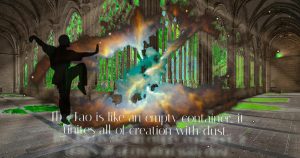
The tao that can be described is not the eternal Tao. The name that can be spoken is not the eternal Name.

What Is Your Source of Energy: The tao that can be described is not the eternal Tao… | Music: Tao of Healing Dean EvensonPond Reflecting Stars   

Second Archetypal Animation & Stanza

The nameless is the boundary of Heaven and Earth. The named is the mother of creation.

What Is Your Source of Energy: The nameless is the boundary of Heaven and Earth. The named is the mother of creation. | Music: The Other Side of Darkness — Guide Me Home (One Misstep)

Third Archetypal Animation & Stanza

Freed from desire, you can see the hidden mystery. By having desire, you can only see what is visibly real.

What Is Your Source of Energy: Freed from desire, you can see the hidden mystery. By having desire, you can only see what is visibly real. | Music: Freed From Desire Strange Fruits Music [1] Freed From Desire    2:24

Fourth Archetypal Animation & Stanza (also Feature Animation)

Yet mystery and reality emerge from the same source. This source is called darkness. Darkness born from darkness. The beginning of all understanding.

What Is Your Source of Energy: Yet mystery and reality emerge from the same source. This source is called darkness. Darkness born from darkness. The beginning of all understanding. | Music: Source of Energy | Clear Conscience[1] Source of Energy

Addition Relevant Resources

Our greatest weakness lies in giving up.
The most certain way to succeed is always
to try just one more time
.” — Thomas A. Edison

Hernan Diaz’s anticipated novel ‘Trust’ probes the illusion of money — and the truth

Scott Simon talks with Hernan Diaz about his novel, “Trust.” It tells the story of a New York tycoon who takes advantage of the 1929 crash, and his attempts to rewrite and control his own story. In this interview, Diaz tells Scott that power is the ability to bend reality and shape what others perceive as real. Power imposes someone else’s reality onto others. Wealth and money (and the desire to get more money) does this to people. They burn with the desire to have more of that kind of power over others. Great fortunes create a reality in and of themselves that others are eager to have a part or piece of.

Images from: The Power of Trust: How Companies Build It, Lose It, Regain It; Trust by Hernan Diaz; Power Wealth Classics; Money and Power: How Goldman Sachs Came to Rule the World


What Leadership Looks Like | Ted Radio Hour

From workplaces to schools to national governments, leaders everywhere are being called on to solve complex problems with humility and bravery. This hour, we consider what it takes to be a leader.  Guests include executive coach Patrice Gordon, organizational psychologist Tomas Chamorro-Premuzic, First Minister of Scotland Nicola Sturgeon, and educator Shabana Basij-Rasikh.

I found the first interview particularly compelling as the speaker relates our ancient programming to have strong men leading a tribe or clan. These were times when groups were small and all members knew the integrity of every other member and whether they could be trusted or not. However, as our small bands and groups of people surviving together against vast and overwhelming odds have grown into vast civilizations, the qualities of a good ruler have shifted tremendously.

A good ruler today does not act on gut instinct, as would have been the right thing to do 10,000 years ago. A good ruler today actually must go against gut instinct to grasp the greater complexities of our modern realities and make more calculated, incremental moves that benefits all members of the collective, even those who are against the leader. But as people electing who to rule us, we are still vastly informed by our own gut instincts and emotions choosing ruler who we feel we could have beer with rather than rulers who could stare down the missile silo of a narcissist idiot threatening to use nuclear weapons on the world.

Images from: What Leadership Looks Like | Ted Radio Hour; Trump may tweet better. But nobody rides an ICBM like Putin; Russia nuclear threat: Putin’s deadly underwater nuke which can devastate US targets; Russia warns that it will see any missile launched at its territory as a nuclear attack; Russia has ‘unstoppable’ supersonic nuclear missile that cannot be traced by Western defence systems, says Putin; Vladimir Putin’s 4,000mph nuke can reach Britain in 13 MINUTES – and it CANNOT be stopped

What lovely, reassuring smile Putin has on that last picture!


The New Gilded Age | Throughline

“The World Economic Forum annual meeting at Davos, Switzerland, 2019 – an exclusive event where the world’s richest and most powerful people get together to solve the world’s problems. I was there when David Attenborough, you know, was showing his new film. The Garden of Eden is no more. Beautiful – you know, absolutely beautiful, stunning footage of how we’re wrecking the planet. And people were literally crying while they were seeing it. And I was thinking, but, guys, you arrived here in your private jets.”

Images from: File:World Economic Forum Annual Meeting 2005a.jpg; World Economic Forum Annual Meeting 2020; ‘Garden of Eden is no more’, Sir David Attenborough tells Davos; Prince William turns interviewer in Davos appearance with Attenborough; Too much money is bad; May 23, 1937: The Death Of The Ultimate Oil Man; The First Battle for Oil in Norway: The Long Arm of John D. Rockefeller’s Standard Oil; The Ultimate List of Corporate Philanthropy Benefits and How To Achieve Them; The Quick Fix: Why Fad Psychology Can’t Cure Our Social Ills; The Self-Help Myth: How Philanthropy Fails to Alleviate Poverty; Were the Titans of the Gilded Age “Robber Barons” or “Entrepreneurial Industrialists”?; Gilded Age Blog; Up To a Point: Robber Barons Make Way For Robber Nerds; The Modern Robber Barons; Ludlow Massacre; On This Day April 20, 1914: Remembering the Ludlow Massacre; Ludlow Massacre: PBS;


Why Russia’s military appears to be struggling in Ukraine

Aired May 1, 2022 on Heard on  All Things Considered

Why does Russia's massive and powerful military force continue to struggle against a smaller, less well-equipped opponent? Journalist David Volodzko wrote about this in a recent piece in The Daily Beast titled "The Embarrassing Truth Behind Putin's War Failures." He says the Russians appear not to have internalized the lessons they could have learned during other conflicts, particularly the civil war in Syria, where Russia backed the government of dictator Bashar al-Assad. -- MICHEL MARTIN, HOST
The problem is, in April 2021, I believe, the company that makes the Azart and its owner, Leonid Reiman, who's the former minister of communications, came under investigation for fraud. They had evidently been using cheap Chinese parts. This led to a bunch of problems, including the batteries didn't really work that well. So they've had to switch instead, and they're largely using mobile phones and things of that nature. And this is just one example of how corruption has left Putin and his army out in the open, in a sense, and exposed. -- DAVID VOLODZKO
I think that we all have overestimated Russia's military capabilities. And, I would add, I think that Putin did, too. One point that I make in the piece is that Moscow recently purged 150 Federal Security Service agents, and they sent the head of the FSB's fifth service, which handles counterinsurgency ops in Ukraine, to Lefortovo Prison. Now, there's a couple different theories as to why, and I'm inclined to go with the official explanation on this one, which is that Beseda lied to the state and stole funds. -- DAVID VOLODZKO
So again, as with the radio communications issue, we see corruption coming back to bite Russia. And as a consequence of that, Putin may have gone in on bad intel, thinking that the Ukrainians were going to be waiting with flowers instead of Bandera smoothies - which is, you know, Ukraine's version of a Molotov cocktail - and going in with bad gear, thinking that he had the best and the latest. And so as much as we fell for this idea of Russia being much more powerful than they are, much more capable than they are, Putin fell for that himself. -- DAVID VOLODZKO

Ridley Road | Masterpiece Theater

`Ridley Road' is the story of the 62 Group, a collection of anti-fascists who stood up against the rising neo-Nazi movement in Britain after World War Two, based on Jo Bloom's book of the same name, released in 2014. In the summer of 1962, twenty-year-old Vivien Epstein, a Jewish hairdresser from Manchester, arrives in London following the death of her father. Alone in the world, she is looking for Jack Fox, a man she had a brief but intense love affair with some months before. Her search leads her into the fight against resurgent fascism in East London, where members of the Jewish community are taking to the streets, in and around Ridley Road. -- Google Knowledge Panel

Note: This is 1962 this movies is about; just 17 years after Nazi Germany almost successfully invaded England.

Images from: Ridley Road; Ridley Road review – fascism thriller resonates in our current dark age; What is Ridley Road About?; Ridley Road: Viewers are all doing the same thing after episode two of the BBC drama; Ridley Road reviewfascism thriller resonates in our current dark age

What Is Your Source of Energy: Archetypal Animations

First Archetypal Animation

Buddha Yoga Meditation Relax Welfare Buddhism | PatrizioYoga | Patrizio  •  Italia  •  Member since March 21, 2018

Fantasy Transcendence Composing Magic Gold | KELLEPICS | Stefan Keller  •  Deutschland / Germany  •  Member since March 22, 2017  •  #240

Matrix Communication Software Pc Virus Computer | geralt | Gerd Altmann  •  Freiburg/Deutschland  •  Member since Sept. 15, 2012  •  #13

Music: Tao of Healing Dean Evenson [1] Gentle Season    6:46 [2] Clouds on Mountain    7:30 [3] Pond Reflecting Stars    6:14


Second Archetypal Animation

Astronaut Astronomy Satellite Moon Future | PIRO4D | PIRO  •  Heidelberg/Deutschland  •  Member since June 7, 2016

Background Stationery Guestbook Heaven Moon Swans | pixel2013 | S. Hermann & F. Richter  •  Germany  •  Member since April 9, 2016

Woman Mother Nature The Excitement Creation Birth | Ka_Nia | Katarzyna Micińska  •  Age 42  •  Częstochowa/Polska  •  Member since Sept. 25, 2017

Fantasy Dark Gothic Goth Surreal Ethereal | darksouls1 | Enrique Meseguer  •  Age 49  •  Madrid/España  •  Member since March 9, 2016  •  #812
Music: The Other Side of Darkness36 [1] Take Me by the Hand    9:42[2] Spinning Around    5:11[3] To Start Again    4:28[4] Shelter  3:09[5] Ripples    3:57[6] Past Self    5:12 [7] Guide Me Home (One Misstep)    4:53


Third Archetypal Animation

Portrait Look Red Scarf Mystery Hidden Eyes | lanamorphose | pamela laporte  •  Age 36  •  limoges/france  •  Member since March 5, 2017

Fantasy Surreal Mask Wall Eye Mysticism Girl | KELLEPICS | Stefan Keller  •  Deutschland / Germany  •  Member since March 22, 2017  •  #240

War Ukraine Landscape Girl Emotion Destruction | KELLEPICS | Stefan Keller  •  Deutschland / Germany  •  Member since March 22, 2017  •  #240

Surreal Eye Fantasy Mysterious Halloween | blende12 | Gerhard G.  •  Deutschland  •  Member since March 25, 2014  •  #149

Dove Of Peace Flag Symbol World Peace Ukraine | blende12 | Gerhard G.  •  Deutschland  •  Member since March 25, 2014  •  #149

Music: Freed From Desire | Strange Fruits Music[1] Freed From Desire    2:24


Fourth Archetypal Animation & Feature Animation

Hands Water Wash Color Source Hand Background | drfuenteshernandez | Manuel Darío Fuentes Hernández  •  Age 27  •  Guantánamo/Cuba  •  Member since Jan. 19, 2018

Nature Source Fountain Water Reflection Trees | Antranias | Manfred Antranias Zimmer  •  Chiemgau/Germany  •  Member since Aug. 27, 2013

Alive Energy Divine Body-Mind Mind-Body Faith | johnhain | John Hain  •  Age 72  •  Carmel/United States  •  Member since July 24, 2014

Woman Waterfall Naked Landscape Mountain | Mysticsartdesign | Mystic Art Design  •  Deutsch  •  Member since July 3, 201

Library Heaven Birds Mystical Clouds Sun | Mysticsartdesign | Mystic Art Design  •  Deutsch  •  Member since July 3, 201
Music: Source of Energy | Clear Conscience[1] Source of Energy    2:30

Just Breathe… Through Grief, Through Strife to Begin Again

“Breath Is Too Precious for Hate” — Rev. William Barber

In a time of Great Grief, one must find a thread of Great Belief to hang onto. Not just any thread, but one grown and spun from the center of your heart… the core of who you are as a living being traveling through space and time with other living beings all struggling to survive the setbacks and challenges inherent in being a space-time being. It must be a thread spun with compassion, understanding, truth (at least a willingness to sink into and see truth as it is revealed through time), kindness, patience, and love. This is an elusive thread to find because so many of our systems of being are based and reward the opposites of all these precious qualities of being human. But to survive Great Grief, this is the only way that will lead you and everyone you love to a better place in space and time.

But how do you do this? How does one find this rare and precious thread inside oneself to hang onto as the waves of lost, injustice, disease, death, isolation, exploitation, cruelty, ill treatment, and so many other things that happen to us as we try to survive through time…things that wash away at our very soul?

Just breathe… breath is powerful.

In a Scientific American article that I link to below (Vision and Breathing May Be the Secrets to Surviving 2020), the Stanford neurobiologist Andrew Huberman discusses two things all of us can do to control our response to distress, trauma, pain, and suffering, even during a high-stress time such as this past year has been with an extremely divisive election, racial disparities spotlighted in brutal, traumatic ways in the killing of George Floyd (and so many more individuals unjustly) and unequal access to wealth and healthcare causing black and brown people to suffer the highest death tolls from the COVID-19 pandemic sweeping the world.

Breathe has never been more forefront and center than it has been this past year with the tragic events leading to chants across the country, indeed the world, of “I can’t breathe” combined with COVID-19 patients struggling to breathe as the novel coronavirus robs them of their ability to do so.

In the article mentioned, Andrew Huberman says, “Breathing represents a bridge between the conscious and unconscious control of the body.” Since I’ve been writing about consciousness and unconsciousness in my story Sapience, drawing much from Carl Jung’s work, I wondered what is the equivalent to breath for the psyche. Then, I remembered this song Breathe by Télépopmusik.

Breathe – Télépopmusik – Album: Genetic world

I brought you something close to me
Left for something you see though you’re here
You haunt my dreams
There’s nothing to do but believe
Just believe

Just breathe

Another day, just believe
Another day, just breathe
Another day, just believe
Another day, just breathe

(…) From LyricFind

Breath has long been a symbol for spirit–that invisible force powering all living beings. As human beings, we are aware of this spirit that is powering us and flowing throughout our life on Earth. Jung talks of the importance of this thing that is aware, he calls it Self or psyche. He explains that this small part of self that is aware must swim between that which is conscious inside oneself and that which is unconscious inside oneself to generate the energy necessary to maintain consciousness. This is what gives us the ability as human beings to choose actions different than what our instincts would otherwise dictate. It requires us to ascend up and down within the parts of ourselves that we know about because they exist within our sphere of consciousness and the parts of ourself that we do not know about because they exist within the sphere of our unconsciousness (the bigger sphere). Belief might be like a psychic vessel (a ship, a submarine, or maybe a fish) that we create inside ourselves (in our mind space) in order to make our epic journey through space and time.

However, belief is not omniscient (all-knowing, all-wise, all-seeing) in and of itself. Belief is a part of the immortal body that exists somewhere in the realm of mind, but it is also very mortal and because of that imperfect. For belief to exist through time, just as the body exists through time, beliefs must be refreshed and refined with new knowledge (hopefully even wisdom) all the time, just like the lungs must be refreshed all the time with new air, fresh air so the corporeal body may live.

So how does one hold on during a time of Great Grief, Great Sadness, Great Stress, and Great Lost--like now? It is breath. It is belief. But one must take care to keep the immortal and mortal air breathed clean and refreshing for beliefs can lead individuals into very dark places as well as into illuminated places. It is up to you to choose which place you journey through space and time.

Following is a collection of stories percolating through me since I heard them that have inspired these thoughts. Or perhaps, I should say immortal breaths…and so, another day, just believe, another day, just breathe…

* * *

Michel Martin’s NPR

Civil Rights Activist Weighs In On Biden’s Early Days In Office — NPR’s Michel Martin speaks with civil rights activist Rev. William Barber II about his inaugural homily and what he makes of the first few days of the Biden administration. 

Excerpt from NPR transcript of this interview:

MICHEL MARTIN, HOST: And finally today, it’s been less than two weeks since the Biden administration took office, and it has already been a whirlwind. The president has signed more than two dozen executive orders addressing everything from immigration to climate change, as well as one of the issues he says propelled him to run for the presidency for this third time, racial justice.

So we thought this would be a good time to check in with civil rights activist, the Reverend William Barber II. He was invited to offer the homily at the inaugural prayer service. The text came from the prophet Isaiah.

SOUNDBITE OF ARCHIVED RECORDING of the Rev. WILLIAM BARBER II:

And so the prophet gives the nation God’s clear guidance out of the jam it is in. Choose first to repent of the policy sin, and then repair the breach. The breach, according to the imagery of Isaiah, is when there is a gap in the nation between what is and how God wants things to be.”

MARTIN: It was both an affirming message but also a call to action, so we wanted to hear Reverend Barber’s take on what that should look like. To remind, he is the president of an organization called Repairers of the Breach, which is based in Goldsboro, N.C. He’s a recipient of the MacArthur Fellowship, the so-called genius grant, and the co-chair of the Poor People’s Campaign. And he is with us once again.

Reverend Barber, welcome back to the program. Thanks for joining us.

BARBER: Thank you so much for having me on today.

MARTIN: What gave you the inspiration for the sermon?

BARBER: Well, I was asked to deliver it, and that was quite a humbling request. And then they asked me, did I know much about Isaiah 58? And, of course, that is one of the major passages of scripture recognized by Jews, Muslims and Christians especially. It is a scripture specifically speaking to the nation about how to repair itself after it has been through lying leadership, extreme leadership, mean-spirited leadership, oppressive leadership. And it really gives a step-by-step what has to be done.

MARTIN: Well, to — you know, to that point, I mean, the president in – President Biden in running for office and certainly at his inaugural message has been stressing a message of unity. And during your homily, you spoke of unity. I mean, you said the breach would be knowing the only way to ensure domestic tranquility is to establish justice, but pretending we can address the nation’s wounds with simplistic calls for unity. Can you expand on what you’re saying here?

BARBER: Well, surely. You know, one of the things I think more than just being a civil rights activist, I’m trying my best with others to be, you know, a moral leader, one who looks at things through the lens of moral analysis, moral articulation and moral activism. And you can’t have a simplistic view that all we need is “Kumbaya.” All we need to do is slap back — is pat each other on the back. No, no, no, no. There are real forces — and we have seen them — forces that we saw that would rather put a person on the Supreme Court than protect people from dying in caskets from COVID, forces that would rather give trillions of dollars — trillions — to corporations during COVID while billionaires make almost a trillion dollars and then fight to just give a few trillion to poor and low-wealth people and those who are hurting. These are real battles. And some people are not going to unite with justice. But if enough of us can unite with justice and love, we can move this country forward.

MARTIN: But I am interested in how you feel that happens when some have made it abundantly clear that they do not agree with this agenda. I mean, for example, I mean, your first, as I – you announced on Twitter that beginning tomorrow, the Poor People’s Campaign will be holding special Moral Mondays events. Your first event will center on increasing the minimum wage. Your group is calling for some very ambitious things like universal health care, limiting defense spending. I mean, the fact is that a significant number of people in this country don’t agree with that. So how does he reconcile both the desire that some people clearly have for a more sort of temperate, more moderate, more constructive tone and yet people like yourself who say, no, there are ambitious things that need to happen? How does he resolve that?

BARBER: Now, yes, 70 million people voted for Trump, but over 80 million people voted for Biden and Harris. They knew they were going to pass – they were going to fight for living wages, addressing systemic racism and to address health care. Biden won 55% of all poor and low-wealth people voting under – that made under $50,000 a year. In Georgia and other places, poor and low-wealth people voted for Biden and Harris at a rate 14% higher.

We’re talking about, how do we heal the soul of the South Side? And it’s only by healing the sickness in the body. And so what we’re talking about is a must – is a must. These things must happen, and when you have the power, even if you only have one vote – Republicans showed us something. They did it for the wrong reason, but they didn’t care if they had just one vote. They did what was wrong. So people who have one vote now must do what is right.

MARTIN: I can’t tell from listening to you whether you feel encouraged or you still feel frustrated.

BARBER: So I’m encouraged because the movement is encouraged. I’m encouraged because more people turned out to vote in the midst of COVID than ever turned out in the history of this country. I’m encouraged because 6 million more poor and low-wealth people turned out in this election than they did in 2016. I’m encouraged because this country has shown us that if you run on a progressive agenda, if you talk about health care, living wages and dealing with racism, you can win in California. You can win in GeorgiaYou can win in Pennsylvania. You can win all over this country if you give people a vision of progress for which they can vote.

I am discouraged on one thing, and it’s — but it’s going to come — that we still don’t hear enough about poverty. We hear Democrats talking about the middle class and workers. But if 43% of this country was poor and low-wealth before COVID, and 8 million more have been thrust into poverty since May of last year, and if only 39% of this country can afford a thousand-dollar emergency, we must use the word poverty. We must talk about poor and low-wage people. We must say their name and say their condition. And we must say we’re not going to lift from the middle up. We’re not going to trickle down. We’re going to lift from the bottom up.

MARTIN: So before we let you go, I want to acknowledge that, as you have acknowledged, that many people are still struggling because of the pandemic, because of the downturn. Obviously, some people – many people were struggling before that, but a lot of people are suffering right now. And this is something that you brought up in your homily. And I just wondered if you had some words of encouragement for people who are struggling.

BARBER: You know, as a pastor, I will tell you, in this season, sometimes I have not had words. I’ll just be honest. All we’ve had is presence, even if it was distant presence. All we’ve had is love. All we’ve had is sometimes just getting on a video and crying together when people couldn’t go visit their loved one. Sometimes that’s all we’ve had.

You know, one of the things some of us have done is ask the question real seriously, why are we still alive? I mean, in this moment when any of us could be gone in seven days, seven minutes – you know, we could contract COVID. We could be breathing fine one minute, and it could all shut down – why is it that we’re still alive? Or more importantly, what is it that we’re going to do with the breath we have?

And some of us have decided in the midst of the tears, in the midst of the hurt, in the midst of the pain, we decided that breath is too important to waste. We don’t have any breath to waste on being mean and hateful and unjust and hurting people. The only real use of our breath is to try to breathe some more love and truth and grace and justice into this world and in this society.

And so whether we live seven minutes, seven days, seven months, seven years or 70 years, that’s what we’re committing ourselves to do with every breath we take from now on because this moment has been a moment where we all have to face the potential of our own mortality in a very real way. We can end any moment, be alone on a breathing machine with nobody able to come and see us. And many people have died like that. And in their name and in their memory, even with our pain, we must use every breath we have to turn things around, to push our political system to do right from the bottom up, with every breath we have left until we have no more breath in us.

MARTIN: That was the Reverend William Barber II. He’s president of Repairers of the Breach. He’s co-chair of the Poor People’s Campaign. Reverend Barber, thank you so much for joining us once again.

BARBER: Thank you so much. And blessings to you and your staff.

Copyright © 2021 NPR. All rights reserved. Visit our website terms of use and permissions pages at www.npr.org for further information.

NPR transcripts are created on a rush deadline by Verb8tm, Inc., an NPR contractor, and produced using a proprietary transcription process developed with NPR. This text may not be in its final form and may be updated or revised in the future. Accuracy and availability may vary. The authoritative record of NPR’s programming is the audio record.

* * *

After hearing the Rev. William Barber speaking with Anderson Cooper earlier in the year of 2020 at the onset of the COVID-19 pandemic and then again in the aftermath of the brutal murder of George Floyd, I was so inspired by his deep wisdom, knowledge, and words that I created a playlist: Repairers of the Breach. We are all responsible for the existence of this breach, which grows deeper and wider with every act of ignorance, malice, and hate that we conduct into the world through our thoughts, words, and actions.

But we are all also healers of this breach, and we can repair this breach when we act with knowledge that we have distilled from our experiences in the world and that we have gained by taking the time to educate ourselves about things, about great mysteries and unknowns in this complex and beautiful world, and when we pay attention to great masters/teachers who have lived throughout time who can help us remove the veils of illusions and delusions–sadly created by others who have chosen to trick and deceive people for their own self-betterment.

We can repair this great divide, the breach we have all forged inside ourself and between each other when we conduct ourself with love and compassion, when we take time to pay attention to other people, especially to people who are suffering, who are in need, who have been ignored and left behind, who have not received the blessings meant for all living being on Earth because these blessings have been diverted and hoarded by a few, especially in these modern times.

Each of us is a healer and repairer of this terrible breach that has broken so many families and friendships recently, but we must constantly refresh our beliefs.

* * *

This American Life

Beware the Jabberwock — Stories from the upside-down world where conspiracy theorists dwell

Just Breathe… Through Grief, Through Strife to Begin Again: Image from This American Life — Matt Chase

I had heard Act 1 of This American Life before (Down the Rabbit Hole, which is the story of Lenny Pozner, whose son, Noah, was killed at Sandy Hook. In the years after Noah’s death, Lenny and his family were harassed by people who believed the shooting at Sandy Hook never happened – that it was all a conspiracy. Until one day, Lenny decided to fight back).

This is a powerful, heart-breaking, and terribly important story to hear. So, if you have not heard it, you should start with Act 1.

Act 2 is new to me, and it blew me away. Reporter Jon Ronson travels to Texas to uncover the origin story of Alex Jones, infamous founder of InfoWars. Having just finished watching HBO’s Watchmen, I was into origin stories. This is one that needs to be heard because it encapsulates an Archetype of our time. One that is dominating the minds of millions and millions of people these days. One defined by Conspiracy ObsessionSatan FixationBully Compulsion tendencies. It is so prevalent in America society today, percolating even more fiercely by the isolation imposed on every human being in the world due to COVID-19. Alex Jones is a man who had great sway and influence on our former President, Trump, who has a very similar mental world bound by the same Conspiracy ObsessionSatan FixationBullying Compulsions as Jones—something we all saw fall off the page of Facebook and come to life in the storming of the Capitol of the United States of American on Jan. 6, 2021.

I can just feel how one’s breath must tighten and grow shallower and shallower as one depends deeper and deeper into such rabbit-holes of deception and obsession that leads to hate, grief, and pain all for the good of someone like Alex Jones or Donald Trump, not for the good of the ones going into the holes.

* * *

The Moth — An Hour of Incredible Stories

Crashing the Coronation by Bokara Legendre“And she turned to me and she said, ‘Did you know the queen’s wig was eaten by a yak this morning?'”  

Just Breathe… Through Grief, Through Strife to Begin Again: Photo by Sarah Stacke as featured on The Moth

Which direction in life will you choose to go? The journey running away from grief and pain by going to fancy parties and coronations in fancy golden high heels? Or will you choose to climb the highest mountain to see the llama or the Lama? 😉

* * *

The TedRadio Hour

Breathe — “Breathing is essential to life. And lately, the safety of the air we inhale, or the need to pause and take a deep breath, is on our minds a lot. This hour, TED speakers explore the power of breath.


This episode is all about breath. I did not think too much about it after I heard it, but then I heard the words of Rev. William Barber and I saw the importance of these stories in a new light. Because of this, I am highlighting them here and providing links to them so you can listen to them as you have time and interest to do so if you decide to explore the links between breathing, believing, and life. [Note that the images accompanying each story do not necessarily match the TedRadio Hour images but rather link to similar ideas/stories but different sources.]

Just Breathe… Through Grief, Through Strife to Begin Again: Image from TedRadio Hour Benjavisa Ruangvaree Art/Shutterstoc

First Story: Tanya Streeter: How Can Breath Help Us Understand Our Limits And Our Potential? 

Just Breathe… Through Grief, Through Strife to Begin Again: Image from Everything You Need to Start Free Diving — BY MEG LAPPE, MAY 18, 2019

Description: In 2002, free diver Tanya Streeter completed a record-breaking dive of 525 feet—in one breath. She reflects on the obstacles she faced, and the experience of pushing her body and lungs to the limit. This is a riveting story!

About: Tanya Streeter is a world champion freediver who was inducted into the Women Diver’s Hall of Fame in March 2000. For more than two months, she held the world record — for both men and women — diving to 525 feet in the “no limits” category, which is still the women’s world record for No Limits Apnea.

She has been featured in the documentaries, Freediver, and A Plastic Ocean. She also hosted a show on BBC Two called Shark Therapy, in which she attempted to overcome her fear of sharks.

Streeter received degrees in Public Administration and French from the University of Brighton.


Second Story: Andy Puddicombe: What Is The Connection Between Mind, Body, And Breath?

Just Breathe… Through Grief, Through Strife to Begin Again: Image from Manhattan Mental Health Counseling: TOP 5 SCIENTIFIC FINDINGS ON MEDITATION/MINDFULNESS

Description: Mindfulness expert and Headspace co-founder Andy Puddicombe guides listeners through a meditative reflection on appreciating breath.

About: Andy Puddicombe is a former Buddhist monk and the co-founder of Headspace, a project to make meditation more accessible to more people in their everyday lives.

Puddicombe also writes for The Huffington Post and The Guardian on the benefits of mindful thinking for healthy living.

He attended Wellsway Comprehensive School in Keynsham, and studied Sports Science at De Montfort University. He also has a Foundation Degree in Circus Arts.


Third Story: Beth Gardiner: What Are The Consequences Of Breathing Dirty Air?

Just Breathe… Through Grief, Through Strife to Begin Again: Image from Smart Cities World — Who cares about dirty air?

Description: Journalist Beth Gardiner and activist Yvette Arellano explain the long-term health effects of air pollution. Yvette lives in a Houston neighborhood near the largest petrochemical complex in the U.S.

About: Beth Gardiner is an American journalist based in London. For ten years, she reported for the Associated Press in New York and London.

Now, her reporting primarily focuses on the environment. She has discussed her work on NPR’s All Things Considered, WNYC’s Brian Lehrer Show, and the BBC’s World at One.

Gardiner is the author of Choked: Life and Breath in the Age of Air Pollution, an exploration into the long-term health effects of air pollution. Gardiner received grants to support her work on Choked from both the Pulitzer Center on Crisis Reporting and the Society of Environmental Journalists.


Fourth Story: Emma Schachner: How Did Dinosaurs’ Lungs Help Them Dominate The Earth For So Long?

Just Breathe… Through Grief, Through Strife to Begin Again: Image from TedTalks

Description: Dinosaurs ruled Earth for 180 million years, but to dominate they had to outcompete a slew of other animals. Paleontologist Emma Schachner thinks their lungs could have been the competitive advantage.

About: Emma Schachner is an anatomy professor at LSU Health Sciences Center in New Orleans. She also specializes in the 3D digital modeling of anatomy from CT and MR images, as well as scientific illustration, which merges anatomy, art, and scientific communication.

Schachner’s research uses an interdisciplinary approach to study the soft tissue and skeletal anatomy of a broad range of animals including alligators, chameleons, parrots and ostriches. She uses these data to reconstruct the biology of extinct reptiles, particularly dinosaurs and the fossil ancestors of crocodilians.

She received her master’s degree in paleontology at the University of Bristol and her PhD in philosophy at the University of Pennsylvania.


Fifth Story: Andy Puddicombe: How Can Breathing Help Us In An Ever-Changing World?

Just Breathe… Through Grief, Through Strife to Begin Again: Image from Scientific American | Vision and Breathing May Be the Secrets to Surviving 2020 | Credit: Bonnie Tarpey Getty Images

Description: Mindfulness expert and Headspace co-founder Andy Puddicombe guides listeners through a meditative reflection on breath and impermanence.

About: Andy Puddicombe is a former Buddhist monk and the co-founder of Headspace, a project to make meditation more accessible to more people in their everyday lives.

Puddicombe also writes for The Huffington Post and The Guardian on the benefits of mindful thinking for healthy living.

He attended Wellsway Comprehensive School in Keynsham, and studied Sports Science at De Montfort University. He also has a Foundation Degree in Circus Arts.


Sixth Story: Caro Verbeek: What Can The Scents Of The Past Tell Us About Our History?

Just Breathe… Through Grief, Through Strife to Begin Again: Image from article: Life Without a Sense of Smell | Losing your sense of smell takes away more than scents and flavors — it can fundamentally change the way you relate to other people. By Emma Young | August 4, 2015 1:00 AM | Discovery Magazine [I chose this image/article because COVID-19 is robbing the sense of smell from many people, sometimes for months… and we don’t know how long yet this could last]

Each day, we breathe about 22,000 times–and all that time we smell. Scent historian Caro Verbeek recreates scents of the past. She says, just like music and art, smell is a part of our heritage.

About: Caro Verbeek is an embedded researcher of olfactory heritage at Vrije Universiteit Amsterdam, the Rijksmuseum and International Flavours & Fragrances. She creates olfactory tours and interventions for museums.

Verbeek teaches the course ‘The Other Senses’ at the Royal Academy of Arts The Hague and is the curator in chief of the olfactory culture program ‘Odorama’ at Mediamatic Amsterdam. She is also an advisor for immaterial heritage projects at Mondriaan Fonds.

She received her M.A. in curatorial studies at VU Amsterdam University and her M.A. in art history at the University of Amsterdam.


Seventh Story: Andy Puddicombe: How Can Breathing Help Improve Our Relationships?

Just Breathe... Through Grief, Through Strife to Begin Again; this is ancient wisdom.
Just Breathe… Through Grief, Through Strife to Begin Again: Image from Tiny Buddha | Let Go of Control: How to Learn the Art of Surrender By Dr. Amy Johnson | “You must learn to let go. Release the stress. You were never in control anyway.” ~Steve Maraboli

Mindfulness expert and Headspace co-founder Andy Puddicombe guides listeners through a meditative reflection on how breath can bring us closer together.

About: Andy Puddicombe is a former Buddhist monk and the co-founder of Headspace, a project to make meditation more accessible to more people in their everyday lives.

Puddicombe also writes for The Huffington Post and The Guardian on the benefits of mindful thinking for healthy living.

He attended Wellsway Comprehensive School in Keynsham, and studied Sports Science at De Montfort University. He also has a Foundation Degree in Circus Arts.

* * *

NPR’s Lulu Garcia-Navarro Interview with Sophie Fustec

Sophie Fustec’s New Albuum Is A Journey Through Her Grief

NPR’s Lulu Garcia-Navarro speaks with Sophie Fustec, known artistically as La Chica, about her new album La Loba, in which she comes to terms with her brother’s recent death who died after jumping into a hot spring to save his dog. I was deeply touched by this interview and Sophie’s beautiful voice.

LA CHICA – LA LOBA | Dec 2, 2020

LA CHICA – OASIS | Dec 5, 2015

LA CHICA – Agua | Dec 3, 2020

LA CHICA – Sol | Dec. 3, 2020

ALTERLATINE | La Chica | Jun 27, 2019

* * *

Sophie Xeon

Then there is the tragic death of another beautiful Sophie–Sophie Xeon who was popularly known as just Sophie. She died at 34 after a terrible accident where she fell from a roof that she climbed to get a picture of a full moon. Ludovica Ludinatrice, Sophie’s representative, said: “True to her spirituality she had climbed up to watch the full moon and accidentally slipped and fell. She will always be here with us. The family thank everyone for their love and support and request privacy at this devastating time.”

SOPHIE — It’s Okay To Cry (Official Video) | Oct 19, 2017

Concluding Thoughts

Each breath we take is precious for every breath links us to every individual we ever come into contact with each and every day. Breathing\believing is how we weave the web of life (our shared reality). It is a timeless process done in our corporal bodies through breath and in our immortal bodies through belief. We all need to breath…to believe to survive and thrive.

What will you do with your breath today?

It is so precious…you are so precious…and life is so fragile and short.